






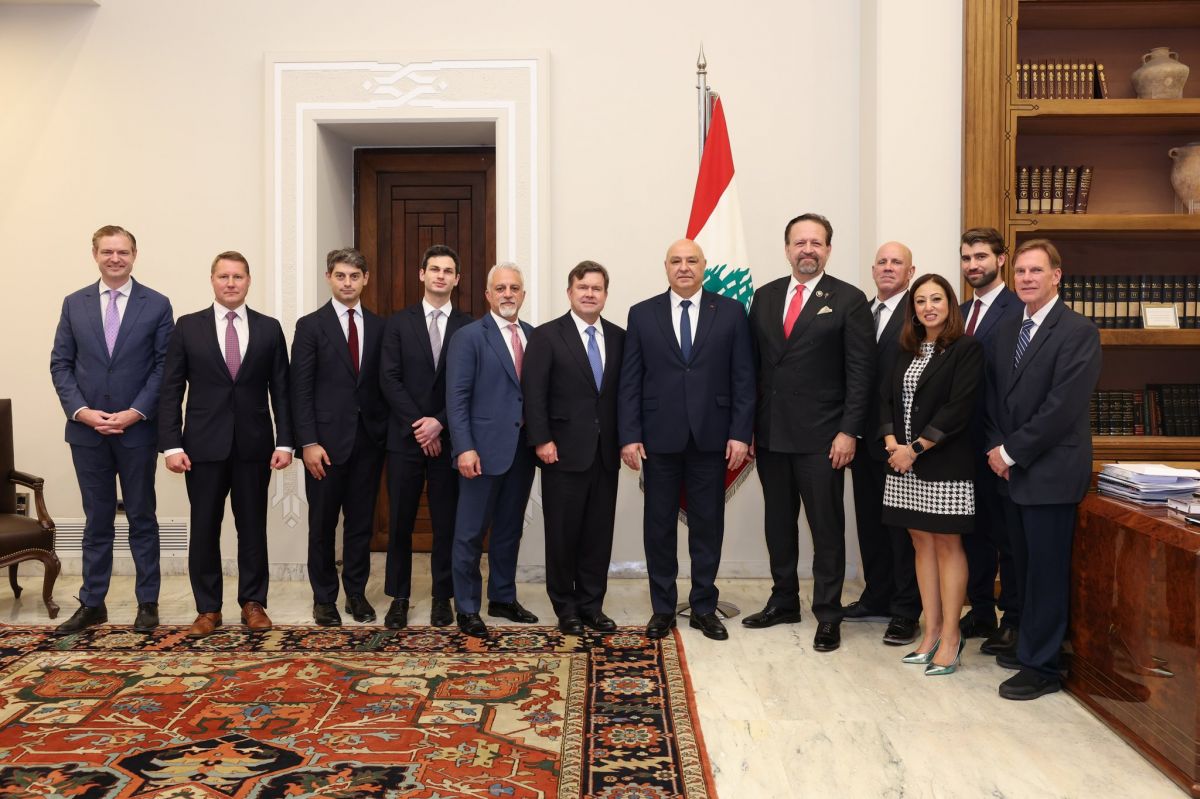
Lebanese President Joseph Aoun receiving a delegation of American officials in Baabda, on Nov. 9, 2025. (Credit: X/ @LBPresidency)






BEIRUT — Lebanese President Joseph Aoun met Sunday evening with an American delegation of sanctions and counterterrorism officials, to whom he asserted that Beirut was working "strictly" to prevent money laundering, smuggling, and the financing of terrorism.
One of the officials received by Aoun told Reuters in an interview that the time had come to strengthen measures to financially strangle Hezbollah by limiting transfers from Iran.
During the meeting with the delegation — composed notably of US Deputy Assistant to the President for Counterterrorism Affairs Sebastian Gorka, his colleague Rudolph Atallah, and John Hurley — President Aoun said that Lebanon "strictly enforces the procedures in place to prevent money laundering, its smuggling, or its use in the financing of terrorism."
Beirut "severely punishes all financial infractions, whatever their nature," he added, noting that to this end, Parliament had passed the law amending banking secrecy and the law related to restructuring the banking sector. He also said the government is about to finalize the financial deficit law, "which should help restore the balance of the national financial system."
At the same time, the army and security services "continue to pursue terrorist cells" and prevent any attempt to destabilize security "in all regions of Lebanon," Aoun stated.
Discussions with the American delegation also addressed ongoing talks with the International Monetary Fund and ways to reach an agreement, as well as steps to revive the banking sector.
War has never led to any result
Regarding the situation in southern Lebanon, where the Lebanese Army has begun dismantling Hezbollah's infrastructure, President Aoun called, as he does with all his international visitors, to "pressure Israel to stop its continued aggressions against Lebanon" and ensure it abides by the truce agreement.
"This would allow the Lebanese Army to deploy up to the border and implement the plan to restore the state's monopoly on weapons," he stated. While Hezbollah — with its political clout in Lebanon — has not blocked the army’s seizure of its weapons caches south of the Litani, it has so far refused complete disarmament.
The president also emphasized that negotiations with Israel, which he has been calling for nearly a month, are "based on the conviction that war has never led to any result," while stressing that this requires "favorable conditions," such as calm in the South and an end to Israeli attacks.
Israel, a U.S. ally, believes Hezbollah is trying to restore its capabilities and continues to strike Lebanon almost daily. Over the weekend, the Israeli army killed five people in targeted raids.
The American delegation emphasized its willingness to help Lebanon achieve stability in the South, and to support the Lebanese Army in its missions to end "armed phenomena," a reference to militias and particularly Hezbollah.
Lebanon in a 'decisive period'
John Hurley's regional tour aimed, as he announced before departure, to end Iran's influence over its proxies. In an interview with Reuters, the U.S. official said Washington is seeking to take advantage of the "opportune moment" in Lebanon to curtail Iranian funding to Hezbollah and pressure the group to hand over its weapons.
According to him, Iran has managed to send about $1 billion this year to Hezbollah despite a series of Western sanctions that have damaged its economy. Late last week, Washington sanctioned two people accused of using currency exchange offices to help finance Hezbollah, which is considered a terrorist group by several Western governments and Gulf states.
"Lebanon is currently living through a decisive period. If we could disarm Hezbollah, the Lebanese people could reclaim their country," Hurley said.
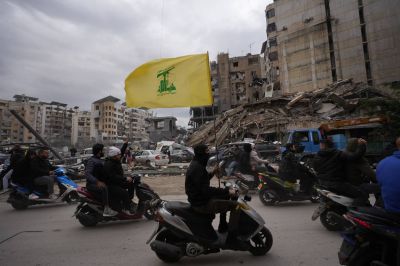
"The key to achieving this is eliminating Iranian influence and control, which starts with the funds they inject into Hezbollah," he said from Istanbul, as part of a tour of Turkey, Lebanon, the United Arab Emirates, and Israel.
During his first trip to the Middle East since taking office under President Donald Trump, John Hurley reiterated U.S. arguments against Iran to government officials, bankers, and private sector leaders.
"With all that Iran has faced, even though its economy is not in great shape, that country continues to inject a great deal of money into its terrorist proxies," he concluded.
