





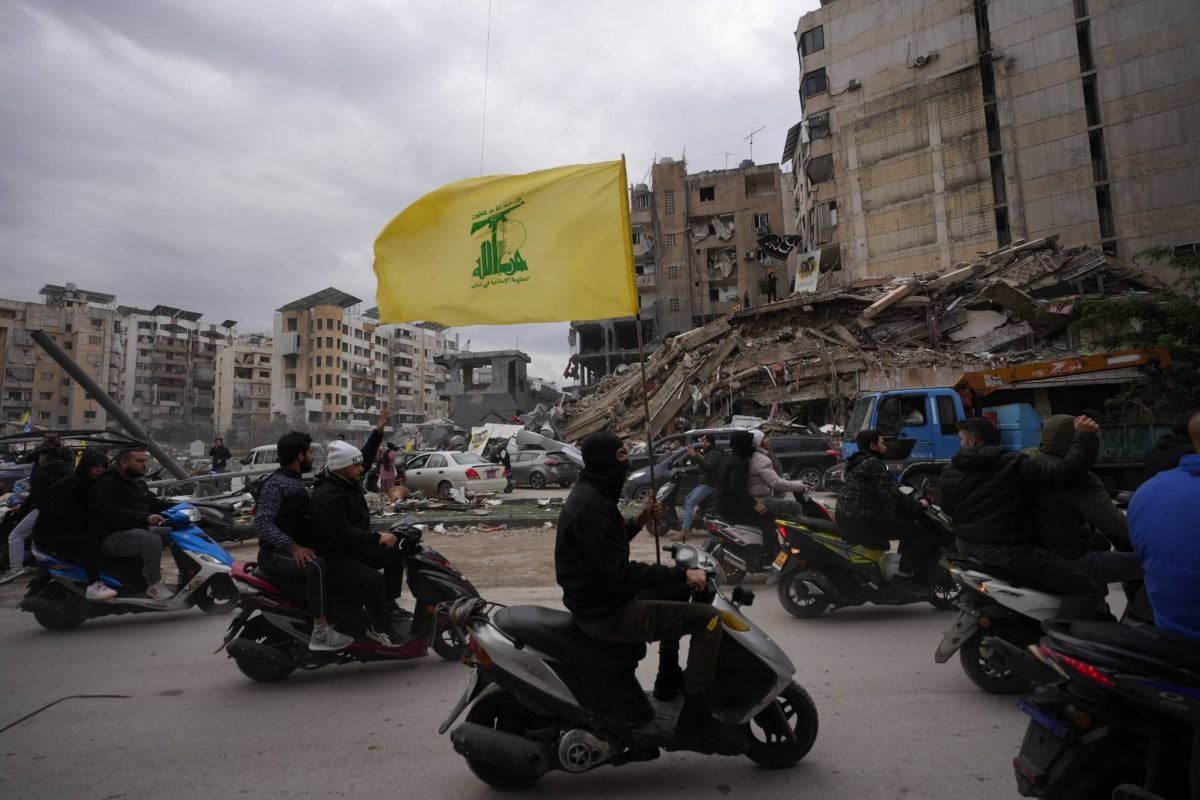
Hezbollah supporters ride motos and carry party flags through the southern suburbs of Beirut in early August 2025. (Credit: Mohammad Yassin/L’Orient Today)






BEIRUT — The U.S. Department of the Treasury’s Office of Foreign Assets Control (OFAC) imposed sanctions on Thursday on three Hezbollah financiers who "facilitated funneling tens of millions of dollars" from Iran to the group in 2025.
The concerned operatives are Ossama Jaber, Jaafar Muhammad Qasir, and Samer Kasbar.
According to OFAC, the money funneled from Iran includes "funds generated through covert business dealings by Hezbollah’s finance team, including through the sale of Iranian oil and other goods into Lebanon through both licensed and unlicensed money exchanges."
It added that these funds are used to support the group's "paramilitary forces, rebuild its terrorist infrastructure, and resist the Lebanese government’s efforts to assert sovereign control over all Lebanese territory." These sanctions, OFAC claimed, are intended to support the group's disarmament.
The U.S. Treasury said that since January 2025, the Iranian Islamic Revolutionary Guards Corps-Qods Force (IRGC-QF) has transferred over $1 billion to Hezbollah, "mostly through money exchange companies."
Pressure from Israel, the United States and Arab states has been mounting on Lebanon to ensure the disarmament of the party and the closure of its supply chains. In September, U.S. Envoy Tom Barrack claimed the group was receiving some $60 million per month from "unknown sources."

Who are the sanctioned individuals?
According to OFAC, Ossama Jaber "works directly with Lebanese money changers and exchange companies, personally collecting money for Hezbollah."
Between September 2024 and February 2025, Jaber allegedly "collected or converted tens of millions of dollars via several money changers and exchange companies, some of which were owned by, or associated with, Hezbollah members."
Jaafar Qasir is the son of Muhammad Qasir, who was sanctioned in 2018 by OFAC. According to the U.S. Treasury, the financial responsibilities held by the elder Qasir were split among multiple individuals following his death in October 2024. These individuals include his son Jaafar and his nephew and Ali Qasir.
"Jaafar is in charge of the Hezbollah finance team’s management as well as the group's revenue-generating economic portfolio," the OFAC statement says. In mid-2025, Ali and Jaafar worked to recover the Arman 114, a U.S.-blocked oil tanker formerly known as the Adrian Darya 1, that had been seized by Indonesian authorities in 2023, the Treasury adds.
"The vessel had been conveying Iranian-origin crude oil in the name of Hezbollah-controlled oil broker Concepto-Screen S.A.L."
"Jaafar and U.S.-designated Syrian businessman Yasar Husayn Ibrahim, a close confidant of former Syrian dictator Bashar al-Assad have a history of collaborating on the sale of Iranian oil, gas, and other energy products on behalf of Hezbollah," OFAC continues.
In early 2025, according to the U.S., Ibrahim offered to meet with Jaafar to coordinate a business deal sealed by either himself or his deputy Samer Kasbar, which OFAC says is the director of Hezbollah front company Hokoul SAL Offshore Company.
"Kasbar regularly collaborates with Hezbollah finance team members on business deals: For example, in mid-2025, Ali, Kasbar, and Ibrahim worked together to export metals and chemicals from Iran," OFAC states.
The sanctions coincide with the U.S. Treasury Department's top sanctions official, John Hurley's first Middle East Trip, which also includes Lebanon.
OFAC's announcement comes in parallel to a surge in Israeli bombardment of southern Lebanese villages after it issued evacuation orders for five villages across four districts followed by a wave of airstrikes.
On Sunday, Israeli Prime Minister Benjamin Netanyahu claimed that Hezbollah was attempting to "rearm itself," adding that Israel won't allow Lebanon to become "a renewed front" against it, and that Israel would act as it saw fit.
Despite a cease-fire agreement reached in November 2024, following nearly a year of cross border fire and two months of open-war between Hezbollah and Israel, the latter has been attacking Lebanon on a near-daily basis, killing more than 340 people since agreeing to the supposed truce.

 Evening recap: Netanyahu announces West Bank offensive; 7 killed in Jordan church shooting; tents burned in south Lebanon