






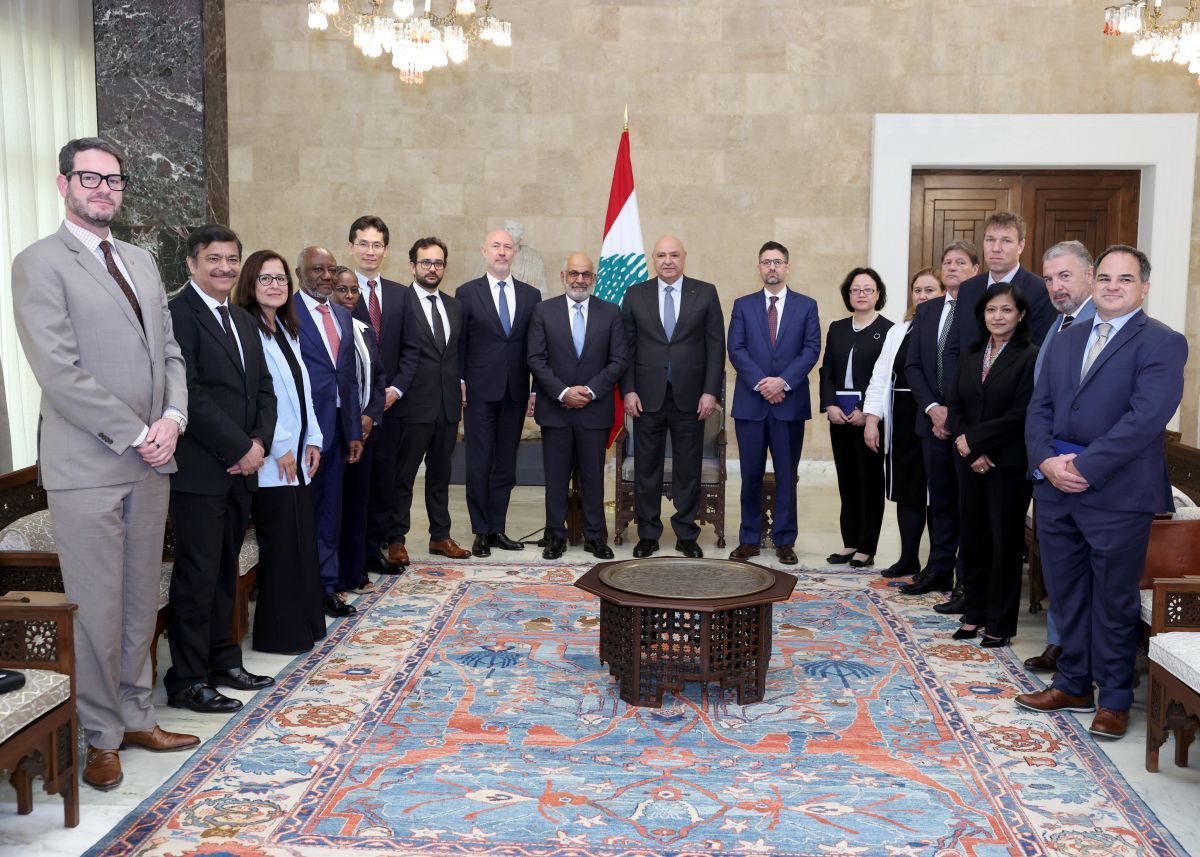
At the Baabda Palace, surrounding President Joseph Aoun, the World Bank delegation. (Credit: Lebanese presidency)






BEIRUT — President Joseph Aoun urged the World Bank on Friday to stay by Lebanon’s side, saying it “must remain at Lebanon's side” as political deadlock over elections and Hezbollah’s disarmament threatens the release of approved loans.
At the top of these projects is a $250 million loan intended to finance the reconstruction of infrastructure — roads, water, electricity, and health care — in regions badly affected by Israeli strikes.
The delegation, which has been in Beirut since Thursday, also met with Parliament Speaker Nabih Berri, the prime minister, and several members of his Cabinet.
In remarks to the delegation received at Baabda Palace, President Aoun stated that "Lebanon respects the ceasefire agreement. Yet Israel continues to occupy five hills and multiplies its aggressions against the country," referring to positions on Lebanese territory where the Israeli army has set up military outposts and its daily shelling of the South.
"The World Bank must remain at Lebanon's side and continue its constructive cooperation to enable recovery and sustainable growth," added Aoun, according to comments published on the presidency's X account.
Berri outlines 'the scale of destruction' in the South
Parliament Speaker Nabih Berri, discussed with the World Bank representatives at Ain al-Tineh "the organization's projects, plans, and programs in Lebanon, with particular focus on the reconstruction dossier," according to the state-run National News Agency (NNA).
"We presented the delegation with a detailed and comprehensive explanation, using a map prepared by the National Council for Scientific Research, illustrating the scale of destruction caused by the Israeli aggression against Lebanon over the past two years, before and after the cease-fire, across various sectors," said Berri, according to a statement from his press office.
"We highlighted the total destruction of several border villages, as well as the damage inflicted on infrastructure, including roads, educational, health, tourism, and industrial facilities, as well as the energy sector," he continued. "We also outlined the losses suffered by the agricultural sector and the environmental impact resulting from Israel's use of weapons banned under international law," added the legislative leader.
The World Bank delegation was also received by Prime Minister Nawaf Salam at the Grand Serail, in the presence of several ministers and the president of the Council for Development and Reconstruction, Mohammad Kabbani.
Among the members of the delegation were Abdulaziz al-Mulla, the World Bank's representative for the Middle East, regional director Jean-Christophe Carriere, Lebanon office director Enrique Armas, and executive director representing France at the World Bank Group, Arnaud Buisse.
Lebanon has a $250 million World Bank loan pending parliamentary approval. Parliament has not legislated for several months, amid a boycott by anti-Hezbollah parties demanding that Berri add to the agenda a draft law amending the electoral law regarding expatriate voting.
The total cost for reconstructing areas in Lebanon destroyed by the latest war between Hezbollah and Israel is estimated at $11 billion, according to a World Bank report published last March.
On Tuesday, a high-level meeting on reconstruction was held in Msayleh, in southern Lebanon, on Berri's initiative, who has repeatedly called on the government to launch reconstruction work, accusing it in early October of neglecting the issue.
The meeting was also an opportunity for Hezbollah and Amal to reaffirm their demand to include, in the 2026 state budget, a clause funding reconstruction projects in the South, failing which Hezbollah and Berri's Amal movement would refuse to adopt the budget.