


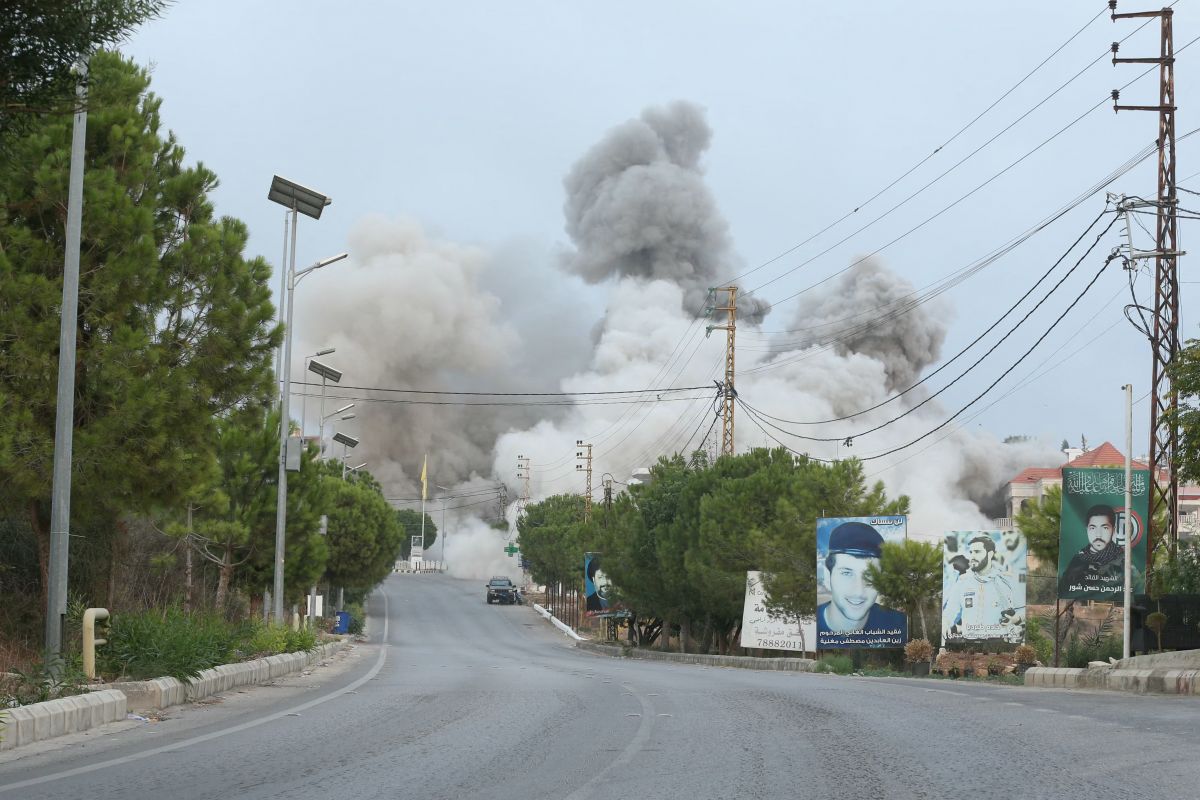
Smoke rises from the site of an Israeli airstrike in Tayr Debba, in southern Lebanon's Sour district, on Nov. 6, 2025. (Credit: Mahmoud Zayyat/AFP)






SOUTH LEBANON — In a move reminiscent of its widespread bombing campaign in Lebanon during last year's all-out war, Israel released five evacuation orders for five different villages across four districts in southern Lebanon on Thursday afternoon, followed by a wave of attacks.
Israeli jets bombed Taybeh (Marjayoun district), Tayr Debba (Sour district), Aita al-Jabal (Bint Jbeil district), Zawtar Sharqieh, (Nabatieh district) and Kfar Dounin (Bint Jbeil distrct) across a roughly three-hour window, leaving less than an hour between evacuation warnings for the targeted buildings and the subsequent strikes.
According to the Health Ministry, Israel's afternoon strikes wounded one person, while strikes on areas east of the southern city of Sour killed one person and wounded eight others.
The Israeli army claimed to be targeting Hezbollah infrastructure but failed to provide any evidence to back up its claims. The Lebanese Army stated in last month's report on the progress toward disarming Hezbollah that the process was 80 percent complete south of the Litani River, the area covered in the cease-fire agreement.
As the strikes were taking place, Cabinet was meeting in Baabda to hear the army's second monthly report on Hezbollah's disarmament.

President Joseph Aoun responded to Israeli bombardment calling it a "heinous political crime," and pointing out that "whenever Lebanon has shown openness to peaceful negotiations to resolve outstanding issues with Israel, the latter has intensified its aggression against Lebanese sovereignty.”
Aoun accused Israel of showing "contempt" for Security Council Resolution 1701 and repeatedly breaching its commitments under the Nov. 27, 2024, cease-fire agreement.
"Almost a year has passed since the cease-fire came into effect, and during this period Israel has spared no effort to show its rejection of any negotiated solution between the two countries... Message received," he added.
Last week, Aoun said publicly that Lebanon was prepared to mediation with Israel amid the latter's ever-increasing violence in the country. "Lebanon is ready to negotiate to end the Israeli occupation," Aoun said, "but any negotiation cannot be one-sided; it requires a mutual willingness, which does not yet exist."
Yet another message to the Lebanese Army
Israel's threat against Kfar Dounin concerned a building that was around 200 meters away from a Lebanese Army barrack. Soldiers refused to evacuate the building. Following the bombardment of the marked building, Israel issued another statement warning that its evacuation order for the area was still in effect. Again the soldiers refused to move.
A second attack was launched against the building nearby. According to a source in the army, the barracks did not sustain any damage, but several southern Lebanese villages praised the army — which has expanded its deployment in the South, replacing Hezbollah's military presence — for standing its ground and refusing to evacuate areas marked for attack by Israel.

In a statement, the Houla municipality said this stance "confirms that the Lebanese Army remains the guarantor of the country’s security and protection, and a key pillar of stability and defense for its citizens."
The Lebanese Army, which condemned Israel's attacks as an attempt to prevent it from deploying in the South, was given instructions on Friday by Aoun to respond to any further Israeli incursions over the border following a violent siege by Israeli soldiers of the Blida municipal building.
In late October, the Israeli army twice attack the Lebanese Army, a rare occurrence considering the latter having generally kept to the sidelines throughout the conflict.
Five hours after issuing its first evacuation order, the Israeli army announced its string of attack was over. However, shortly after, an Israeli drone bombed the town of Aitaroun, hitting an excavator, while another dropped a sound bomb near a fisherman off Ras Naqoura.
'Avoid any response likely to worsen the situation'
Farid Nannouh, the mayor of the southern Lebanese town of Tayr Debba, in Sour district, released a statement following Israeli bombardment of a house in the village.
"The Occupation [the Israeli army] targeted a house claiming that it was a military site belonging to the Resistance [Hezbollah], which is completely false," Nannouh stated. "We remain resistant in our villages and on our land, despite all the Israeli attacks," he insisted.
"No population displacement has taken place either in the locality or in the surrounding area, contrary to what some local and foreign media have claimed."
Following the attacks, UNIFIL released a statement calling on Israel "to immediately cease these attacks and all violations of Resolution 1701" and urging "Lebanese actors to avoid any response likely to worsen the situation."
These strikes "are clear violations of UN Security Council Resolution 1701," stressed UNIFIL, recalling that they come as "the Lebanese Army is conducting operations aimed at controlling unauthorized weapons and infrastructure south of the Litani."
"Any military action, especially on this scale, endangers civilian lives and jeopardizes progress toward a political and diplomatic solution," it added.
 Israeli army carries out demolition at Jabal Amel School in Houla as strikes continue