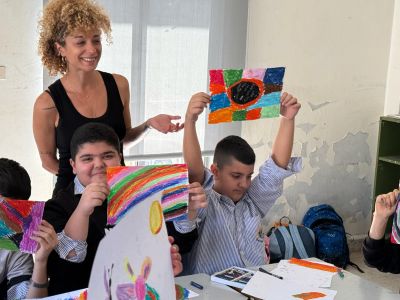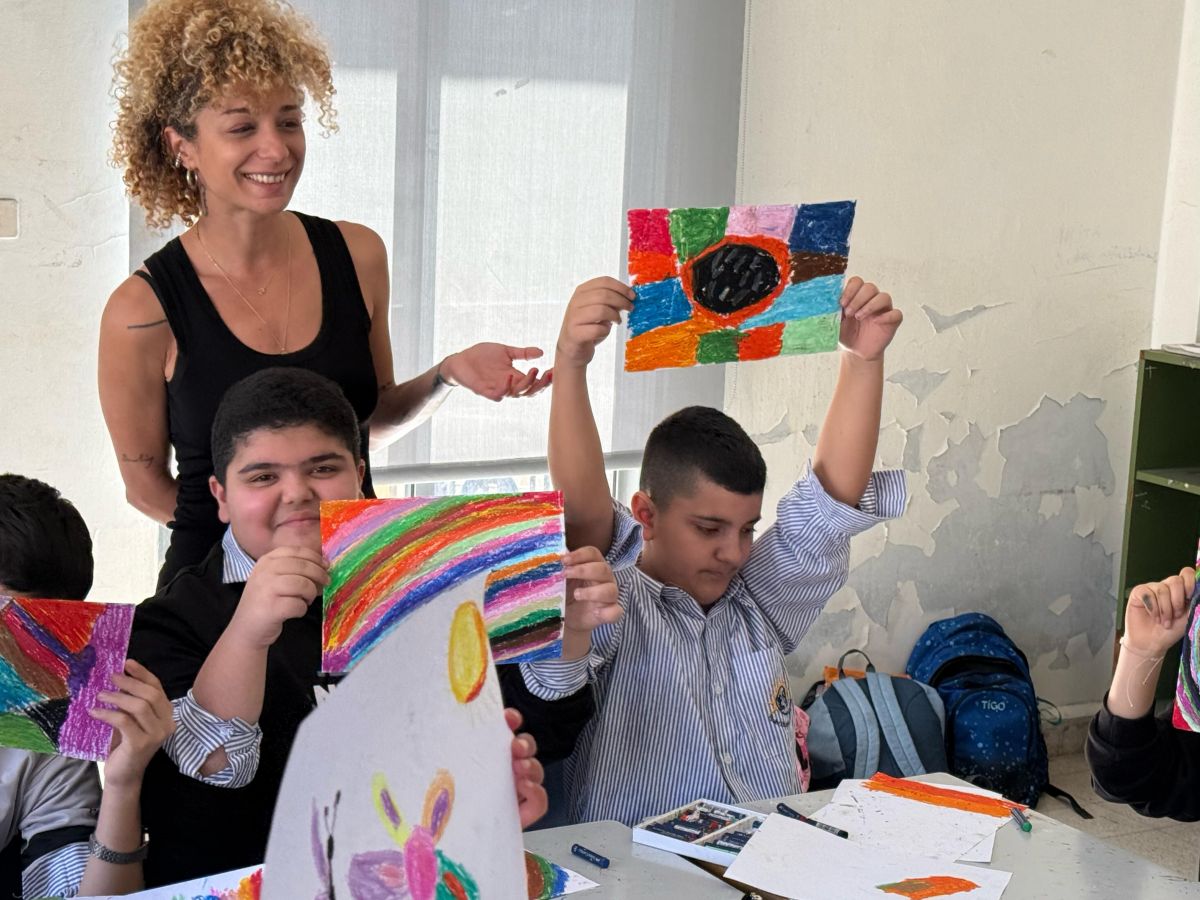
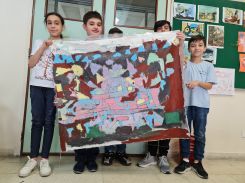
Photo taken at the Batroun Public School — artist: Emne Mroueh. (Credit: BeMA)






Long before having its own walls, the Beirut Museum of Art (BeMA) has, since 2016, been blazing a trail of hope and beauty.
Through its initiative "Creative Pathways," developed under a contractual agreement with the Education Ministry, the museum strives to introduce public school students to Lebanese art, drawing on the 3,000 works from the national collection of the Ministry of Culture entrusted to its care.
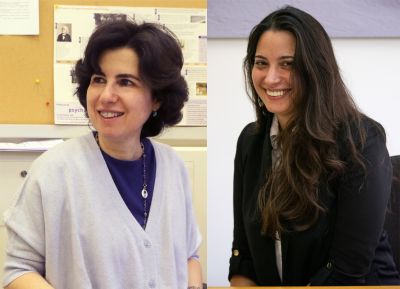
This novel approach, designed as an educational model, is led by BeMA co-directors Juliana Khalaf and Taline Boladian, with artistic direction by Clémence Cottard Hachem.
"It's a formula that quickly connects children," emphasizes Taline Boladian, adding: "The success of this model pushes us to make it evolve and innovate to remain a pioneer in the field. This year, new formats have been launched, including a series of educational posters called 'Toute une histoire / القصة كلها / The Story Within,' where an artwork, an artist, and stories are shared front and back. With these formats, we hope to reach as many classrooms as possible."
Art as a living experience
The principle is simple, but the result is astonishingly rich: every school year, BeMA chooses a theme inspired by a work, a Lebanese artist, or a group of works from the national collection. In 2025, painter and writer Helen al-Khal will be honored with a "Creative Pathways" exhibition scheduled for November in Beirut, at the Villa Audi.
Contemporary artists are invited to interact with the theme, drawing inspiration from technical, emotional, or symbolic details to design, over several months, workshops for children ages 9 to 12.
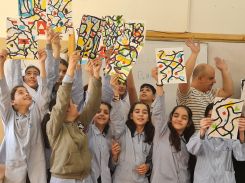
These workshops, both fun and formative, result in collective creations that students then present to their parents. The children thus become messengers themselves. They invite their parents to look at art — theirs and that of the artists.
"Our trained artists gently and effectively incorporate elements of art therapy and psychosocial support. In the end, something changes: the children think, feel, and move forward as a single community," says Rayane Raidi, BeMA’s head of educational programs.
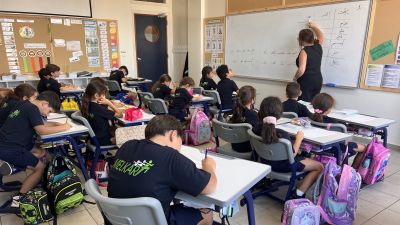
Each exhibition mirrors a professional approach and exhibition standards, where children are treated as true artists. "Much more than an educational program, 'Creative Pathways' acts as a catalyst for dialogue and connection, showing that art has the power to link territories as much as sensibilities," notes Maya Hage, director of BeMA’s education department.
The Beirut Museum of Art banks on joy, pride, and responsibility: learning to look at a work, to respect it, not to touch it, to observe it from a certain distance or through a magnifying glass revealing technical secrets, and finally to interpret it. "We are building a culture of culture," sums up the BeMA leadership.
A traveling museum: Moving arts
The initiative also expands through "Unfolding Landscapes," a program of itinerant exhibitions bringing art to everyone by decentralizing it. Inspired by the Culture’s Ministry collection, the project is built around four scenographed trunk-cabinets: real tiny traveling museums, inspired by the traditional Sandouk al-Ferjeh (traditional story-telling puppet box) and cabinets of curiosities, fully lit and ready to be set up anywhere. The first stop took place in Beiteddine, before traveling to other Lebanese regions, starting with Beirut.
"When we show this program, we open the box and there’s something magical: everything is already in place, you just need to close it and take it elsewhere," explains Taline Boladian. Each stop lasts two to three months at each exhibition space, accompanied by workshops led by specially trained artists and educators.
Workshops at the heart of learning
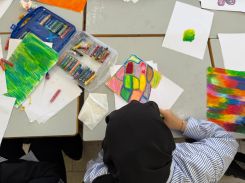
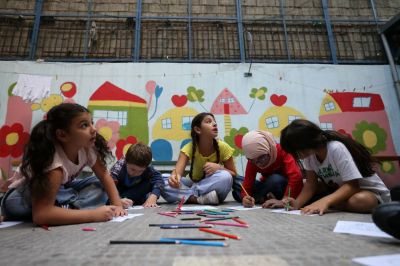
The BeMA "Learning Department" designs a complete activity program for each location: plastic arts workshops, "therapeutic" breaks in nature or in free artistic expression, games and educational tools.
The work of artist Bibi Zogbeh, for example, leads children through sessions focused on landscape, nature, and flora. Illustrating both the artwork and its natural environment (flowers, thistles, skies, vegetation), a new educational format, created this year by BeMA and titled "Toute une histoire," is dedicated to her.
This device takes the form of reversible posters, showcasing large-format works, stories, observation games, and creative prompts, all meant to enliven public school classrooms.
A teaching kit and lesson plan are also provided to teachers to extend the experience in class, especially during unscheduled hours. The game “Taktak” (or "Flip the Frame"), a bilingual (Arabic-English) memory game also created in 2024, helps build vocabulary and visual memory around the ministry collection’s works and their graphic and artistic details.
A network of committed actors
The program leaves no one behind: for example, the museum’s artistic director, Hachem, designed the "Unfolding Landscapes" exhibition with a fully collective approach. In partnership with the British Council in Lebanon and the "CATAPULT.visual’arts 2.0" program, emerging artists and visual arts students from the Lebanese University were commissioned to produce new works in dialogue with the historical pieces displayed.
In collaboration with designer Kamal Aoun, they also contributed to the development and scenography of the museum boxes, reflecting the will to include all levels of the artistic ecosystem: artists, teachers, students, and technicians, in the creation of the exhibition and its related programs.
BeMA funds the transport of public school students and strives to minimize costs so that access to art is no longer a privilege. "We want to give access to all, without barriers or distance," emphasizes the museum leadership, proud to have inspired similar initiatives across Lebanon.
A national mission
On its tenth anniversary, BeMA is energetically relaunching its educational mission. Driven by its co-founders Sandra Abou Nader and Rita Nammour, the museum aims to reach at first 100 public schools out of the country’s 1,000, in coordination with the Education Ministry.
A new strategy will be unveiled soon, marking a turning point: after a decade devoted to developing the museum both in its physical construction and programming, the focus is now on engaging students with the artworks and preparing them to interact. "Every child should be able to remember a moment of art in their school life," affirms BeMA’s leadership. "That should be the foundation, something normal."
Art as a shared heritage
With "Creative Pathways," BeMA isn’t just educating — it’s weaving ties across generations, regions, and disciplines. It invites people to revisit the Lebanese landscape, both physical and interior, through painting, panoramas, plants, and memory.
It puts within reach of a broad, uninitiated audience the aesthetics and history of 3,000 works by Lebanese artists from the Culture Ministry entrusted to its care.
In a country where access to culture remains fragile, this initiative draws a collective future where art becomes a common language. "We want to disseminate this heritage and share it with everyone. That’s how pride and the joy of belonging to a culture are born," stresses BeMA’s leadership.
Hachem also affirms: "Supporting and defending the transformative power of art and culture, nurturing intellectual and emotional autonomy — this is the aim of this continuing, long-term commitment of more than eight years." This first public program powerfully illustrates BeMA's vision and mission since its founding.