


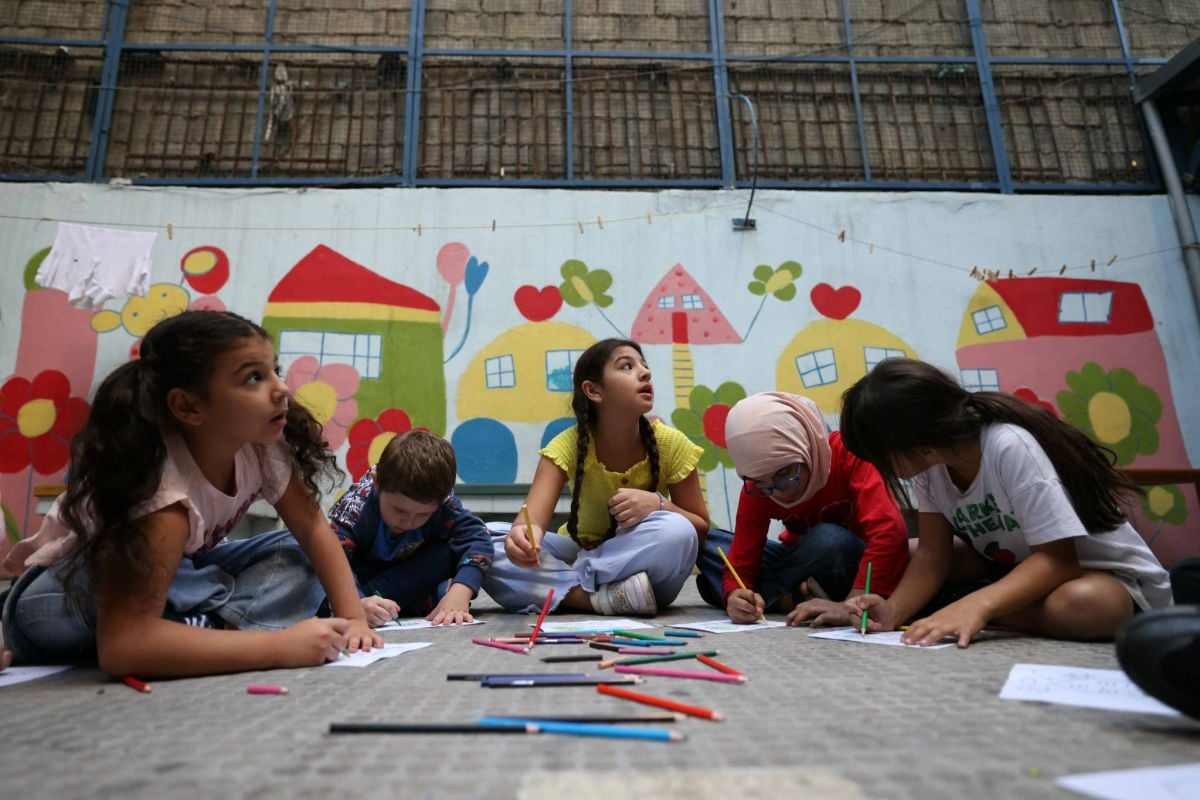
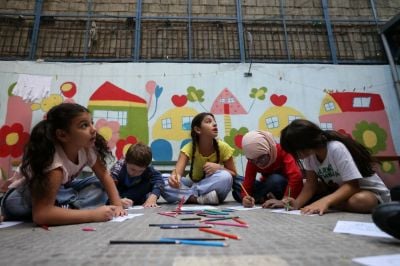
Children who fled Israeli bombings in southern Lebanon took part in a drawing workshop organized by volunteers, in a reception center in Beirut where they found refuge with their families, on Oct. 20, 2024, during the war between Israel and Hezbollah. (Ibrahim Amro/AFP)






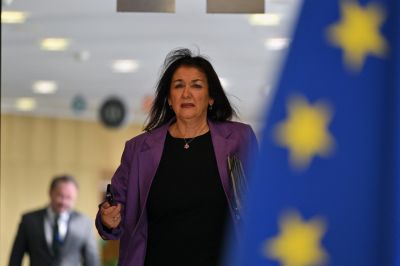
All young Syrian refugees in Lebanon of school age, whether documented or not, will be allowed this year to enroll in public schools for afternoon classes. The exceptional measure, announced Thursday by Education Minister Rima Karameh, comes on the first day of refugee student registration, following a year during which only those with residence permits or documents issued by the United Nations High Commissioner for Refugees (UNHCR) were admitted to public schools.
This measure aims to ensure that Syrian students who sought refuge in Lebanon after the fall of Bashar al-Assad’s regime in December 2024 are not left out, with the consideration that they will one day return to their homeland.
According to ministry figures, 42,000 Syrian students were thus deprived of education in 2024-2025. Lebanon, despite being a signatory to the International Convention on the Rights of the Child, denied them this right on a Cabinet decision, officially to encourage their return to Syria.
According to the UNHCR, as of December 2024, there were 1.4 million Syrian refugees in Lebanon. But with the departure of opponents of the former regime (approx. 300,000) and the arrival of supporters of that regime (approx. 100,000), these figures are now higher than reality and should be revised downward by year-end, according to the institution.
Data transmitted to General Security
The directive signed Thursday by Karameh (following a Cabinet decision on October 9) details the registration conditions in public schools for foreign students attending afternoon programs, mainly Syrians. It should be noted that foreign students present in Lebanon before the Syrian crisis of 2011 are admitted in the morning alongside Lebanese students, except for Palestinian refugees who are educated by UNRWA.
Also according to the Education Ministry, 166,000 Syrian students were enrolled in public schools in 2024-2025, all of them holding valid documents.
Between Oct. 15 and 31, 2025, heads of public schools are thus invited to register foreign students (Syrians) belonging to the following categories: those with valid residence permits issued by General Security or valid documents from UNHCR; those who have started the procedures (or whose parents have) and hold a receipt proving it; and finally, undocumented students who do not have valid papers, provided that all data concerning them (name, parents' names, date and place of birth, registry number, address, phone number) are entered. This data will be forwarded by the Ministry of Education to General Security.
According to a source close to the case, the goal of such a decision, apart from granting children the right to education, is to transmit information to the ministerial committee for the return of Syrian refugees — led by Deputy Prime Minister Tarek Mitri — enabling better control of the file. "The authorities assume that these refugees will go home one day and must obtain the information needed to manage their return."
On social media, supporters and opponents are clashing. Those who want to see the refugees leave immediately, even if it means denying their children schooling; and those who support the official decision, for humanitarian reasons but also out of respect for children's rights. The discourse is taking on political and communal overtones. In early October, the Progressive Socialist Party (PSP) announced it had obtained special authorization for Syrian students displaced from Sweida and other regions after recent conflicts to enroll in Lebanese schools.
UNICEF is already welcoming the Education Minister’s decision. Contacted by L’Orient-Le Jour, Marcoluigi Corsi, UNICEF Representative in Lebanon, “welcomes the efforts made by the ministry to help all children access general education, regardless of their origin. This is a crucial step to ensure the academic year’s success and realize the fundamental right of every child to quality education,” he emphasized.
“UNICEF and its donor partners will continue to support the Ministry of Education and Higher Education through the Transition and Resilience Education Fund (TREF), helping strengthen the public education system, provide teaching materials, train teachers, and ensure inclusive, safe, and quality learning environments for all children in Lebanon, including those with special needs, refugees, and other vulnerable groups,” added Corsi.
This article was originally published in French in L'Orient-Le Jour.
 Israeli army carries out demolition at Jabal Amel School in Houla as strikes continue