


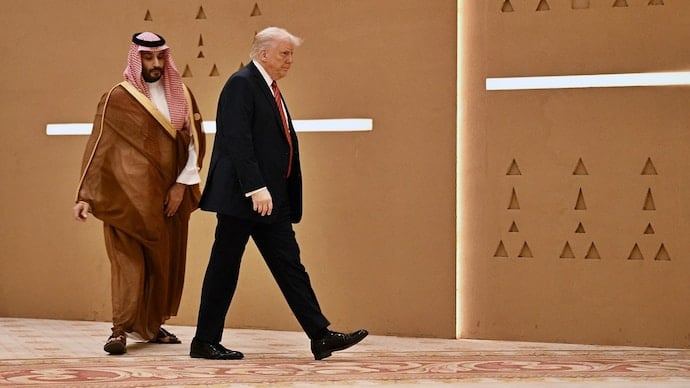
U.S. President Donald Trump walks alongside Saudi Crown Prince Mohammed bin Salman ahead of a group picture with Gulf leaders, during the former's visit to Gulf states in May, 2925. (Credit: AFP)






Saudi Arabia and the U.S. have reopened negotiations on a possible defense pact, the Financial Times reported on Friday, after months of talks between the Gulf state and the Biden administration were brought to a screeching halt by the Gaza war.
Crown Prince Mohammed bin Salman (MBS) is set to visit Washington next month, his first trip to the country since 2018, during U.S. President Donald Trump's first term. It's then that the kingdom is hoping to have the deal signed, the American outlet reported.
During the previous round of negotiations, normalization with Israel was on the table too. But since the Gaza war, in which Israel killed more than 68,000 people and for which MBS accuses it of genocide, the Saudi stance has shifted, conditioning any normalization on the creation of a state of Palestine.
Even amid increased international recognition of Palestinian statehood — following a campaign led by Saudi Arabia and France — Israeli Prime Minister Benjamin Netanyahu has staunchly opposed the possibility. So, this time, for the time being at least, normalization is not part of the discussion, Hussein Ibish, a senior scholar at the Arab Gulf States Institute in Washington, told FT.
While the Trump administration picks up where Biden's left off, this new deal would be a standalone one, FT stated, adding that the final handshake could come through either as an agreement or as an executive order.
On Sept. 29, 20 days after Israel had bombed Hamas negotiators in Doha, Trump signed an executive order recognizing the "enduring alliance" between the U.S. and Qatar and providing Qatar with an explicit security guarantee in the event of "external attack." On Oct. 11, U.S. Defense Secretary Pete Hegseth announced Qatar had been given permission to build an air force facility in Idaho.
Gulf states were shook by the Israeli attack, which had been presumed impossible considering the deep security ties between the U.S. and these oil-rich states. On Sept. 17, Saudi Arabia signed a "strategic mutual defense" pact with Pakistan, which owns nuclear weapons, signalling to the U.S. that it was willing to diversify its alliances, reducing its reliance on an unpredictable Trump administration.
According to an earlier FT report, the U.S. was not informed of the Saudi-Pakistani treaty ahead of its signing, which raised questions in Washington.
But the Doha attack wasn't the first time the Gulf has had reason to doubt U.S. support. In 2019, during Trump’s first term, the U.S. did little in response to a missile and drone attack on Saudi oil fields — for which Iran is accused, but has denied any involvement — which temporarily knocked out half the kingdom’s crude output.
But Saudi Arabia is still one of the U.S.'s top weapons customers and during Trump's visit to Riyadh in May, the White House announced a $142 billion arms deal with the kingdom, which is, FT pointed out, is double Riyadh’s 2024 defense budget.
According to the White House, cited by FT, the deal includes air force and space capabilities, missile defense and maritime and border security. It described the deal as the largest of its kind in history.
 7 p.m. recap: Flames, smoke reported near Aramco site near Riyadh; Houthis accuse Saudi Arabia of 56 strikes on Sanaa