


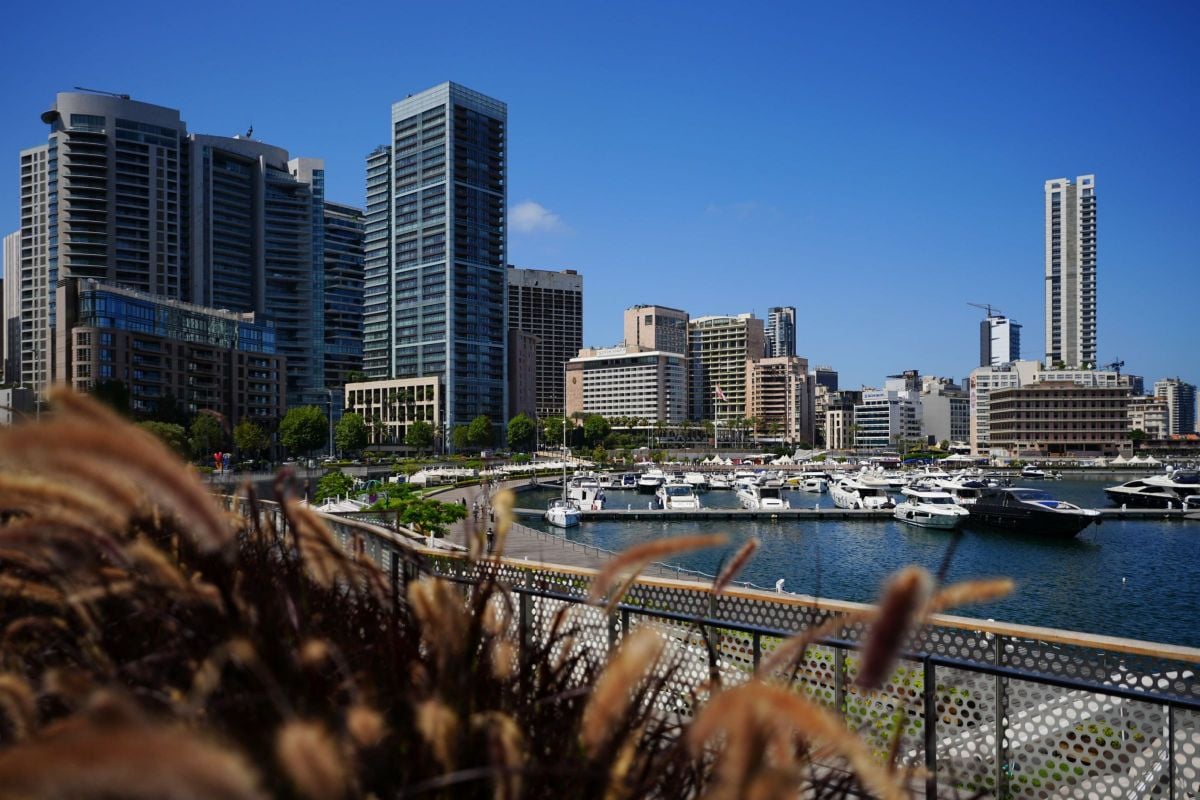
Zaytouna Bay in the Ain al-Mreisseh district in downtown Beirut on July 7, 2025. (Credit: Mohammad Yassin/L’Orient Today)






BEIRUT — With a delay of several years, which has now become customary, Cabinet's Central Administration of Statistics (CAS) announced it had finally published the official figures regarding Lebanon's GDP for 2022 and 2023 on Friday.
According to its report, Lebanon recorded a nominal GDP of LL2,761,000 billion in 2023 ($31.6 billion at the average exchange rate of 87,472.3 LL/USD) and LL651,000 billion in 2022 ($21.4 billion at the average rate of 30,473.5 LL/USD), compared to a GDP of LL255,000 billion in 2021 ($20.1 billion at the average rate of 12,647 LL/USD).
CAS also claimed that Lebanese 2023 GDP "represents about 59 percent of the 2019 level," the year when the economic crisis broke out, equivalent to $53.3 billion.
But taking into account Lebanon's significant inflation rates, combined with the collapse of the national currency during this period, CAS estimates that the real Lebanese GDP, adjusted to 2019 prices, stands at LL61,000 billion in both 2023 and 2022, compared to LL60,000 billion in 2021. This reflects real annual growth rates of 0.5 percent in 2023 and 1.8 percent in 2022, compared to 2.1 percent growth in 2021.
CAS contradicts IMF and World Bank
However, CAS's estimates partially contradict those of the International Monetary Fund (IMF), which estimates that Lebanon’s economy contracted by 0.7 percent in 2023 following two years of growth (two percent in 2022 and one percent in 2021), and those of the World Bank, which estimates that Lebanon’s GDP contracted over all three years: -0.8 percent in 2023, -0.6 percent in 2022 and -7 percent in 2021.
Despite the slight improvements it notes, CAS emphasizes that these growth rates "follow a major economic contraction in 2020," during which it says the size of Lebanon’s economy shrank by 26.8 percent. In real GDP terms, 2023 represents 76 percent of the level recorded in 2019, "reflecting the difficult conditions the Lebanese economy has faced since that period," CAS adds.
CAS breaks down the details further, noting that the information and communications sector (+71 percemt), construction (+27 percent), and private education and health services (+15 percent) saw the largest increases in activity in 2022. The steepest declines occurred in the hotel and restaurant sector (-29 percent), financial services (-22 percent), and industry (-8.4 percent).
For 2023 — the year the war between Hezbollah and Israel broke out — the information and communications sector (+19 percent) again led the way, according to CAS, followed by construction (+6.7 percent) and agriculture (+3.3 percent). The largest declines during the year were seen in the hotel and restaurant sector (-31 percent), financial services (-22 percent), and public education and health services (-4.4 percent).

 7 p.m. recap: 1 person killed near border with Lebanon; 200 kilos of explosives carried by mules; Riyadh shuts its airspace