






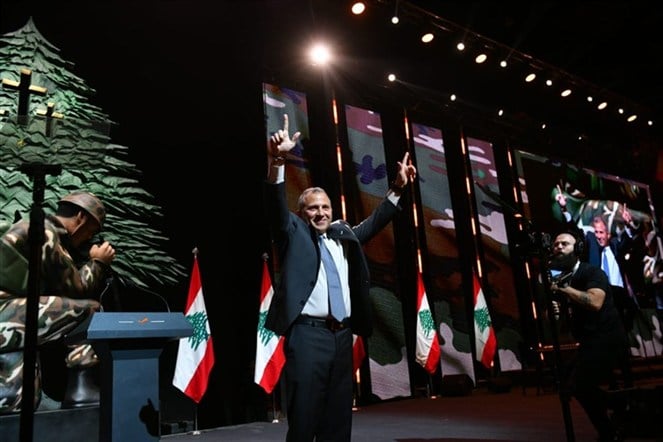
The FPM leader, Gebran Bassil, on Oct. 11, 2025, at the Beirut Forum. (Credit: Tayyar.org)






BEIRUT — Gebran Bassil, leader of the Free Patriotic Movement (FPM), on Saturday outlined a new proposal giving Lebanese voters abroad and at home the choice to cast ballots either for a diaspora representative or for a member of parliament in their home district.
Bassil made the proposal without detailing how the plan would be implemented.
He spoke after a mass commemorating Oct. 13, 1990, the date Syrian troops stormed positions held by the Lebanese Army under General Michel Aoun. That day ended with Aoun’s surrender, his subsequent refuge at the French Embassy in Beirut, and eventual departure from Lebanon 10 months later.
Addressing expatriates, Bassil described creating a bloc of diaspora MPs as a matter of “rights” for emigrants, who he called an “extension of Lebanon throughout the world.” He warned that emigrants risk losing the right to vote or that elections could be postponed, framing his announcement as an “initiative to resolve the problem of expatriate voting.”
'Vote as you wish, but vote'
Calling the 16th district a “strategic achievement for all expatriates and for Christians,” the Batroun MP said expatriates could choose to elect either a diaspora MP or one from their home district. He added that to avoid constitutional challenges, residents would also be given the same choice. “Your vote is essential and decisive: register and vote as you wish, but vote,” Bassil said at the Beirut Forum.
The initiative seeks to bridge differences between political parties, as debate over diaspora voting has been deadlocked for months and risks paralyzing Parliament. Some civil society groups and political parties have pushed to amend the 2017 electoral law to allow expatriates to vote for all 128 MPs in Lebanon, while others advocate maintaining Article 112, which allocates six seats for a special diaspora district.
In early October, Parliament twice attempted to convene, but MPs favoring amendments blocked sessions, disputing the Parliament Speaker’s refusal to place a bill on the agenda under double urgency. The Lebanese Forces, proponents of the amendment, criticized the Parliament Speaker’s refusal.
Honoring martyrs, including Nasrallah
Bassil also invoked the “martyrs” of Oct. 13, 1990, calling them central to Lebanon’s liberation and the FPM’s founding. “Lebanon’s martyrs are anyone who died for Lebanon and for the cause in which they believed. In this sense, Kamal Joumblatt, Tony Frangieh, Bachir Gemayel, Rachid Karami, Mufti Hassan Khaled, Rene Moawad, Danny Chamoun, Rafik Hariri, Gebran Tueni, Pierre Gemayel, Elie Hobeika and all the martyrs are our martyrs, and Hassan Nasrallah is also our martyr,” he said.
Nasrallah, former Hezbollah secretary-general, was killed on Sept. 27, 2024, during massive Israeli strikes on Beirut’s southern suburbs. The party’s decision to open a “support front” in Gaza had escalated tensions with the FPM, ending their 2006 political alliance.
Tribute to army and support for Salam
Regarding the Lebanese Army, tasked since late November 2024 with disarming Hezbollah and other militias, Bassil called it “the only institution still standing in this country” and “the impregnable fortress that protects Lebanon; it may be tired but it will not disappear.”
He also voiced support for Prime Minister Nawaf Salam, who has faced criticism from Hezbollah and the Amal Movement over disarmament efforts. “At the FPM, we did not accept any infringement on the president’s prerogatives” during the presidential vacancy, which lasted over two years, Bassil said. He added, “We will not accept any infringement on the powers of the prime minister; our prime minister is not a Zionist but Lebanese — even if we don’t agree with him, our president is also Lebanese.”

