






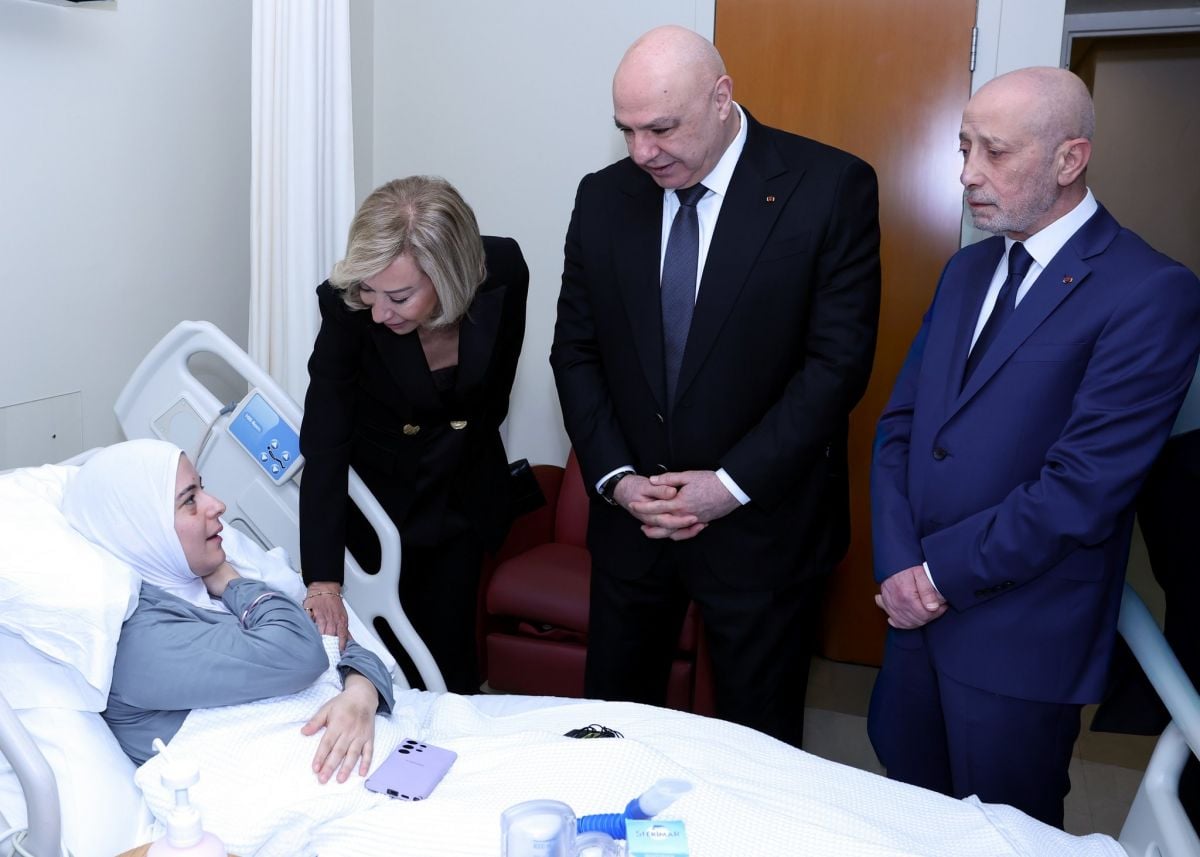
The Lebanese presidential couple at the bedside of Amani Bazzi Sharara, who lost three children and her husband in an Israeli strike on Bint Jbeil in September, on Oct. 10, 2025. (Credit: @LBPresidency/X)






BEIRUT — President Joseph Aoun and First Lady Neemat Aoun visited, on Friday, Amani Bazzi Sharara, a survivor of an Israeli drone attack on her car that killed her husband and three of their four children.
The attack occurred as the family was driving in southern Lebanon's Bint Jbeil district on Sept. 21. Of the family of six, only Amani, with whom the president and the first lady expressed their "deep solidarity," and one of her daughters, who remains in intensive care, survived the deadly attack.
Amani Sharara's husband, Shadi, and their three children — Celine, Hadi, and Celia — were killed, while their only surviving child, Acil, remains hospitalized in critical condition in Beirut.
The Aouns visited Sharara at the American University of Beirut Medical Center (AUBMC), where they received an update on the condition of the two survivors of what has become known as the "Bint Jbeil massacre." According to a statement from the presidency's X account, Aoun assured the grieving mother that "all Lebanese stand with her in this ordeal" and praised her "strength and resilience in the face of tragedy."
In the attack, the Israeli drone fired two missiles, one at a moto driving near the family's car and a second at the family's car directly. The moto driver, who was reportedly a relative or close friend of the Shararas, was also killed.
Aoun, who was at the U.N. General Assembly in New York at the time of the strike, first conveyed his condolences on Sept. 23 through Information Minister Paul Morcos, who visited Sharara with Health Minister Rakan Nasreddine.

Aoun's visit to Sharara on Friday came after Parliament Speaker Nabih Berri criticized the government of ignoring the plight of southern Lebanese residents who have endured war, displacement and destruction. Prime Minister Nawaf Salam responded by recalling some of the decisions Cabinet has made in support of the South.
Since the cease-fire between Israel and Hezbollah took effect in November 2024, the Israeli army has continued to attack southern Lebanon on a near-daily basis.. Hundreds have been killed in these attacks, including more than 100 civilians, according to a U.N. tally released early October.