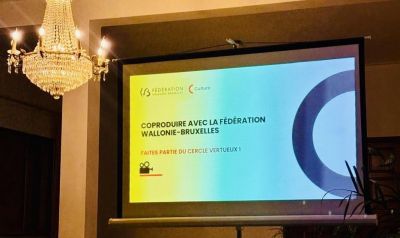


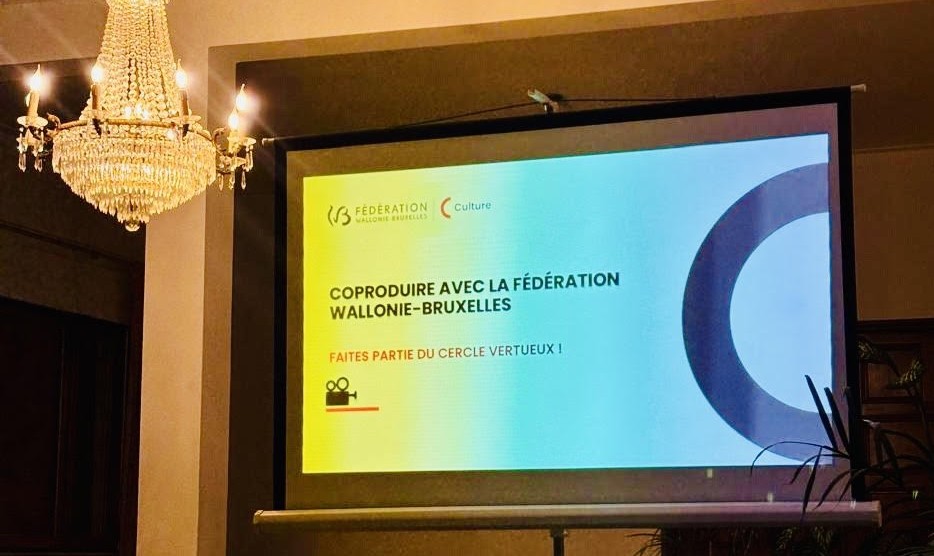
The co-production agreement between Lebanon and Belgium is an important signal of trust and interest. Photo sent by the Belgian Embassy.






The film coproduction agreement between the government of the French-speaking Community of Belgium and Lebanon was announced at the residence of Belgian Ambassador Arnout Pauwels, in the presence of Minister of Culture Ghassan Salameh and Lebanon Cinema Foundation President Maya de Freige.
It took nearly a decade of discussions, diplomatic back-and-forth, and political hurdles in both countries before the project finally came to fruition. The Wallonia-Brussels Federation and Lebanon formalized the signing of a film coproduction agreement last June — a deal expected to open new opportunities for creators from both nations, especially for Lebanon, where public institutions are financially drained.
The culture minister highlighted the agreement’s significance for Lebanese filmmakers and actors, joking that he never has to debate spending public funds on culture because his ministry simply has none.
The second such accord, after one signed with France, comes at a time when, according to Salameh, “the authority of the state in Lebanon has shrunk dramatically.”

He estimated that public finances will likely not recover for at least five to seven years, making such international partnerships even more crucial. In the meantime, Salameh said he is working to persuade investors that cultural industries can also drive economic recovery.
“Establishing coproduction agreements with other countries aims to facilitate production and increase visibility. This aligns with the Lebanon Cinema Foundation’s objectives — to boost production in Lebanon and, above all, help films get made,” de Freige said. “This complements our training and support programs for filmmakers throughout the production process — from screenwriting to seeking international partners. It’s one solution to the financing and visibility challenges faced by Lebanese cinema.”
She emphasized the urgent need for a support fund similar to one previously established. “We must make financing tools and national aid sustainable so our filmmakers can approach stronger producers with a more independent voice and attract partners. Having national support sends a message: we too are strong and bring both talent and public backing,” de Freige said.
She recalled that “the Lebanon Cinema Foundation also created the Lebanese Film Fund with support from the European Union, which provided a small grant that allowed nine films to be produced. As always, we rely on our patrons and the diaspora and are exploring several funding channels, including a potential support or even investment fund.”
A Cannes-born idea
It all began in Cannes in 2016. During a conversation between representatives of the Wallonia-Brussels Cinema Center and the Lebanon Cinema Foundation, the idea of a partnership first took shape. Lebanon — with a cinema scene deeply rooted in international collaboration — drew attention.
Its directors, trained around the world, and its steady presence at global festivals made it a natural partner for French-speaking Belgium, which was already open to audiovisual cooperation with the Middle East.
That meeting sparked an ongoing dialogue. In 2018, the Wallonia-Brussels Federation sent the first draft of the agreement. Another seven years of reviews and approvals followed before the final version was endorsed in Beirut in March 2024 and signed by Lebanon’s culture minister in May 2025. A month later, Wallonia-Brussels Federation Minister-President Elisabeth Degryse added her signature.
A shared framework for collaboration
In practice, the agreement places films coproduced between the two countries — regardless of format — on equal footing. A work born from a Belgian-Lebanese partnership will be considered “national” in both countries, granting it the same financial and institutional benefits as local productions.
For Ambassador Pauwels, the economic impact of the agreement is key to attracting coproductions. Belgium offers a “tax shelter” system that provides fiscal incentives encouraging Belgian cinema to expand beyond its borders. Filmmakers such as the Dardenne brothers and French actress Marion Cotillard, who starred in their Belgian film Two Days, One Night, have contributed to that momentum.
“I am pleased that, despite financial pressures in Europe, including in Belgium, the Community found the energy and resources to finalize this agreement with Lebanon. It is an important signal of trust and partnership. Belgium, a small Francophone country, must stand alongside Lebanon, another small Francophone country — France should not bear the entire burden,” Pauwels said.
Under the agreement, each producer must contribute between 10 percent and 90 percent of the budget and provide real artistic and technical input — purely financial coproductions are excluded. This ensures genuine creative collaboration, combining the expertise of Belgian and Lebanese teams in the service of a shared cinematic vision.
Both countries also pledged to support the distribution and promotion of films produced under the agreement within their territories. A joint commission will oversee its implementation, assess its outcomes, and consider future revisions.
The culture minister concluded by stressing that the signing of this agreement “in no way hinders the ministry’s intention to conduct an assessment with stakeholders across various cultural sectors to develop a cultural policy strategy for the coming years,” which he said “should take place next January.”
Details of the agreement are available on the Lebanon Cinema Foundation website.