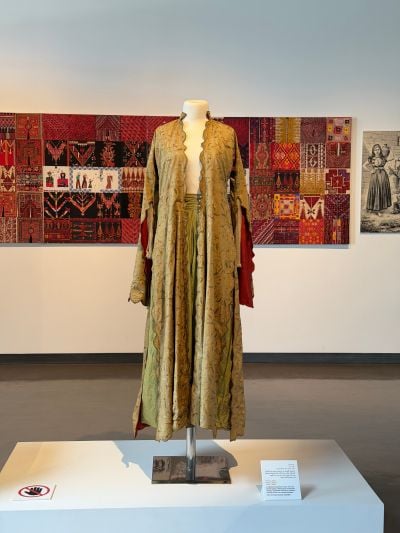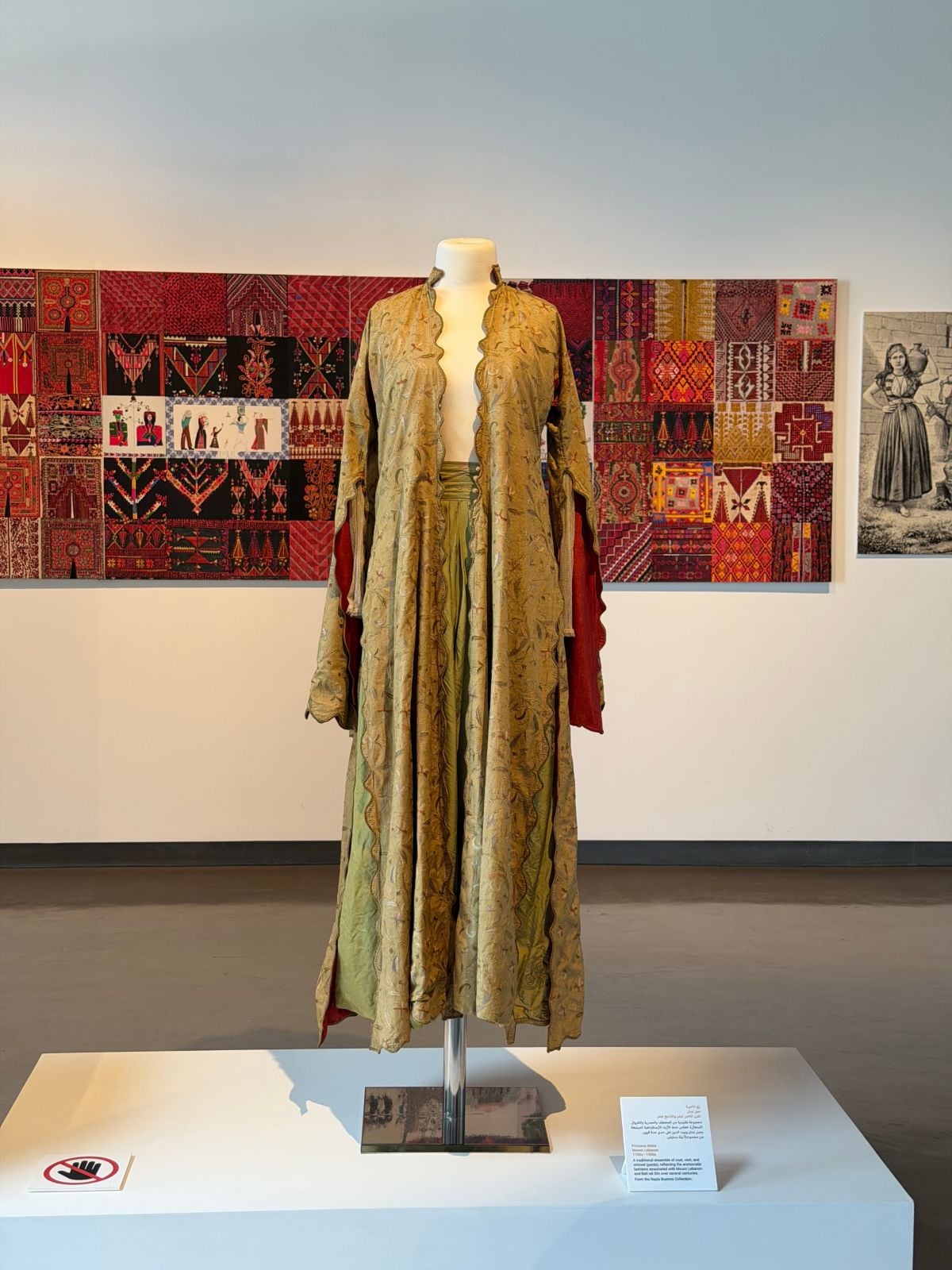
Traditional Lebanese embroideries exhibited at the Nabu Museum, witnesses to a textile heritage passed down through the centuries. (Credit: Nabu Museum)






The Nabu Museum in Heri (Batroun) is presenting "Our Identity and Symbols," an exhibition exploring the ancient origins of textile motifs from Lebanon, Syria, and Palestine. The selection of works on display — including a princess's costume from Mount Lebanon, intricately engraved silver tantours, and abayas and thawbs from the 18th and 19th centuries — features ornaments directly inherited from the Canaanite and Mesopotamian periods.
Ceramics and glassware produced by these ancient civilizations display the same motifs. Likewise, illustrations of sculptures show similar ornaments on the garments of Iddi-Ilum and Ishtup-Ilum, military governors of the ancient city-state of Mari, in Syria, in the 22nd and 21st centuries B.C., respectively. These motifs also appear on the stele of the Sumerian king Ur-Nammu, known for instituting the oldest known law code.
Among the exhibition's highlights is a bronze and silver figurine of the Phoenician god Baal, dating from 1400 to 1200 B.C., wearing a conical headdress strongly resembling the tantour. A 1913 icon of Saint Anthony depicts him wearing the Great Schema adorned with water and wave motifs identical to those seen on the ancient ceramics on display. The icon's exact origin remains difficult to determine because of stylistic similarities between Syria and Palestine at the time.
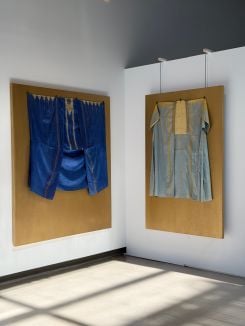
Modernity also has its place, with a wooden artwork by Gebran Tarazi. The artist, who died in 2010, devoted his life to blending traditional Near Eastern craftsmanship with contemporary art rooted in Oriental geometric abstraction.
An unbroken thread through the centuries
The exhibition highlights the deep connections between the decorations of the ancient Levant and modern embroidery. "This is a collective visual memory that has endured across time and space through women's everyday practices. By preserving these forms, women safeguarded symbols expressing identity, territory, and beliefs," explains Karl Abi Karam, chief curator of exhibitions at the Nabu Museum.
He notes that the Mesopotamian era, often associated with stone and clay, was also the beating heart of wool and linen production in the East. A true "white gold," textiles represented a major economic and cultural pillar. Sumerian, Babylonian, and Assyrian sanctuaries managed vast herds and employed thousands of women in spinning and weaving.
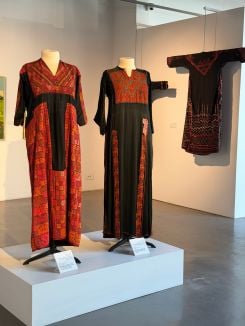
The works on display were lent by collectors Nayla Bustros, Saleh Barakat, Rami al-Nemr, and Jihad Kawas, but above all by Heike Weber. "Much of the collection and research presented in this exhibition stems from her work. Founder of the Anat Center in Damascus, both a workshop and a research institute, she published her findings in a book entitled 'Anat and Her Hero Baal: The Language of Embroidery Motifs in the Levant,'" notes artist and art critic Faysal Sultan.
From sacred geometry to architecture
The textiles on display convey universal themes through triangles, diamonds, palm trees, stars and the Tree of Life, all evoking the eternal cycles of time. The triangle, for example, serves as an allegory of temporal cycles — days, months and seasons — with lunar cycles acting as the principal chronological reference and the great clockmaker behind these woven works.
The Tree of Life, reaching toward the heavens, symbolizes fertility and continuity, while zigzags and waves represent the flow of creation, decline, and renewal. An illustration depicting the blazing sun god Shamash, featured in the wall paintings of the palace of Mari during the reign of Zimri-Lim (1775-1761 B.C.), evokes the link between earthly order and the cosmic system.
For German prehistorian Marie E. P. König (1899-1988), known for her work on Paleolithic symbolism, the geometric zigzag-and-triangle motif, known in Arabic as tishreefa, originated in the sixth millennium B.C. Mesopotamia and later gave rise to the Phoenician letter mem, associated with water. The related motif of the seven-step staircase evokes the struggle of the goddess Anat, deity of war and fertility.
According to Sultan, this sacred geometry, symbolizing the passage between sky and earth, has left a lasting imprint on Levantine art, from the monumental architecture of the Temple of Bel in Syria and the great altar of Faqra in Kesrouan to the 19th-century houses of Beirut and the decorations of churches and mosques.
Mythological art, anthropological exploration, and the symbolic roots of embroidery are clearly explained through display panels that provide visitors with the necessary historical and technical context. A catalog has also been published for the occasion.
The exhibition runs through the end of June.