





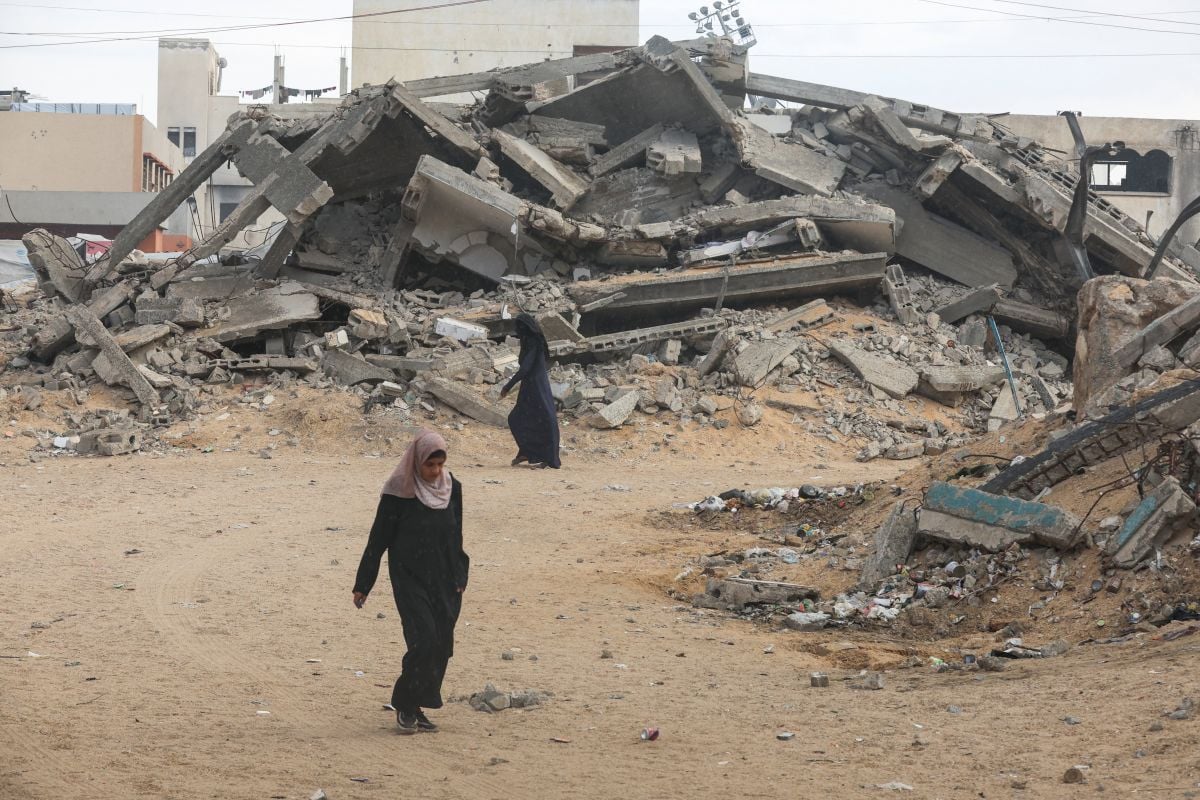
Palestinian women walking near rubble in Khan Younis, in the southern Gaza Strip, on Oct. 9, 2025. (Credit: Ramadan Abed/Reuters)






Arab media have unanimously welcomed the cease-fire agreement in Gaza reached on Wednesday night between Israel and Hamas. While some outlets merely relayed reactions to the accord — which still requires approval Thursday night by the Israeli government — others are already discussing the new balances it could shape in the region.
Israel
In Israel, Haaretz reported the joy of families of hostages held in Gaza since Oct. 7, 2023, as well as that of Gazans rejoicing over the prospect of "returning home and rebuilding their lives." The left-leaning daily, however, highlighted internal divisions over U.S. President Donald Trump’s peace plan, noting that far-right Israeli Finance Minister Bezalel Smotrich and his party will not support it.
On the right, The Times of Israel focused mainly on international reactions and those of the hostages’ families, while omitting those of Gazans.
The Jerusalem Post explained that Israel is entering "a new geopolitical arena [...] with the signing of the Gaza agreement, evolving situations in Syria and Lebanon with Hezbollah, the recent operation in Iran, and simultaneous developments in Europe and Asia."
For the right-wing daily, "Israel now faces an operational, political, and economic reality that demands a fundamental strategic overhaul." Another article argued that the end of the war could "reshape the Middle East and expand the Abraham Accords [which normalized diplomatic relations between Israel and several Arab states], which have withstood the test of war."

Palestine, Qatar, Iran, Egypt
On the Palestinian side, the WAFA agency relayed the reaction of Palestinian Authority President Mahmoud Abbas, who hopes the agreement will lead to the creation of a Palestinian state. Qatari outlet Al-Jazeera highlighted "hope after years of death and devastation," describing scenes of jubilation in the enclave.
In Iran, official national agency IRNA simply confirmed the agreement, noting that the "non-negotiable demands [of Hamas] had been met," while Tasnim agency, close to the Revolutionary Guards, emphasized the role of the Qatari mediator.
Egypt’s official Middle East News Agency and Egypt Today, which follow the government line, reported on the agreement and international reactions, highlighting the roles of Egypt, Qatar and Turkey.
In Turkey, Anadolu Agency, closely aligned with the regime, said President Recep Erdogan will closely monitor the implementation of the agreement.
Hurriyet Daily News, historically critical of the government but more cautious since its acquisition by a group close to the administration, reminded readers that Foreign Minister Hakan Fidan will participate Thursday in the Paris meeting on Gaza to discuss the "post-war" period.
Saudi Arabia, Syria, Yemen
In Saudi Arabia, Al-Sharq al-Awsat said "the region seems to be on the brink of an exceptional turning point," quoting American generals who mentioned a "radical change in the balance of power in the Middle East."
Al-Arabiya asked: "The president of peace... Will Trump’s wish come true and will he win the Nobel Prize?" referring to a White House post on X awarding it to him after the announcement of the agreement, with the Nobel ceremony expected Friday in Oslo.
In Jordan, official agency Petra, as well as The Jordan Times and Jordan News, reported the government’s satisfaction with the cease-fire.
In Syria, official agency SANA simply reported the conclusion of the agreement, as did the Qatari and Iraqi press. Yemeni agency Saba Press also reported Hamas' statement, without further comment.

 Evening recap: Netanyahu announces West Bank offensive; 7 killed in Jordan church shooting; tents burned in south Lebanon
 US strike on Iran this weekend? ‘Absolutely,’ says Barrack; ‘I have no idea,’ says Trump