





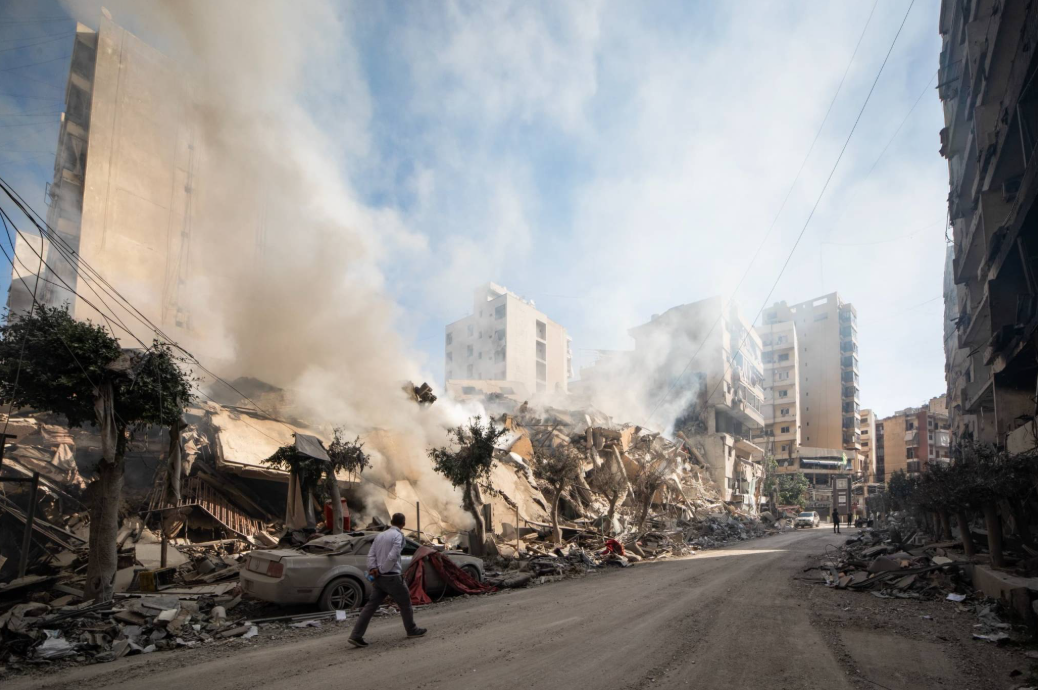
Smoke rises from the site of Israeli strike on the southern suburbs of Beirut during the war between Israel and Hezbollah in the fall of 2024. (Credit: Mohammad Yassin/L'Orient Today)






BEIRUT — Over the past few months, Lebanese authorities have arrested 32 people found guilty or suspected of passing information to Israel aimed at targeting Hezbollah leaders, a judicial official told AFP on Wednesday.
Before launching a two-month open war against Hezbollah, Israel’s Mossad intelligence agency carried out an unprecedented attack in September 2024 using explosive pagers against members of the party. According to Lebanese authorities, the operation killed 39 people and wounded thousands, temporarily paralyzing Hezbollah’s communication network.
The judicial official, who requested anonymity, said “at least 32 people were arrested on suspicion of collaborating with Israel, including six before the cease-fire” between Hezbollah and the Israeli army on Nov. 27, 2024. As Lebanon and Israel are officially at war, any contact with the enemy is punishable by imprisonment.
During questioning, some suspects admitted to “providing information to Israel during the war,” the official said. Hezbollah leader Hassan Nasrallah himself was killed on Sept. 27, 2024, in a dramatic Israeli airstrike targeting a highly secret underground bunker in the southern suburbs.
A Hezbollah singer
Among those arrested is a singer close to Hezbollah, accused of “collaborating with Mossad in exchange for money,” according to another official.
The man allegedly provided coordinates that led to the killing of a Hezbollah official and his son in an Israeli airstrike in April 2025, several months after the cease-fire took effect. He also reportedly shared the names of new Hezbollah officials appointed to replace those killed during the war, helping facilitate their assassination, the same source said.
“Nine people have been tried before the military court,” the official added, “including two sentenced to eight and seven years of hard labor.”
They were found guilty of “providing the enemy with coordinates, addresses, and names of Hezbollah officials, later used in strikes.” The remaining 23 are still under investigation.
A security official said interrogations revealed that Israel sought to identify the types of vehicles used by Hezbollah members, likely to help guide drone strikes, which remain frequent despite the cease-fire.
High-profile espionage cases
One alleged espionage case made headlines last September. Mohieddine Hassaneh, who had been sentenced by a military court to 15 years in prison for “spying for Israel,” was released by the Military Court of Cassation on Aug. 28, 2025, after serving 22 months.
Two weeks later, he appeared on Lebanon’s Al Jadeed TV to share his version of events, saying he had been acquitted of collaborating with Israel. He said the court only upheld “a sentence equal to the time already served for operating without a license,” referring to his work for an American company.
The telecommunications engineer had been arrested on Dec. 14, 2023, by Parliament Speaker Nabih Berri’s guards at Ain al-Tineh, a little over two months after the Israel-Hezbollah conflict began.
Some local media outlets close to Hezbollah, as well as social media users who labeled him a “spy,” accused Hassaneh of having paved the way for Israel’s deadly pager attack.

In January 2025, four Lebanese nationals accused of working for Israeli intelligence — three from southern Lebanon and one from the Bekaa — were arrested.
Mohanad Hajj Ali, a researcher at the Carnegie Middle East Center, said at the time that “Hezbollah was heavily infiltrated and was only beginning to grasp the extent of it.” He added that “some Hezbollah officials were also arrested on suspicion of collaboration.”
In October 2024, a man with dual American and Israeli citizenship, Joshua Samuel Tartakovsky, was arrested in Beirut’s southern suburbs. Handed over to army intelligence, he was later expelled, according to two Lebanese judicial and security officials.
The man claimed to be “a supporter of Hezbollah and Gaza” who wanted to inform the party “about Israeli army tactics.”
In September of the same year, a former Hezbollah fighter and nurse who worked at Rassoul al-Azam Hospital in Beirut’s southern suburbs was arrested on suspicion of spying for Israel.
According to the pro-Hezbollah daily Al Akhbar, the nurse provided “his Israeli employers with security information, photos, and coordinates before being arrested by the Internal Security Forces on Feb. 20 in Kharayeb, a village in the district of Saida in southern Lebanon.”