


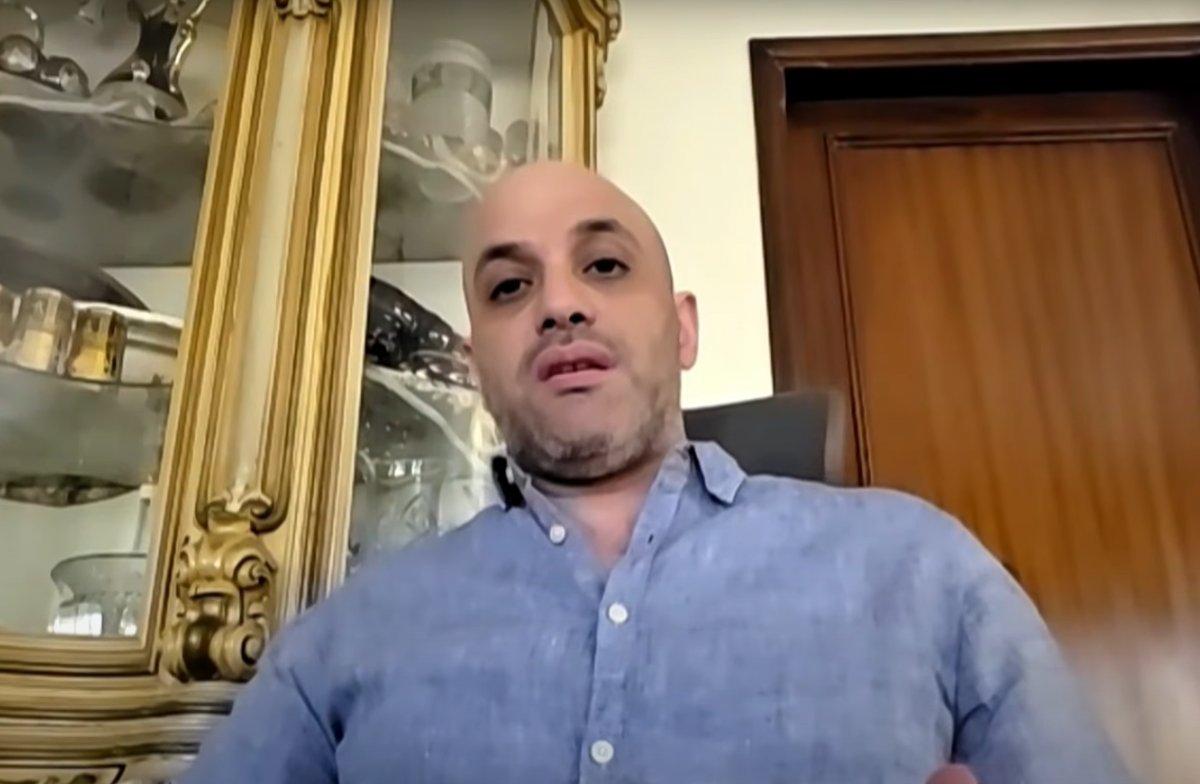
The Lebanese Mohieddine Hassaneh during his interview on al-Jadeed, Sept. 10, 2025. (Credit: Screenshot/al-Jadeed)






Two weeks after his release, Mohieddine Hassaneh broke his silence Wednesday in an interview on Lebanese channel al-Jadeed. The telecommunications engineer had been sentenced by a military court to 15 years in prison for “spying for Israel” but was freed on Aug. 28 by the military Court of Cassation after 22 months in detention.
Hassaneh was arrested Dec. 14, 2023, by guards of Parliament Speaker Nabih Berri at Ain al-Tineh, just over two months after Hezbollah opened the support front with Gaza, marking the start of the latest war with Israel.
In the interview, Hassaneh denied political interference in his case, saying he was acquitted of collaboration with Israel. The court, he said, only upheld a sentence equal to time already served for working without a license, tied to his employment with an American company. He insisted he had proven his innocence by showing the company’s existence, though he declined to name it.

Work and photos
Hassaneh said his work involved installing 360-degree cameras on vehicles to collect images and radio frequency data for “smart city projects.” He claimed the job covered Lebanon and other countries, including Egypt, Turkey and Saudi Arabia.
Al-Modon reported that Hassaneh and his colleagues took more than 350,000 photos of Lebanon, including Beirut’s southern suburbs and Ain al-Tineh, the parliament speaker’s residence.
Hassaneh told al-Jadeed the American company had ordered them to avoid sensitive areas and said the images were taken “in broad daylight, from 8 a.m. to 3 p.m.” He also denied entering the southern suburbs.
Hezbollah’s accusations
Following his release, Hezbollah’s al-Manar channel alleged Hassaneh had equipment capable of locating Wi-Fi users, intercepting walkie-talkie and pager communications, and retrieving passwords.
Hassaneh rejected the claim, saying the gear was commercially available and used by large firms “to enhance their networks.”
No link to pager attack
Some Lebanese media and social media users accused Hassaneh of facilitating Israel’s Sept. 17, 2024, pager attack in Lebanon, which mainly struck Hezbollah circles. Hassaneh denied any role, stressing he was in military custody at the time and “never transmitted any data that could have led to it.”
The interview sparked backlash. Al-Akhbar journalist Radwan Mortada urged victims of the pager attack, their families, and Hezbollah leadership to file legal action against Hassaneh, claiming he had transmitted pager frequency data to his operator.
Other pro-Hezbollah journalists, including Hassan Ollaik from al-Akhbar and Fatima Ftouni from al-Mayadeen, echoed the call.
Hezbollah officials have since acknowledged internal security failures that allowed Israel to smuggle in rigged pagers.

 The 7 p.m. recap: Houthis advance, government announces counteroffensive; Iran raises stakes; Israeli shells hit close to journalists in south Lebanon
 2 Israeli soldiers injured in 'operational accident,' as army continues attacks in the South