


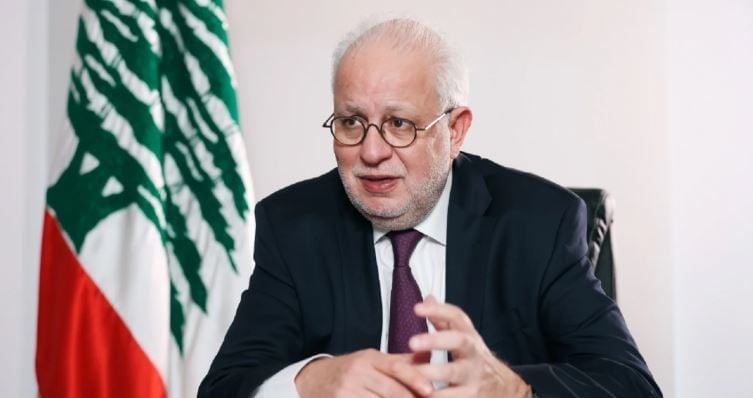
Justice Minister Adel Nassar. (Credit: National News Agency)






A meeting lasting over three hours took place on Monday between Justice Minister Adel Nassar and the Notaries' Council, represented by its president, Naji al-Khazen, along with five of its eight members. The purpose was to clarify a circular issued by Nassar on Friday.
The circular sparked intense debate within the notarial profession and the media. It creates a stronger framework for fighting money laundering and terrorist financing, requiring notaries to verify the identities of parties involved in transactions more thoroughly, as well as the beneficial owners and the source of funds, while also ensuring their clients are not subject to national or international sanctions.
Among the criticisms circulating, the minister was accused of "wanting to turn notaries into intelligence agents tasked with collecting information on their clients, even though they do not have the logistical means necessary for this mission."

At a conference held Saturday at Saint Joseph University, Nassar defended his circular, stressing that "this step is crucial if Lebanon wants to remain connected to the global financial system." "Lebanon cannot remain isolated from the world; we must accept the principles of transparency because the greater national interest requires it," he insisted.
In a context where corruption is often enabled by fake powers of attorney, registering property through shell companies and nominees, and using funds from illegal activities like drug trafficking, which allow individuals under national and international sanctions to transfer assets while bypassing control mechanisms, this circular is part of Lebanon’s efforts to meet the requirements of the Financial Action Task Force (FATF).
In October 2023, this body placed the country on its gray list, which tracks countries that do not sufficiently fight financial crime.

When asked by L’Orient-Le Jour about the details and results of the Monday meeting with the minister, Khazen noted that the latter "has the legal prerogative to issue circulars to guide notaries in the exercise of their functions," adding that "he is not required to consult the Notaries' Council in advance."
He nevertheless regretted that such a consultation did not take place, especially since "the subject is very sensitive and far-reaching."
"It was precisely the need for coordination and clarification of the mechanism for implementing the circular that prompted the meeting," Khazen continued, emphasizing that "it addressed several questions, especially regarding the procedures for checking whether a client is on a sanctions list, tracing the origin of funds and identifying the real beneficial owner of a transaction."

Outcomes in four points
The president of the Notaries' Council indicated that the meeting with the minister clarified four points:
1) The verification requirement only concerns financial transactions, excluding acts related to civil status (marriage, personal status, etc.) or election candidacies. In these cases, strict checks are not required, especially since this responsibility falls to the Interior Ministry.
2) Notaries will be provided with a link to lists established by the Internal Security Forces to check the names of individuals wanted by the justice system.
3) Notaries must check the origin of funds used in transactions "to the extent of the means available to each."
4) Clients will have to fill out detailed official forms in which they declare, "under their responsibility," the identities of the actual beneficial owners. Until now, notaries had to certify signatures without being obliged to verify the truthfulness of their clients’ declarations.
Khazen noted that a 2015 law already required notaries to play "an active role in improving the economic and financial system." He said that in cases of suspected illicit transactions, this law requires them to report confidentially to the Special Investigation Commission under the Central Bank of Lebanon, which is empowered to carry out investigations "thanks to the means at its disposal."
He finally indicated that another meeting with the justice minister would be held "in the coming days," particularly about the project to electronically connect notaries to the records of the Finance Ministry, as part of "enhancing technology in the service of the profession" — a project that is not yet finalized.
This article was translated from L'Orient-Le Jour.


 7 p.m. recap: Houthis strike Riyadh airport again; Yemeni forces claim Bab al-Mandeb gains; Abbas postpones Palestinian polls