


The UEFA logo at the organization's headquarters in Nyon, Switzerland. (Credit: Denis Balibouse/Reuters)






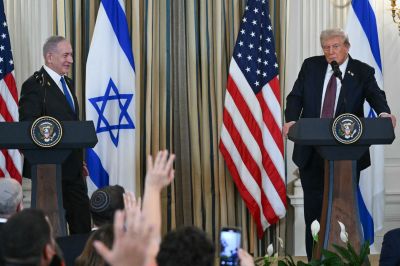
The emergence of U.S. President Donald Trump's plan at the end of September — two years after the start of Israel's devastating war in the Gaza Strip — cut short an unprecedented initiative to suspend the Israeli federation from the Union of European Football Associations (UEFA).
It took four days for Russia to see its national and club football teams banned from international football after it invaded Ukraine in 2022, and Israel was about to meet a similar fate.
However, the move, orchestrated by the American president, was swiftly seized upon by the highest levels of global football to postpone any decision on this thorny issue.
While a UEFA executive committee vote, which was supposed to decide the future of the Israeli football federation, was due to take place last week, it was postponed because it coincided with a diplomatic breakthrough aimed at securing a cease-fire in the Palestinian enclave, as revealed by The Times.
The British publication reported that a "large majority" of the 20 committee members were ready to vote in favor of exclusion. "Everything was put on hold by Trump's initiative," confirmed a source in an UEFA member federation to L’Orient-Le Jour on condition of anonymity.
"Discussions on the subject were on the committee meeting's agenda, but the meeting ultimately did not take place," the source continued, while noting that the issue could resurface "if the war in Gaza continues," at a time when the Israeli war was recently called a genocide by a UN-appointed commission of inquiry. UEFA did not respond to repeated requests for comment.
Russian precedent becomes 'hard to bear'
If not yet definitively buried, the initiative appears to have been shelved indefinitely by Aleksander Čeferin's superior, the UEFA president.
Following a FIFA Council meeting on Oct. 2 in Zurich, Switzerland, FIFA president Gianni Infantino stated that "FIFA cannot solve the world's geopolitical problems," while also highlighting "the importance of promoting peace and unity, particularly in the context of the current situation in Gaza," without directly referencing Israel.
"UEFA and FIFA are rather put out to have to talk politics and consider excluding Israel while the next World Cup is only months away in the United States," says Raphael Le Magoariec, a geopolitical analyst specializing in Gulf countries' sports policies.

"The precedent set by the Russia case and ensuing accusations of double standards are increasingly hard for public opinion to swallow. But it's only under internal pressure from their members that these bodies end up acting," he adds.
A member of UEFA since 1994, after being excluded 20 years earlier from the Asian Football Confederation (AFC), Israel has recently faced unprecedented pressure on the international sporting stage.
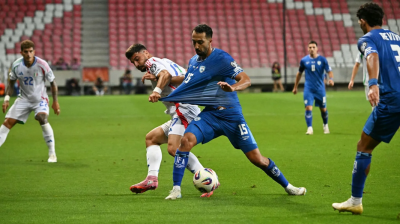
In the wake of protests against the Israel Premier-Tech cycling team's participation in the Tour of Spain, and at the EuroBasket in Poland, there have been mounting calls to boycott competitions involving Israeli teams, even as the Israeli national team will play for a spot in the next World Cup (United States, Canada, Mexico) next week against Norway and Italy.
Nearly a year after incidents involving Maccabi Tel-Aviv fans, Amsterdam's city council announced the Israeli club, playing this season in the Europa League (C3), was "not welcome" in the Dutch capital.
Yet, before UEFA's reversal, events accelerated in just a few days after the Turkish federation, also a member of the European confederation, requested the convening of an exceptional meeting.
The initiative was publicly supported on Sept. 26 by a letter signed by its president, Ibrahim Haciosmanoglu, and sent to counterparts worldwide.
"The time has come for FIFA and UEFA to act ... We feel compelled to express our deep concern at the illegal [and above all totally inhumane and unacceptable] situation enacted by the State of Israel in Gaza and its surroundings," he wrote.
"It should not be forgotten that, in Turkey, sports structures are closely tied to the political sphere and to [Recep Tayyip] Erdogan, who has made sport one of the pillars of his policy. On the other side, Netanyahu associates are found in numerous key sporting federations," adds Le Magoariec.
'898 athletes, including 416 footballers,' killed by the Israeli army
Such a move could not have occurred without the support of another key player in the football world, Qatar. Host of the 2022 World Cup and owner of Paris Saint-Germain, Qatar also pulled strings at UEFA to put pressure on Israel. An escalation was seen after the Israeli strike on Doha on Sept. 9 targeting Hamas leaders.
"With influence gained over the past 15 years, Qatar wants to position itself as the only Arab country capable of undermining the Israeli offensive, notably by using its soft power via major influence within football organizations, which far surpasses Israel's," continues the expert, noting that Doha is one of UEFA's main sponsors via "sponsorship and TV rights," largely held by beIN Sports.
"Qatar and Turkey are well aware of the symbolic role of sport for Israelis, invested by the Zionist movement as early as the 1920s-1930s as a tool to affirm national identity. That's why many Israeli athletes, often former conscripts, openly support the Israeli army's Gaza offensive," he explains.
Although not openly announced by the federations, the Turkish-Qatari initiative was reportedly supported by several European countries, including Norway and Spain, according to the source above. Madrid even threatened to boycott the next World Cup if Israel participates.
Meanwhile, a U.N. expert panel and some 50 athletes under the banner of "Athletes 4 Peace" appealed to UEFA in two separate op-eds, accusing it of complicity in Israel's "sportwashing."
They also point to the systematic targeting of Palestinian athletes by the Israeli military, citing the recent killing of footballer Suleiman al-Obeid. Nicknamed the "Palestinian Pelé," the 41-year-old, who had 24 national team caps, was killed in August during a humanitarian aid distribution.
"In total, 898 athletes, including 416 footballers, have been killed by the occupying army since the start of the genocide, plus 150 missing," Palestinian Football Association spokesperson Dima Youssef told L’Orient-Le Jour.
She added, "287 facilities have been totally or partially destroyed" in Gaza and the occupied West Bank. On Sunday, the headquarters of the Palestinian Football Association, a full FIFA member since 1998, was targeted with tear gas, halting activities in the East Jerusalem building.
"This new attack is part of the daily assaults against Palestinian sports. Despite dozens of cases we have filed with FIFA documenting Israeli violations, no concrete measures have been taken. All we are asking is for FIFA to stop its double standards when it comes to Palestine. We still hope it will happen one day, and it will apply the same decisions it took against Russia," she said.
This article was translated from L'Orient-Le Jour.

 7 p.m. recap: 1 person killed near border with Lebanon; 200 kilos of explosives carried by mules; Riyadh shuts its airspace