


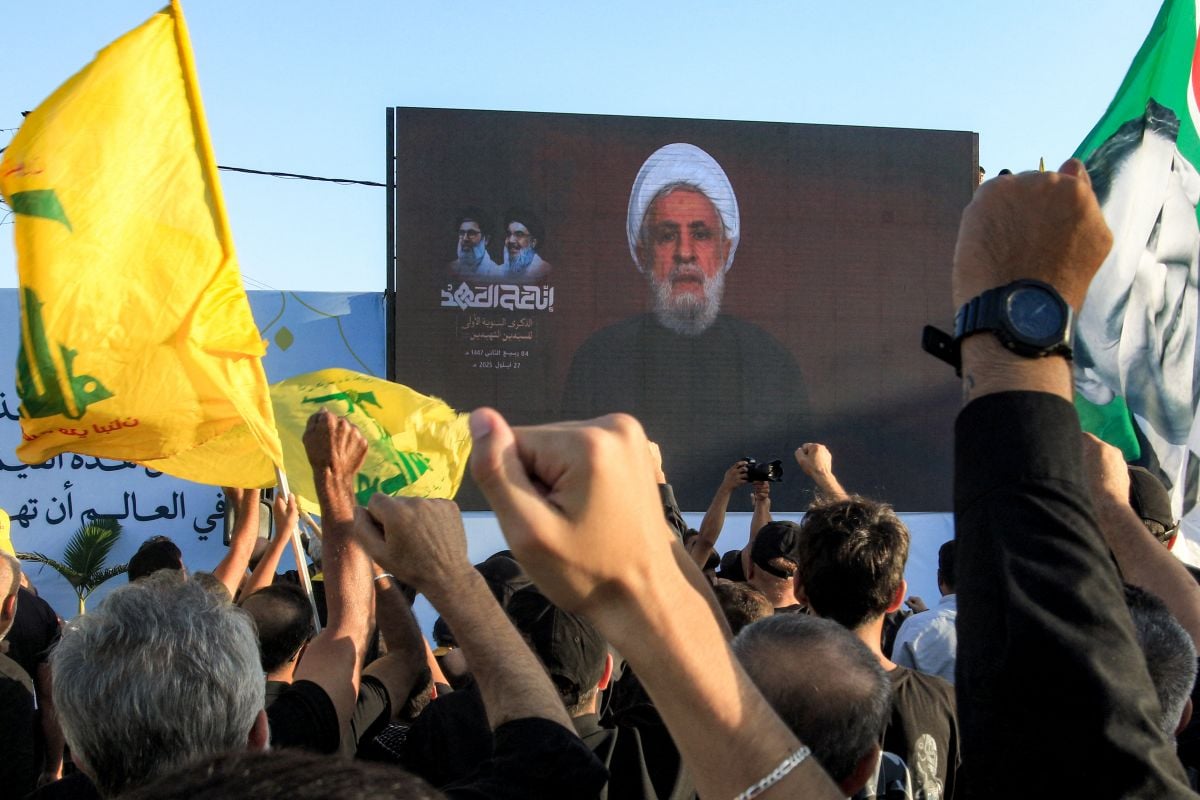
Naim Qassem, current leader of Hezbollah, delivering a speech broadcast on a giant screen during the first anniversary of the assassination of Hassan Nasrallah, in Deir Qanun al-Nahr, near Sour, southern Lebanon, on Sept. 27, 2025. (Credit: Mahmoud Zayyat/AFP)






BEIRUT — Former U.S. Under‑Secretary of State David Schenker warned in an interview with This Is Beirut that a “kind of confrontation” between the Lebanese Army and Hezbollah could occur if the party refuses to comply with the government’s militia disarmament plan.
Schenker, who served under Donald Trump from 2019 to 2021 as under‑secretary for Near Eastern affairs, said he believes a direct clash may be difficult to avoid.
"Certainly, to date, Hebollah has largely cooperated — or collaborated — with the LAF in the South," Schenker said, "But let's say they wont do so in the North? You want to avoid a clash at all costs, but at the same time, there's going to be differences going forward."
"Are they going to open fire on their fellow countrymen, the LAF?" Schenker posited. "At a certain point, it becomes a matter of state sovereignty. The government is going to have to decide."
When asked by interviewer Tylia al-Helou about Hezbollah leader Naim Qassem's comment that Hezbollah would wage the disarmament battle “as the Shiites waged the battle of Karbala,” Schenker replied saying, "I don't think it ended particularly well for those in Karbala."
While the Lebanese Army has around 75,000 personnel, he said, he estimates Hezbollah has about 15,000 fighters. “No body wants to see this kind of clash,” he said. “But if Hezbollah is going to say that they will continue in the service of Iran, that they put their allegiance to Iran above the state of Lebanon, I think that necessarily there will be some sort of confrontation."
Schenker also argued that Hezbollah is preventing the reconstruction of areas of Lebanon destroyed by Israel during the war. The U.S. has stated that foreign aid to Lebanon for the purpose of rehabilitation, is contingent on Hezbollah disarming.
The former American diplomat also expressed hope for “warm and normal relations” between Beirut and Tel Aviv, citing the ongoing rapprochement between Syria and Israel under U.S. oversight as an example.
For context:
Estimating Hezbollah’s true military strength is difficult. In an October 2021 speech, Hezbollah’s leader Hassan Nasrallah claimed the group could mobilize “up to 100,000 fighters,” a figure that raised debate among experts. The group was significantly weakened by losses during the recent war with Israel, which reportedly killed many of its commanders and fighters over 13 months of conflict.
Qassem has repeatedly invoked the specter of civil war to oppose the Lebanese government’s plan to disarm all militias — a policy reaffirmed by President Joseph Aoun during his 2025 inauguration. Aoun himself has acknowledged fears of civil war and expressed a desire to avoid it, while the army submitted its disarmament plan to Cabinet in September.
This article was updated on Oct. 6, 2025, at 20:25 to correct quotes attributed to David Schenker.