






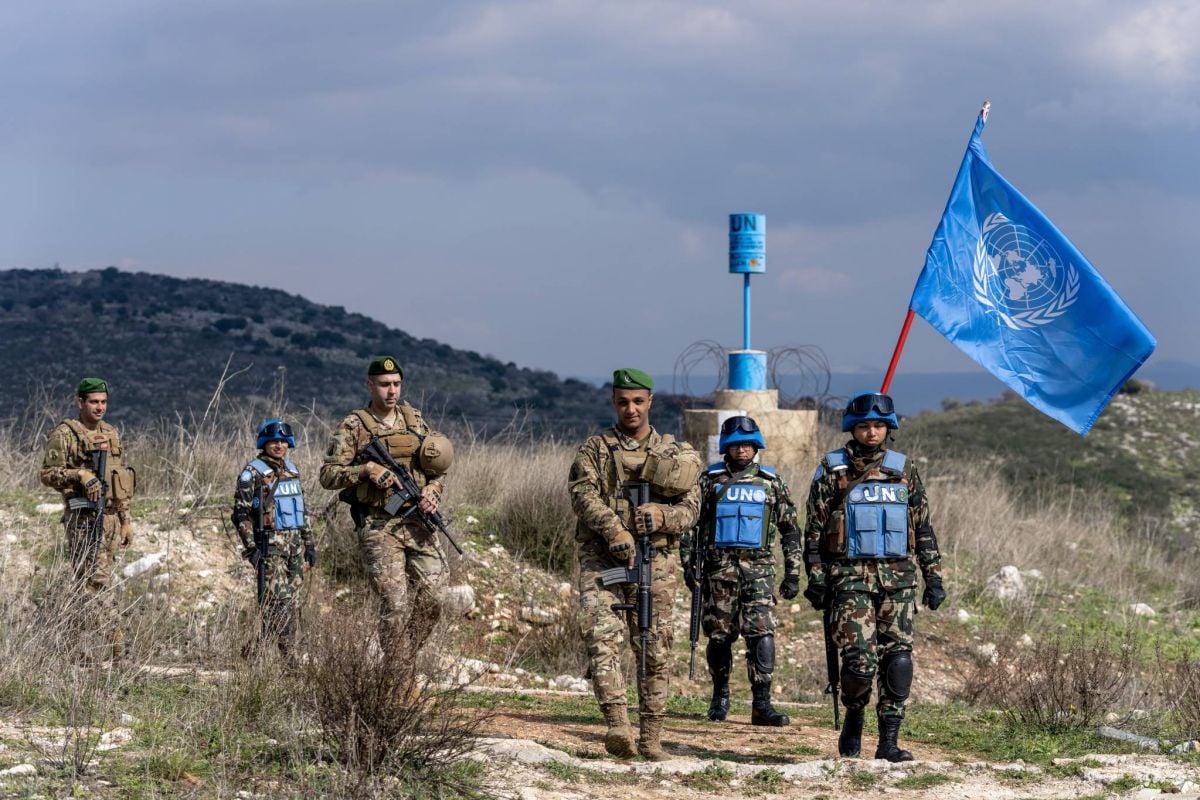
UNIFIL peacekeepers marching with Lebanese Army soldiers along the southern border. (Photo sent to L'Orient Today by UNIFIL)






As Israel continues its violations of the cease-fire agreement in Lebanon, several MPs called last week for the government to file more complaints with international bodies.
Since clashes began in October 2023, when Hezbollah opened a support front for Gaza from southern Lebanon, and until November 2024 when a cease-fire came into effect, the Foreign Affairs Ministry had submitted 66 formal complaints to the United Nations Security Council (UNSC), each accompanied by “identical letters” addressed to both the U.N. Secretary-General and the President of the Security Council, and circulated among all 15 Security Council member states, a source at the ministry told L'Orient Today.

Since the cease-fire came into effect between Hezbollah and Israel, Hezbollah has only attacked Israel once, while Israeli attacks on southern Lebanon continue on a daily basis, and have struck the Bekaa and the southern suburbs of Beirut frequently.
How UN complaints work
Although often mistaken for legal proceedings, complaints submitted to the UNSC are fundamentally political and diplomatic in nature. Their primary purpose is to document incidents, apply pressure and put issues on the international radar.
When a member state files a complaint, it typically does so by submitting a formal letter detailing the alleged violation and requesting that the matter be addressed. It’s then circulated to all 15 members and becomes part of the U.N.’s official record.
Depending on the nature and seriousness of the complaint — and the political will of UNSC members — the council may respond in several ways. This includes convening meetings (either public or closed-door), issuing formal or informal statements, or, in rarer cases, adopting a resolution.
However, most complaints result in no concrete action due to political sensitivities, lack of consensus, or veto threats from the Council’s five permanent members (P5). The U.N. Secretary-General may also refer to complaints in periodic reports to the UNSC, mainly those related to ongoing U.N. mandates like Resolution 1701 (2006).
For smaller or less influential states such as Lebanon, the complaint process is less about securing immediate outcomes and more about gaining diplomatic visibility, creating an official record and signaling ongoing concerns to the international community.
A source at the U.N. Interim Force in Lebanon (UNIFIL) told L’Orient Today that "the peacekeeping mission is not consulted before the letters are sent and has no direct involvement in the complaints process."
'Blatant violation of the cease-fire'
Fadi Alameh, head of the Parliamentary Foreign Affairs committee, told L'Orient Today on Wednesday that the "ambassadors of countries overseeing the [cease-fire] agreement have repeatedly encouraged us to submit complaints against Israel. But these complaints won't change the course of Israel's attacks against Lebanon, but they matter to public opinion."
A source within the committee told L'Orient Today that the MPs are split. Some view the condemnations by President Joseph Aoun and Prime Minister Nawaf Salam against Israel as enough without the need for a complaint to the UNSC, while others insist on their importance.
“We haven’t submitted complaints because what’s happening is a blatant violation of the cease-fire; both sides shouldn’t be firing against one another, and that is clear,” the foreign ministry’s source stated.
In November 2021, the U.N. General Assembly adopted a resolution acknowledging that $856.4 million in damage was caused by an Israeli oil spill in the 2006 war against Lebanon, when Israeli jets hit a power station, releasing approximately 15,000 tons of oil into the eastern Mediterranean Sea.
Lebanon had immediately filed a complaint against Israel to the UNSC in 2006. The 2021 resolution called on Israel to take responsibility and compensate Lebanon and Syria, whose coastlines were partially polluted. Israel has not compensated Lebanon or Syria to this day.

 1 p.m. recap: Qatari PM expected in Beirut; missile intercepted in Medina; Hezbollah seeks to recover its explosives seized in Dahr al-Baidar