


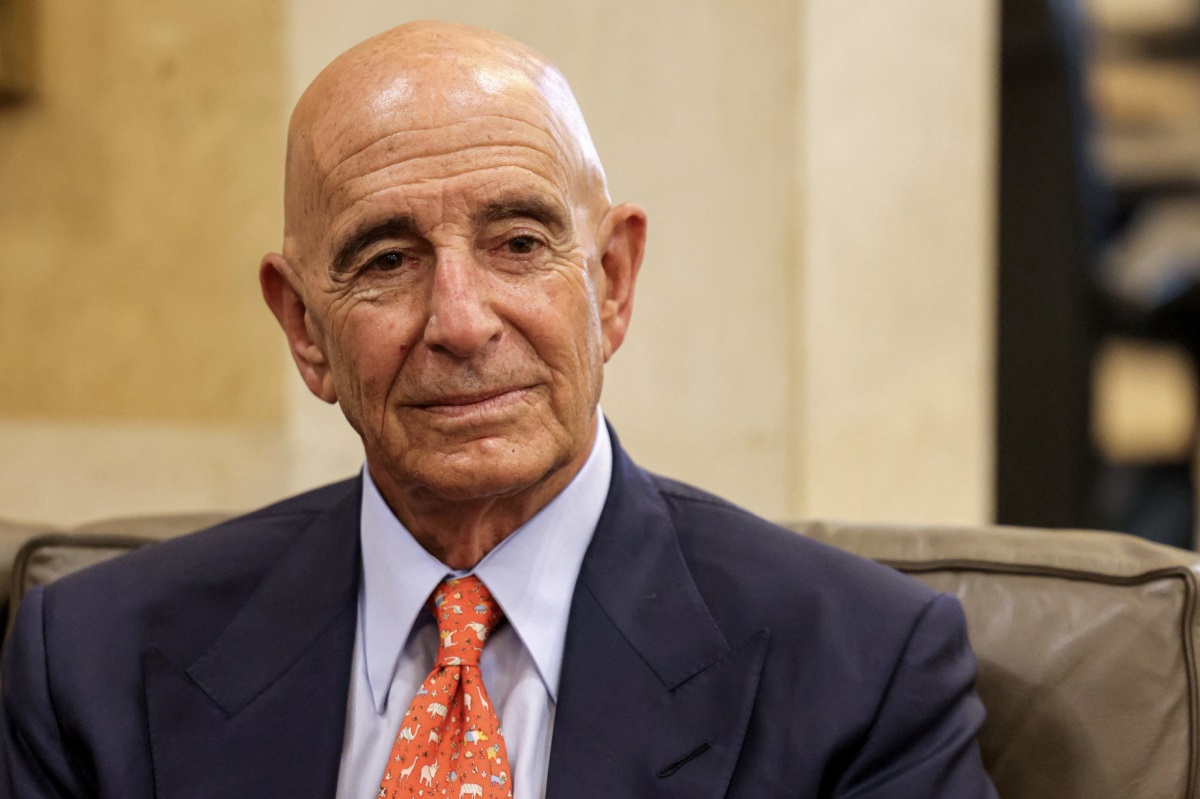
U.S. Special Envoy for Syria Tom Barrack during his meeting with Prime Minister Nawaf Salam at the government palace in Beirut, on June 19, 2025. (Credit: Anwar Amro/AFP)






Tom Barrack, the U.S. ambassador to Turkey and special envoy to Syria, said Monday in an interview with Sky News Arabia that "the situation in Lebanon is very difficult," also warning that Israeli Prime Minister Benjamin Netanyahu "does not care about borders or red lines."
"The situation in Lebanon is very difficult, but we have a good team in power," the U.S. envoy told Sky News Arabia, referring to President Joseph Aoun, elected in January after two years of vacancy at the head of state, and to Nawaf Salam's government, formed in February. Israeli Prime Minister Benjamin Netanyahu "does not care about borders or red lines. He would go anywhere and do whatever he deemed necessary if he felt Israel was threatened," he added.
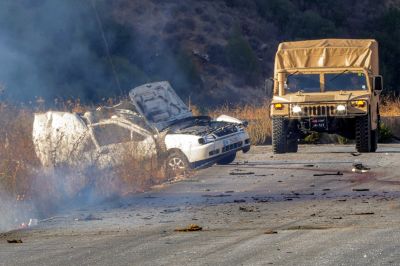
"The Lebanese government must declare clearly that it wants to disarm Hezbollah," insisted the American diplomat, noting that "the Lebanese Army is well organized but not yet sufficiently equipped." He observed that "Lebanon fears the disarmament of Hezbollah due to what it considers risks of civil war," saying he was convinced that "everything Lebanon does boils down to talk but no tangible action."
According to Barrack, "Hezbollah is regrouping, contrary to what people in Lebanon may think, and the Lebanese government must take responsibility," claiming that "this party has received as much as $60 million per month from unknown sources lately." Hezbollah emerged considerably weakened from the most recent war with Israel in 2023-2024, having lost its main leaders and supply channels through Syria, whose regime under Bashar al-Assad was toppled in December 2024.
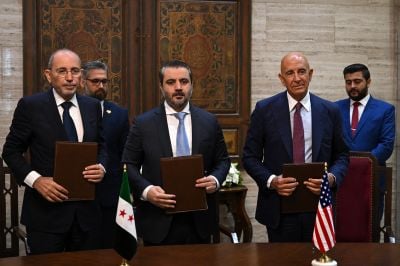
"Hezbollah is our enemy, and Iran is our enemy; we must cut off the heads of these snakes and prevent them from receiving funding," he said. "We will not intervene to confront Hezbollah, whether through our troops or via U.S. Central Command [in the region]," he clarified. Regarding the Israeli presence in southern Lebanon, the American envoy affirmed that the Israeli army "will not withdraw from the five positions occupied on Lebanese territory."
Following the war between Hezbollah and Israel in 2024, the country remains waiting for the reconstruction of vast areas destroyed during the conflict in southern Lebanon, in the Bekaa, and the southern suburb of Beirut, all against a backdrop of a severe economic and financial crisis since 2019.

The question of Hezbollah's disarmament, demanded by the international community and especially the United States — which is now the subject of a Cabinet decision (to disarm all militias and grant the state a monopoly on arms, taken Aug. 5, 2025) — continues to provoke controversy, with the party so far refusing to give up its weapons voluntarily.
Trump has plan for Gaza
Barrack also answered a question about Qatar, which is sponsoring negotiations between Hamas and Israel toward a cease-fire in Gaza. Doha, its capital, was the unexpected target of an Israeli strike on Sept. 9, as part of an assassination attempt on senior Hamas political leaders who were to gather there.
The attempt failed, but the strike prompted outraged reactions from the whole Arab world, in an extraordinary Arab-Islamic summit held in Doha on Sept. 15. "Qatar hosted Hamas and the Taliban [of Afghanistan] at the request of the United States," Barrack specified.
The American envoy was pessimistic regarding peace prospects in the region, saying, "There has never been peace and there probably never will be because neither side will agree to submit to the other."
On Gaza, the American envoy to Syria said, however, that "efforts to reach a cease-fire will not succeed." "I think the recognition of a Palestinian state [by many countries during the latest U.N. General Assembly, currently underway in New York] is a good thing, but it has no real impact," he added. He also indicated that U.S. President Donald Trump "has a plan regarding Gaza and that he is seeking to end this situation."
The Gaza War has lasted for nearly two years. Sparked by a large Hamas operation on Oct. 7, 2023, against Israel, it has mainly affected the civilian population of Gaza, who pay the price each day, whether due to massive Israeli army bombings or famine, following the Israeli blockade.
This article was translated from L'Orient-Le Jour.
 7 p.m. recap: Riyadh under Houthi fire; 'Look what Hezbollah is doing to us,' the anger of a southern suburb resident; 1.5 more hours of electricity in Lebanon?