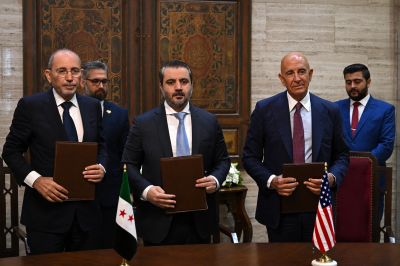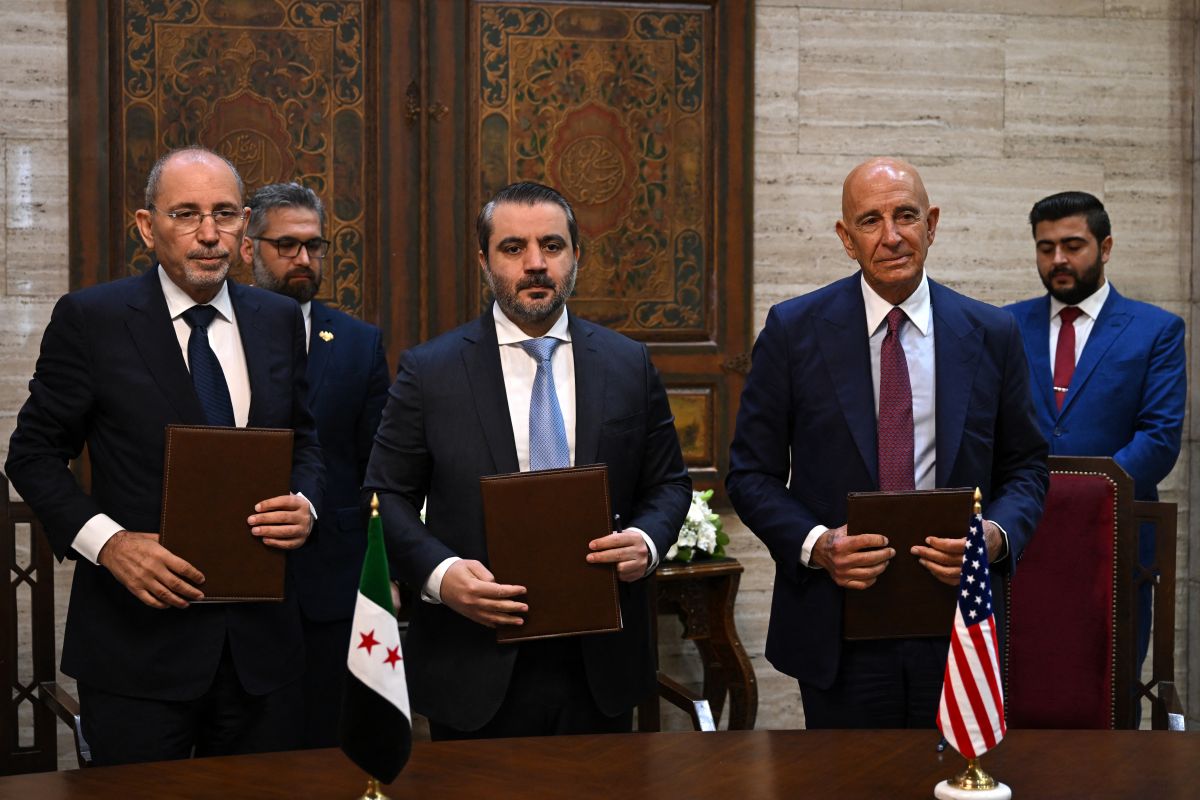
(From left to right) Jordanian Foreign Minister Ayman Safadi, Syrian Foreign Minister Asaad al-Shibani, and U.S. Special Envoy for Syria Tom Barrack pose for a photo after signing an agreement in Damascus on Sep. 16, 2025. (Credit: Louai Beshar / AFP)






U.S. envoy to Syria Tom Barrack said he is “hopeful” about the adoption by Congress of a resolution to repeal the Caesar Act, emphasizing “the need to follow President Donald Trump’s recommendations, give them a chance, and lift sanctions” against Syria.
The U.S. Caesar Act, which came into effect in 2020, provides Washington with a framework to impose sanctions on anyone cooperating with the Syrian regime of former President Bashar al-Assad, who was ousted last Dec. 8 by an Islamist-led coalition under Ahmad al-Sharaa.
On Thursday, Barrack told the American newspaper The Hill that “the situation with the Caesar Act is complex, but it allows for economic activity to resume.” He added, “There is a lot of attention and accountability. Syria is performing well in implementing what we requested in terms of accountability, and I am optimistic,” speaking on the sidelines of Syrian Foreign Minister Assaad al-Shibani’s visit to Washington, the first official visit by a Syrian official to the U.S. in 25 years.

Shibani had previously traveled to the United States to attend meetings at the World Bank and the International Monetary Fund, but without meeting any U.S. officials. His visit came about four months after a meeting between U.S. President Donald Trump and Syrian President Ahmad al-Sharaa in Saudi Arabia. At that time, President Trump called for a full lifting of sanctions, granting Damascus a temporary six-month exemption under the Caesar Act. Supporters of the White House incumbent in Congress are pushing for a permanent lifting of the sanctions, arguing that it is a necessary condition to pave the way for reconstruction and long-term investment.
Assaad al-Shibani met with several Republican and Democratic lawmakers while Congress debates the fate of the sanctions imposed under the “Caesar Civilian Protection Act of Syria.”
Proponents of lifting the sanctions argue that the law is now outdated, as it was originally designed to hold the Assad regime accountable for large-scale crimes, such as killings, torture, enforced disappearances and the use of chemical weapons, according to the Lebanese site Al Modon, which commented on the interview. They believe that maintaining sanctions hinders investment and reconstruction and that temporary measures, such as presidential waivers, are insufficient. Conversely, opponents of lifting the sanctions warn against a “lax approach” toward Damascus, noting that President al-Sharaa has a controversial past, including links to extremist groups and the severe ethnic violence that has recently shaken the country.
The issue of Syria-Israel relations was also addressed during the talks in Washington. Axios reported that before arriving in the U.S. capital, Shibani had met with Israeli Minister of Strategic Affairs Ron Dermer, who proposed a security agreement between the two countries. Israel’s requests include the creation of an expanded buffer zone along the border, restrictions on the Syrian army’s armament in the south, and an air exclusion zone stretching from southwestern Damascus to the occupied Golan Heights.