





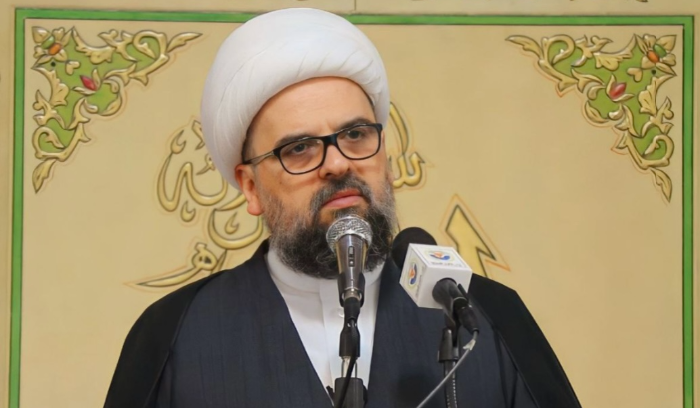
The mufti Ahmad Kabalan. (Credit: NNA)






BEIRUT — Jaafari Mufti Ahmad Qabalan on Sunday called for the establishment of a "national, protective, responsible, and diligent government," as well as the creation of a "national crisis cell to protect the 'Lebanese entity' from internal divisions and external threats."
These statements come amid a tense political climate, since the Salam government adopted the goals of the American road map calling for the disarmament of Hezbollah.
"The solution lies in a national, protective, responsible, and diligent government, capable of ensuring Lebanon's ability to overcome the most dangerous phase of its existence," said the mufti, a close ally of Hezbollah, in a statement.
"Nothing is more urgent than the creation of a national crisis cell to protect the 'Lebanese entity' from internal divisions and external threats. The government, just like the opposition, is required to provide responses proportionate to the existential catastrophes and to the strategic threat facing Lebanon and the region. In this regard, Israel represents an existential threat," he continued.
"The government cannot be a political adversary, otherwise, Lebanon would be finished. The deadly crises shaking the country must be overcome, at the heart of a region plagued by divisions and projects aiming to fuel sectarian, ethnic, and communal tensions," Qabalan said.
Since the decision to grant the state a monopoly on arms, made by the Council of Ministers at its meeting on Aug. 5, Prime Minister Nawaf Salam has faced a smear campaign from Hezbollah and its popular base, who accuse him of stoking tensions.
Hezbollah party continues to reject disarmament.
Despite a cease-fire established on Nov. 27, 2024, Israel continues to strike Hezbollah targets almost daily while occupying several strategic points in southern Lebanon.
Qabalan also called for a "national mobilization to address the country's problems under a state of emergency, without which no national vision for rescue and solidarity will allow Lebanon to survive, especially since the country is trapped in a spiral of crises that threaten its value and its identity function, in a context of financial, economic, and sovereign hemorrhage."
"What we are experiencing now is not a threat to internal legitimacy, but to the very existence of the entity," he added.
Kabalan calls for a "protective, responsible, and diligent" government
Jaafari Mufti Ahmad Kabalan on Sunday called for the formation of a “national, protective, responsible, and diligent” government, along with the creation of a “national crisis cell to shield the Lebanese entity from internal divisions and external threats.” His remarks come amid heightened political tensions following the Salam government’s adoption of the U.S. roadmap, which includes a call for Hezbollah’s disarmament.
“The solution lies in a protective, responsible, and diligent national government capable of enabling Lebanon to overcome the most dangerous phase in its existence,” said the mufti, a Hezbollah ally, in a statement. “There is nothing more urgent than forming a national crisis cell to shield the Lebanese entity from internal fragmentation and external threats. Both the government and the opposition must rise to the level of existential disasters and the strategic threat Lebanon and the region face. Israel, in this regard, is an existential threat.”
“The government cannot act as a political adversary — otherwise, Lebanon is finished. The country must overcome deadly crises at a time when the region is plagued by division and agendas aimed at fueling sectarian, ethnic, and communal tensions,” Kabalan continued.
Since the Cabinet’s Aug. 5 decision to enshrine the state’s monopoly on arms, Prime Minister Nawaf Salam has come under attack from Hezbollah and its popular base, who accuse him of stoking tensions. The Iran-backed Shiite party continues to reject disarmament.
Despite a cease-fire established on Nov. 27, 2024, Israel continues to strike Hezbollah targets almost daily, while maintaining positions in several strategic points in South Lebanon.
Kabalan also called for “national mobilization to address the country’s problems within the framework of a state of emergency. Without this, no national rescue or solidarity vision will allow Lebanon to survive — especially as it spirals deeper into crises threatening its value and identity amid financial, economic, and sovereignty hemorrhaging.” He added, “What we are witnessing now is not just a threat to internal legitimacy, but to the very existence of the entity itself.”
Khatib: The resistance 'remains strong'
Meanwhile, the vice president of the Higher Shiite Council, Sheikh Ali Khatib, on Sunday criticized “those within the domestic scene who have tried to accomplish what the enemy failed to do — to pressure and disarm the resistance [Hezbollah].”
“But facts have proven that the resistance has been defeated neither militarily nor psychologically, that its support base remains strong, and that Lebanon will not be defeated as long as the resistance exists,” Khatib said at a ceremony organized by the municipality of Lebbaya (West Bekaa) honoring students who passed official exams.
Khatib also criticized leaders who “place their hopes in diplomacy or American protection,” asking: “Where is that protection now, as Israeli aggression strikes at the heart of the Gulf and Doha — which hosts the largest U.S. base? Claims that the threat to Arabs came from Iran or the resistance have been disproven — the real threat is Israel and those who back it.”
“Despite Lebanon’s sectarian and confessional diversity, society remains united, and its stance must be unanimous against the brutal Israeli enemy, which has targeted our sovereignty, unity, and very existence,” Khatib said. “But the resistance stood firm and preserved Lebanon.”
“The Israeli enemy believed it could defeat Lebanon,” he continued. “But when it confronted resistance fighters at the border — in Kfar Kila, Mais al-Jabal, Kfar Shuba, and elsewhere — it realized it could not advance and that its decisions had failed in the face of resistance.”
Khatib concluded by expressing hope in “new generations raised in the culture of resistance and victory, who will carry the torch in their future roles to defend the dignity of Lebanon, Palestine, and the nation.”

 Evening recap: Netanyahu announces West Bank offensive; 7 killed in Jordan church shooting; tents burned in south Lebanon
 US strike on Iran this weekend? ‘Absolutely,’ says Barrack; ‘I have no idea,’ says Trump