






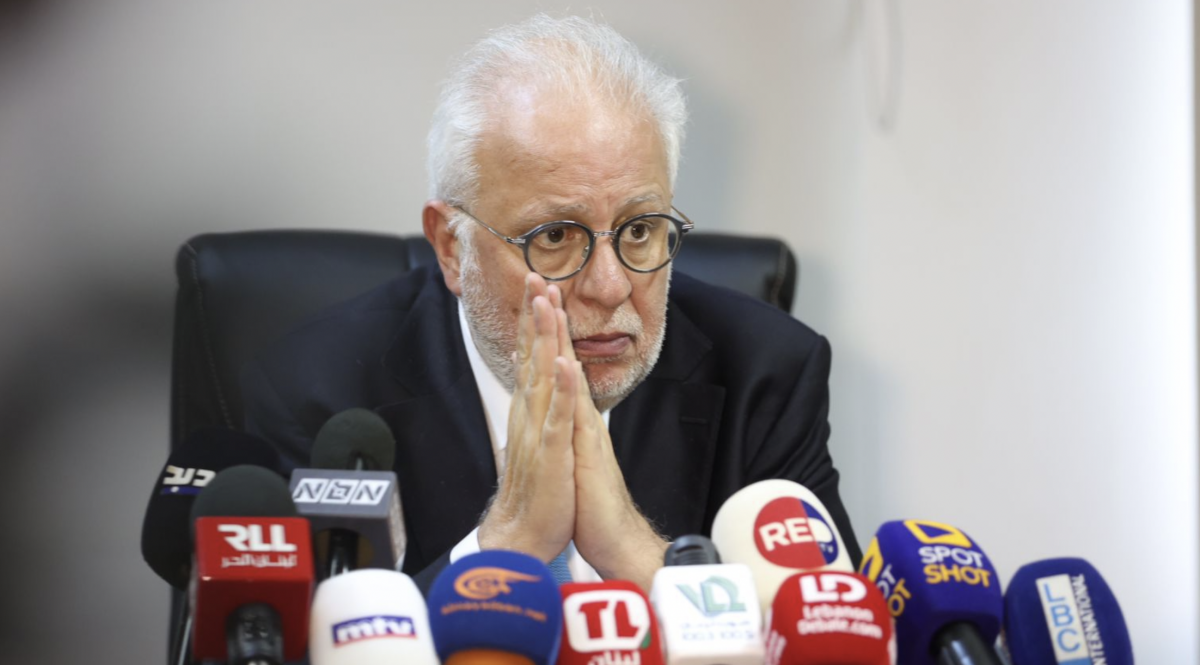
Lebanese Minister of Justice, Adel Nassar, during a press conference. (Credit: NNA)






Lebanese Justice Minister Adel Nassar stated on Saturday that “no party is allowed to impose its will on the state or set its conditions,” referring to Hezbollah, and emphasized that the decision to enforce the state monopoly on weapons in Lebanon is “final.”
“No party can impose its will on the state or set its conditions,” Nassar stressed in an interview with the pan-Arab channel al-Arabiya. “There will be no backtracking on the decision to control the proliferation of arms,” he added.
Responding to remarks by Hezbollah Secretary-General Naim Qassem, who reaffirmed on Friday his party’s refusal to relinquish its arsenal, the minister said that “there is no public at the disposal of any party.” “It is not appropriate for Hezbollah to address a foreign state; the party must serve the state. It is not permitted to impose its will on the state or to set or condition anything for the state,” he said.
The Lebanese government had tasked the army with developing a plan to disarm militias by the end of the year and subsequently “welcomed” the plan without setting a specific implementation timetable.
On the judicial front, Nassar said his ministry continues to hold talks with the Bulgarian ambassador, two weeks after the arrest of Igor Grechushkin in Sofia. Grechushkin is identified by Lebanese authorities as the owner of the ship Rhosus, which transported and offloaded the ammonium nitrate that caused the massive double explosion at Beirut port on Aug. 4, 2020. The minister assured that “the necessary logistical coordination to accelerate the investigation continues.”
Judicial cooperation with Damascus
Regarding Syrian detainees in Lebanon, Nassar stated that “an agreement can be reached between the two countries” and that “three Syrian judges are awaiting the second meeting scheduled in Beirut.”
Two Lebanese delegations had already visited Damascus on Sep. 7 to discuss the issue of Syrian prisoners in Lebanon and the delineation of the common border. According to Deputy Prime Minister Tarek Mitri, who oversees relations between Beirut and Damascus, the first delegation included three magistrates who are to begin working with their Syrian counterparts to draft a new bilateral judicial cooperation agreement. This agreement will serve as a basis for the repatriation of certain prisoners. The issue has gained renewed attention since a rebel coalition led by Islamists came to power in Damascus in December 2024. Around 2,400 Syrian prisoners, about 30 percent of the total detainee population, are incarcerated in Lebanon, according to Lebanese Interior Minister Ahmad Hajjar in August.

Regarding Lebanese detainees in Syrian prisons, Nassar recalled that “it is the right of the Lebanese to know the fate of their children” and that “the Syrian side wishes to address this issue in accordance with a legal agreement,” adding that “Lebanon is particularly concerned with any detainee held in Syrian prisons.” The minister also condemned “any kidnapping operations targeting Lebanese or foreigners,” assuring that “the state is making every necessary effort to repatriate the detainees.”
As for the case of Hannibal Gaddafi, one of the sons of the former ousted Libyan dictator Muammar Gaddafi, detained without trial in Lebanon since 2015, Nassar specified that “a request for release has been submitted by his lawyer” and that “it is currently in the hands of the investigating judge, awaiting a decision.” Libya had raised its tone in July, criticizing what it considered a lack of cooperation by the Lebanese authorities regarding the case of their national. According to the Libyan Ministry of Justice, this case is being “politically exploited” in Lebanon.
