


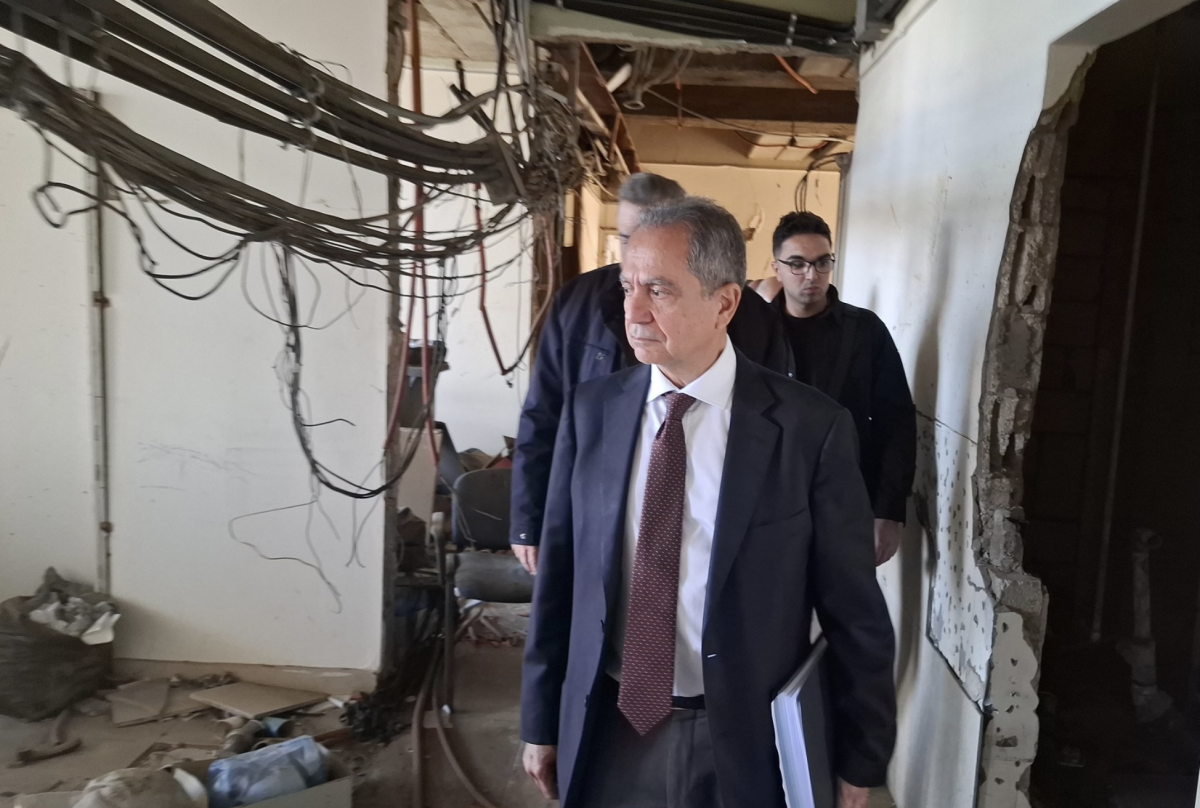
The Minister of Energy, Joe Saddi, visits the premises of Électricité du Liban on Friday, April 11, 2025. Photo taken from his X account.






BEIRUT — Energy Minister Joe Saddi met with officials from TotalEnergies, one of the leading fuel suppliers in Lebanon, in Paris on Tuesday, concerning gas exploration in Lebanese fields, and on Friday, shared the results of those meetings with President Joseph Aoun, the state-run National News Agency (NNA) reported.
In the late 2010s, TotalEnergies led a consortium of companies that won the exploration and exploitation licenses for several blocks within Lebanon's exclusive economic zone. TotalEnergies, Eni and Novatek — which became TotalEnergies/Eni/QatarEnergy after the 2022 agreement between Lebanon and Israel — carried out two initial explorative drillings in two blocks within Lebanon's EEZ in 2020, with no conclusive results. The consortium put its prospecting on hold when the war between Israel and Hezbollah broke out, and in light of disagreements with Lebanon over the terms of the licenses for the other blocks.
EDF, which was also involved in the Paris meetings, has provided Électricité du Liban with technical expertise on several projects.
Maritime borders with Cyprus
On Thursday, the Public Works Committee, chaired by MP Sajih Attieh, examined the issue of border demarcation with Cyprus. The two countries drew up an initial agreement in 2007 — under pressure from Turkey — that involved addressing the intersecting of Israeli, Lebanese and Cyprus territory off the coast of Naqoura in the Mediterranean. The Lebanese Parliament failed to ratify the treaty, which has been blocked since.
"With the delimitation provided for in the agreement signed in 2007, we have lost around 2,600 km² that contain natural gas," Attieh said after the Thursday meeting, according to reports from al-Nashra. "The method of calculating surface areas is subject to profound technical differences. Consequently, the commission issued recommendations, including that of consulting more foreign experts."
"The commission in charge of the border demarcation with Cyprus was invited to take part, as the previous experience had not produced convincing results with the Israeli enemy and had been marred by numerous irregularities," Attieh added. "This is a question of sovereignty, as its positive or negative repercussions will also extend to the delimitation with Syria."
The delimitation of maritime borders with Israel and Cyprus, whose EEZs are directly adjacent, is a major issue for Beirut, which is seeking to position itself as a reliable destination for oil companies wishing to confirm the subsoil's hydrocarbon potential. The dispute between Beirut and Damascus concerns an area estimated at between 750 and 1,000 km², and a meeting was held in March between the Syrian transitional government and Lebanon in the hopes of moving the issue forward.

 7 p.m. recap: 1 person killed near border with Lebanon; 200 kilos of explosives carried by mules; Riyadh shuts its airspace