


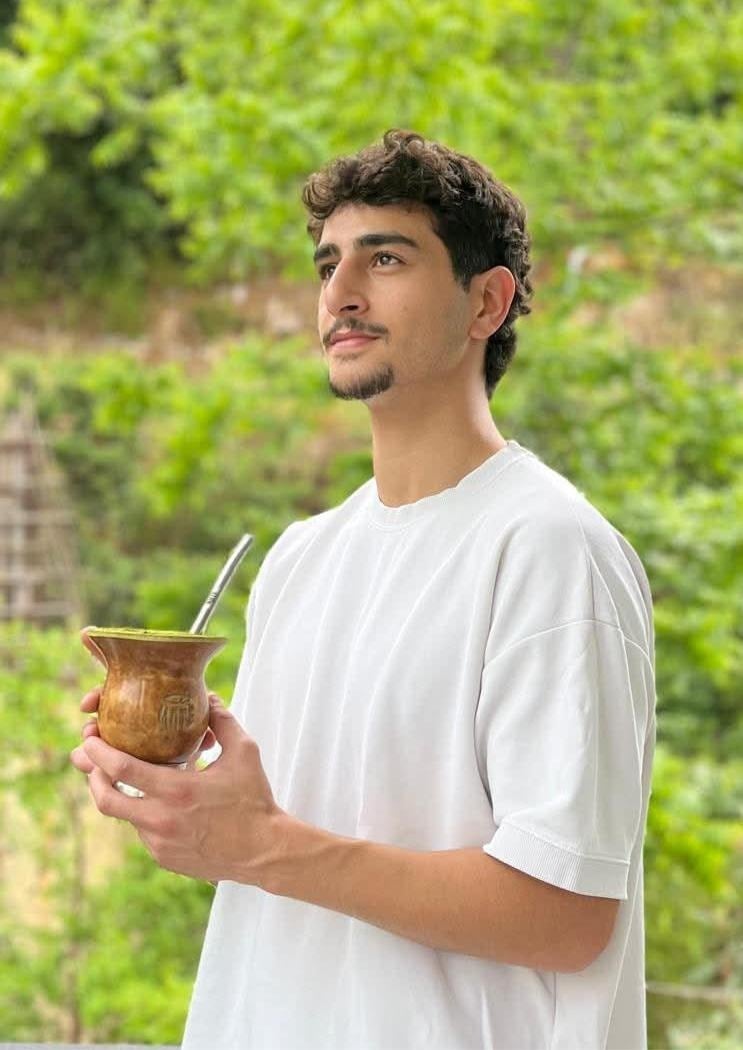
Rubens Bouchabke, founder of Maté LB.






BEIRUT — When Rubens Bouchabke visited Brazil three years ago, what stayed with him was not just the taste of chimarrão – Brazil’s version of mate – but the way people drank it.
The 25-year-old Lebanese Brazilian entrepreneur remembers watching people pass around the cuia, the traditional cup used for the drink, similar to what many in Lebanon know as the ‘araa. The practice reminded him of Lebanon, where coffee, tea, arak, and mate are often tied to gatherings, conversation, and taking time together.
"I tasted Brazilian mate, and it became a personal preference," Bouchabke said. "I told myself: I need my people to experience this, connect with the calming feeling, smooth taste, and beautiful ritual shared here in Brazil. So I decided to bring it back home."
This paved the way for Maté LB, an e-commerce brand importing Brazilian chimarrão to Lebanon. Bouchabke says it is the first business to bring Brazilian yerba mate directly to the local market.
A different kind of mate
The idea first took shape around six months ago, but Maté LB only started operating last week.
Mate is not new to Lebanon. The drink is widely consumed, particularly in communities with long-standing links to Latin America. But the variety most Lebanese consumers know is Argentinian.
"The Argentinian is much more bitter and bolder, while the Brazilian is smoother and has a more earthy taste," Bouchabke explained.
For now, Maté LB is available only through its website. Bouchabke said he plans to expand into both large and smaller supermarkets over the next three to six months.
He is also looking at cafés, with a format adapted to local consumption habits. Rather than serving chimarrão in the traditional shared cup, cafés would prepare it with a French press and serve it as a concentrated drink: "like a shot of espresso, but as a shot of mate," he said.
Entering a market already accustomed to Argentinian mate will not be easy, Bouchabke acknowledged. "But we think we have the right product, in terms of taste and quality."
The target market includes people from all backgrounds and ages, health-conscious customers, athletes, and people who already drink mate in their daily ritual.
After spending four years between London and Madrid, Bouchabke returned to Lebanon about a year ago, driven by the opportunity to start his own business back home.
The country’s instability did not deter him. On the contrary, he said it made him more eager to launch now.
« If things work now, we hope they will work even better when the situation improves, » he said.
The amount invested in the business could not be disclosed at this stage, but Bouchabke said he hopes to recover the investment within a year.
For the time being, he is not planning to expand outside Lebanon. In his view, the problem Maté LB is trying to solve is specific to the Lebanese market: access.
"In Dubai, for example, you have Amazon. You can order whatever you want and it reaches you within days," he said. "In Lebanon, we don’t have this." Consumers who want Brazilian mate, he said, often have to order it from abroad, wait weeks for delivery, and pay significantly more for shipping and import costs.
Maté LB operates under Levant33, an import-export company that serves as its parent company. While the current focus is on Brazilian mate, Bouchabke said Levant33 could eventually diversify into other products or business lines, though there are no concrete plans at this stage.

 7 p.m. recap: Netanyahu seeks mastermind behind Flydubai incident; Washington sanctions 2 French nationals; Ben Gvir's 'I want to kill you' threat