






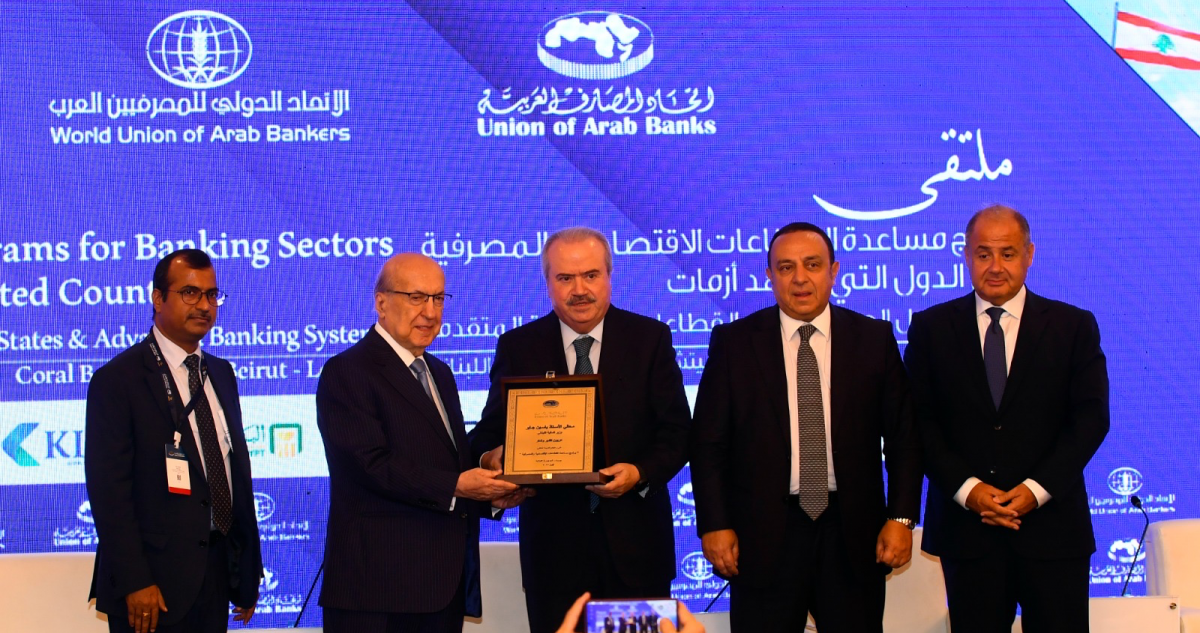
Lebanese Finance Minister Yassine Jaber (center) at the inauguration of the Regional Forum of Arab Banks, on Sept. 18, 2025, at the Coral Beach Hotel in Beirut. (Credit: NNA)






BEIRUT — Finance Minister Yassine Jaber said that Lebanon will not be able to restore confidence in its market without resolving the financial crisis that began in 2019, in a way that respects the rights of both banks and depositors.
The draft laws currently being prepared by the government to distribute the country's financial losses and organize the return of deposits are in line with this approach.
The minister was speaking from the Coral Beach Hotel, where the Regional Forum of the Union of Arab Banks is being held.
"We know there is no economy without banks, and no trust can be restored without protecting depositors' rights. Likewise, there is no way to reclassify Lebanon and remove it from the gray list without a healthy banking sector and banking supervision that prevents money laundering and terrorism financing, and that limits the persistent parallel economy on the Lebanese market," the minister said.
"The primary goal of any recovery plan is to restore confidence in the Lebanese market, which can only be done by respecting everyone's rights. The law on the restitution of deposits fits within this perspective," he added, also reminding that since the formation of the government led by Nawaf Salam early this year, Lebanon has amended the banking secrecy law and adopted a legal framework for bank resolution.
Tens of billions of dollars in deposits have been frozen by banks since the onset of the crisis at the end of 2019, following an overall solvency crisis in the country.
Some banks have argued that the crisis was systemic and that the state should shoulder the losses, while other voices, including the International Monetary Fund (IMF,) call for respecting the order of accountability: Making bank shareholders contribute first, without ruling out the state's potential participation in the losses.
Lebanon reactivated negotiations with the IMF last winter in an attempt to secure a financial assistance program, conditioned on the implementation of reforms.
Jaber, one of the Lebanese ministers most in contact with the IMF, recently confirmed to the press that the government favors the so-called "bail-in" method for the repayment of large deposits, beyond the guaranteed minimum stipulated by the draft law on the distribution of losses in the financial system, currently under development. "No banking system can return depositors' money all at once," he said.