






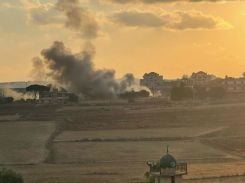
Israeli strike on Debbin, Sept. 18, 2025. (Photo received by our correspondent in the South, Muntasser Abdallah.)






BEIRUT — The Israeli army conducted a series of Israeli strike in southern Lebanon, claiming to target Hezbollah infrastructure and rebuilding efforts in the region.
Two initial strikes hit homes in Mais al-Jabal (Marjayoun district), wounding two Syrian nationals, L'Orient Today's correspondent in south Lebanon reported. Two additional strikes targeted the village of Kfar Tibnit (Nabatieh), and another targeted Debbine (Marjayoun).
According to our correspondent, the strikes targeted uninhabited houses that have been the target of previous Israeli strikes, with the exception of the house bombed in Debbine, which was hit for the first time.
An hour earlier, the Israeli army’s Arabic-language spokesman, Avichay Adraee, posted an “urgent warning to the residents of south Lebanon” on his X account. He announced that the Israeli army “will soon attack Hezbollah military infrastructure in different areas of south Lebanon, in response to its attempts to rebuild its activities in the region.”
Less than two hours later, Adraee issued a second warning on X to residents of Shehabieh (Sour) and Burj Qalaway (Bint Jbeil).
The warning was followed by a new spurt of Israeli strikes, one of which notably bombed the house of Burj Qalaway's mayor, Mohammad Noureddine, our correspondent reported. Meanwhile, al-Zaroub neighborhood in Shehabieh, where many residents had fled following the warnings, was also targeted by airstrikes.
After the strikes, the Israeli spokesman accused Hezbollah of continuing "its attempts to rebuild terrorist infrastructure in southern Lebanon, especially those belonging to the Radwan Force unit, with the aim of targeting Israel." He also claimed that "measures have been taken to reduce the risk of injury among civilians," while affirming that the targeted "warehouses" were located in the heart of civilian areas. In this context, he claimed Hezbollah is using "the population as a human shield."
Against the backdrop of the escalation in Israeli threats and attacks — reminiscent of last year's war — L'Orient Today learned that U.S. envoy Morgan Ortagus is expected in Beirut on Sunday.
Aoun, Salam, Berri urge action
President Joseph Aoun accused Israel of "not respecting" the ceasefire mechanism and the guarantor states meant to uphold it, saying Israeli airstrikes amounted to a “blatant violation” of U.N. Security Council Resolution 1701.
He said the silence of those guarantor countries was a serious failure that encouraged further attacks. “The mechanism must serve all parties, not act as a cover for Israeli strikes. It is time to put an immediate end to these repeated violations of Lebanon’s sovereignty,” Aoun said.
Parliament Speaker Nabih Berri condemned Israeli strikes, describing them as “an aggression against Lebanon, its sovereignty, its army and UNIFIL forces.”
He urged the Lebanese to adopt a united stance against “Israeli aggression targeting all of Lebanon,” adding that the strikes were not “simple violations of the cease-fire agreement” but an attempt to obstruct UNIFIL’s work south of the Litani River under U.N. Security Council Resolution 1701, which he said Lebanon had fully respected.
Berri also called on the international community and guarantor states of the agreement — “in particular the United States” — to “take immediate action and compel Israel, at all its political and military levels, to immediately cease its aggression.”
Before the attacks and responding to the Israeli evacuation threats, Lebanese Prime Minister Nawaf Salam wrote on X: “The Lebanese government, committed to the cease-fire, confirms its participation in the mechanism’s meetings. But the legitimate question today is: Where is Israel’s commitment to these mechanisms?”
Salam called on the international community, “and in particular the countries that sponsored the cease-fire agreement, to exert maximum pressure on Israel to immediately end its attacks, return to the mechanism and honor its commitments, including withdrawal from Lebanese territory it continues to occupy, an end to attacks and the release of prisoners.”
Since the cease-fire reached on Nov. 27, an “international monitoring committee” has been established to oversee the agreement between Israel and Lebanon and ensure Hezbollah’s disarmament south of the Litani. The committee is made up of five members — France and the United States, which co-chair, Lebanon, Israel and the United Nations Interim Force in Lebanon (UNIFIL).
It resembles the 1996 tripartite agreement established after Operation Grapes of Wrath, which ended with the April Understanding. Its main mission is to “implement and monitor the cease-fire between Israel and Lebanon,” primarily ensuring disarmament in the south through the Lebanese Army.
Jaafarite Mufti Ahmad Qabalan criticized the government's response in the face of Israeli attacks, denouncing those calling for Hezbollah's disarmament, at a time when “tragic scenes of displacement have been witnessed in Mais al-Jabal, Kfar Tebnit and Debbine.”
“To the people of the south and the Bekaa, I say: do not rely on this state, because what we call the state does not protect you, and does not want to protect you,” he added.
Hezbollah MP Hassan Fadlallah said the Israeli attack “will not push our people to submit and abandon their land, but will strengthen them in their convictions, their choices and their closeness to the resistance.”
“Lebanon no longer needs further proof to understand that there is no international or diplomatic guarantee to curb Israeli terrorism.” He also argued that “the official abandonment of elements of strength [Hezbollah’s weapons] has only led to more Israeli aggression.”

More than 4,500 Israeli violations
Also on Thursday, the Lebanese Army denounced in a statement the continuation of Israeli violations, which now exceed “4,500 since the cease-fire agreement came into effect.”
“The Israeli enemy continues its attacks against civilians … causing deaths and injuries,” the statement said. According to the army, “these violations are accompanied by repeated infringements of Lebanese sovereignty on land, at sea and in the air.”
It cited attacks “against residents of border villages, including the launching of incendiary bombs and the destruction of houses.” Moreover, right after the Israeli army's "urgent warning," an Israeli helicopter dropped incendiary bombs on a forested area in the Labbouneh, on the southern outskirts of Naqoura in the Sour district, an area that was not mentioned by Adraee.
“These violations hinder the army’s deployment in the South and will compromise implementation of its plans south of the Litani,” the statement added.
The army added while it was conducting demining operations, a specialized unit discovered and dismantled “a camouflaged spying device” planted by Israel in Labbouneh (Sour).
It concluded by saying it continues to monitor the violations in coordination with the cease-fire monitoring committee and UNIFIL.
Meanwhile, UNIFIL said it resumed “humanitarian demining operations” in south Lebanon last week, at the government’s request, after nearly two years of suspension because of “exchanges of fire across the Blue Line.”
The goal is to “reduce risks faced by civilians living in or visiting areas near the Blue Line, particularly after the recent conflict,” the U.N. force said. Demining experts from Cambodia and China began work in two minefields near Blida (Marjayoun) and Maroun al-Ras (Bint Jbeil), covering a total of about 18,000 square meters, the UNIFIL said.
Series of Israeli strikes earlier in the day
Early Thursday afternoon, an Israeli army drone dropped a stun grenade on the town of Yarin (Sour), causing no casualties, according to our correspondent.
In the morning, an Israeli drone destroyed another Israeli drone that had crashed on the roof of a house in Shebaa (Hasbaya). Also, a stun grenade was dropped on a hill outside the town of Odaisseh (Marjayoun) by Israel.
Earlier today, several residents in Beirut reported hearing an Israeli drone flying at low altitude.
On Wednesday, an Israeli army drone strike in Aassira (Baalbeck) killed two people. On Thursday, the Israeli army’s Arabic-language spokesman said the attack had “eliminated the terrorist Hussein Seifo Sherif, an important arms trafficker and supplier operating from Lebanon to run terrorist cells inside Syria, which were planning terrorist operations against the State of Israel.”
According to information gathered by our Bekaa correspondent, the two men killed on Wednesday, Sherif and Kamal Raad, were "senior" Hezbollah members.
Raad, a customs officer close to retirement, ran a supermarket where he was with Sherif at the time of the strike. The men's funerals were held on Thursday. Sherif, originally from Yammouneh in the Bekaa, was buried in his village.
