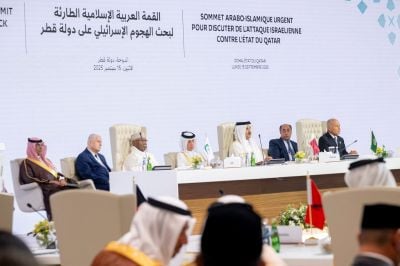
Sheikh Tamim bin Hamad Al Thani, Emir of Qatar, at the Arab-Islamic leaders' summit in Doha, Sept. 15, 2025. (Credit: Hassan Bargash Al Menhali/Reuters)






Arab and Muslim leaders meeting at a summit in Doha on Monday called for a review of ties with Israel after last week’s deadly strike in Qatar that targeted Hamas officials.
The extraordinary joint session of the Arab League and the Organization of Islamic Cooperation, which brought together nearly 60 countries, sought to take firmer action after Israel’s unprecedented attack in Qatar, the main mediator in the Gaza cease-fire negotiations.
According to the final statement reviewed by AFP, Arab and Muslim leaders urged “all states (...) to review diplomatic and economic relations with Israel and to initiate legal proceedings against it.” The statement also called on member states to “coordinate efforts to suspend Israel’s membership in the United Nations.”
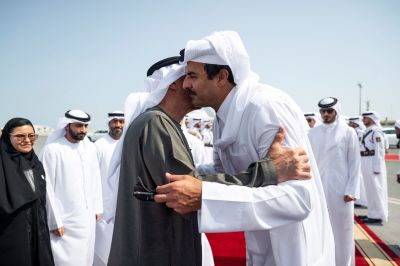
Qatar’s Gulf neighbors, the United Arab Emirates and Bahrain, as well as Egypt, Jordan and Morocco, were among the countries present that recognize Israel. The leaders of the UAE, Bahrain and Morocco — who signed the Abraham Accords five years ago to the day — did not attend the talks, sending senior representatives instead.
U.S. reaction
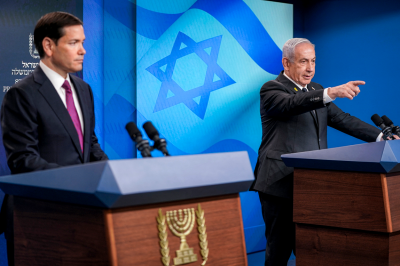
U.S. Secretary of State Marco Rubio was in Jerusalem on Monday — a trip planned before the strikes in Qatar — to show support for Israel ahead of several Western countries’ expected recognition of a Palestinian state at the U.N. General Assembly later this month.
From Jerusalem, he pledged Washington’s “unwavering support” for Israel’s goal of eliminating Hamas, nearly two years after the Gaza war.
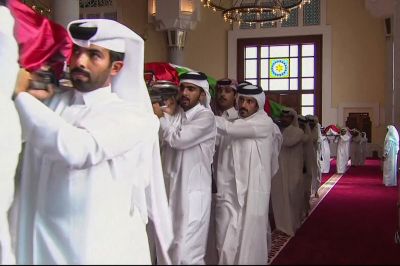
Rubio is scheduled to arrive in Doha on Tuesday. The State Department said he would “reaffirm America’s full support for Qatar’s security and sovereignty” after last week’s strike, which killed five Hamas members and one member of the Qatari security forces.
The attack strained ties between Washington and Gulf allies, raising questions over U.S. security guarantees in a region that hosts major U.S. assets, including a large base in Qatar.
In his opening remarks, Qatar’s emir, Sheikh Tamim bin Hamad Al Thani, accused Israel of seeking to “thwart negotiations.” Israeli Prime Minister Benjamin Netanyahu “dreams that the Arab region will become an Israeli sphere of influence. And that is a dangerous illusion,” he said.
“Whoever works diligently and systematically to assassinate the party with whom he is negotiating intends to thwart the negotiations,” the emir added, referring to Hamas officials who survived the Doha strike.
Regional pushback
The summit drew leaders including Saudi Crown Prince Mohammed bin Salman, Iranian President Masoud Pezeshkian, Palestinian President Mahmoud Abbas, Egyptian President Abdel Fattah al-Sissi, Turkish President Recep Tayyip Erdogan, Iraqi Prime Minister Mohammed Shia al-Sudani, and Pakistani Prime Minister Shehbaz Sharif, along with Jordan’s King Abdullah II.
“Tomorrow, it could be the turn of any Arab or Islamic capital,” warned Pezeshkian, whose country fought a 12-day war with Israel in June and attacked a U.S. base in Qatar during the conflict. “The choice is clear. We must unite.”
Sissi, whose country was the first Arab state to recognize Israel, said the strike “creates obstacles to any prospect of new peace agreements and even undermines existing agreements with countries in the region.”
Israel and Washington are seeking to expand the Abraham Accords, signed during Donald Trump’s presidency, notably courting Saudi Arabia, the region’s oil heavyweight.
Erdogan accused Israel of wanting to “continue massacres and genocide in Palestine while destabilizing the region,” while also denouncing what he called a “terrorist mentality.”
Gulf states weigh in
The six monarchies of the Gulf Cooperation Council, which met on the sidelines of the summit, called on the United States to use its leverage to rein in Israel.
“We expect the United States, our strategic partner, to use its influence on Israel so that this country ceases such actions,” GCC Secretary-General Jassem al-Budaiwi told a press conference. The bloc includes Saudi Arabia, the UAE, Bahrain, Qatar, Kuwait and Oman.