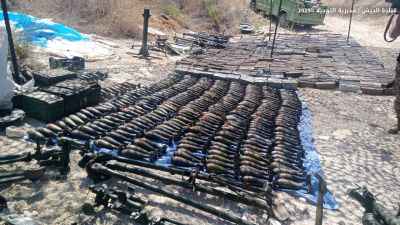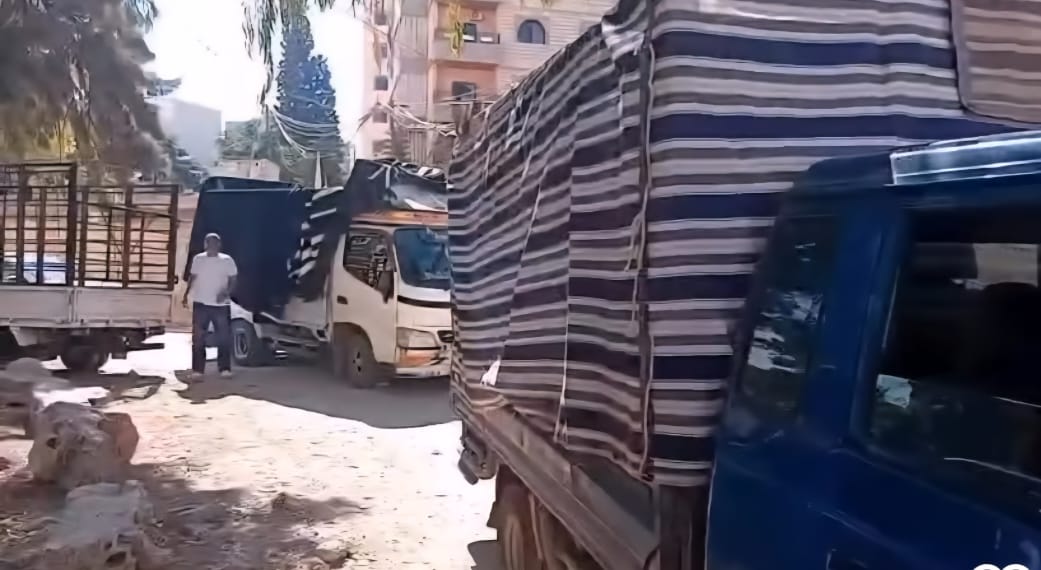
Trucks loaded with weapons in the Beddawi camp in northern Lebanon, Sep. 13, 2025. Photo provided by our correspondent in northern Lebanon, Michel Hallak.






The disarmament of Palestinian camps, which began in August in Lebanon, continued on Saturday morning in the Beddawi camp in the North and the Ain al-Hilweh camp at the entrance of the southern city of Saida.
The director of public relations for the Palestinian National Security Forces in Lebanon, Abdel Hadi Assadi, stated in a press release that these forces have “completed the handover of new batches of Palestinian weapons belonging to factions of the Palestine Liberation Organization [PLO].”
“Five trucks from the Ain al-Hilweh camp and three trucks from the Beddawi camp were handed over to the Lebanese Army,” he added.
‘Lebanese-Palestinian partnership’
Assadi also noted that these measures are part of “the implementation of the joint declaration issued by President Mahmoud Abbas and Lebanese President Joseph Aoun, as well as the work of the Lebanese-Palestinian joint committee responsible for monitoring the situation in the camps and improving the living conditions there.” This initiative “reflects the depth of the Lebanese-Palestinian partnership and embodies the shared concern to ensure security and stability, while preserving the fraternal relations between the two peoples,” he concluded.

According to our correspondent in the North, Michel Hallak, the Lebanese Army inspected the three trucks handed over by Fatah in the Beddawi camp before transferring them to the Qobbeh military barracks in Tripoli. According to a Palestinian security source interviewed by our correspondent in the South, Mountasser Abdallah, the five trucks handed over by Fatah in Ain al-Hilweh contained “weapons, rockets, mines, mortars with their shells, artillery shells of various calibers, and ammunition.”
These operations took place away from the media.
The collection of Palestinian weapons in Lebanon began in August in the Burj al-Barajneh camp in southern Beirut’s suburbs. This first phase followed a meeting between Presidents Aoun and Abbas, during which the Palestinian leader affirmed his support for the sovereignty of the Lebanese state over its entire territory and for its monopoly on weapons.
Subsequently, the Lebanese Army launched operations to collect Palestinian arms south of the Litani River and in the Rashidieh, al-Bass, and Burj al-Shemali (Sour) camps, before recovering another shipment from the Burj al-Barajneh camp. Fatah’s official spokesperson, Abdel Fattah Dawla, described this as “the largest operation of its kind since July 1991,” when a disarmament agreement was signed at the time between Lebanon and Fatah, the main organization of the PLO. This handover included heavy weapons from the majority of officially recognized camps — 10 out of 12, according to the statement.
Commenting on its operation, the Lebanese Army stated that it had successfully “received five trucks of weapons from the Ain al-Hilweh camp in Saida and three trucks from the Beddawi camp in Tripoli.” These trucks contained “various types of weapons, shells, and war munitions, which were handled by specialized military units for inspection and processing in accordance with the necessary procedures,” it added.
Meanwhile, the Lebanese-Palestinian dialogue committee praised the operation, saying it “constitutes a new step in the process of the full disarmament of Palestinians, according to a gradual plan carried out in successive phases.” It also stated that it continues “its meetings with different Palestinian factions, including Hamas and Islamic Jihad, to monitor the situation in the camps and reaffirm the Lebanese state’s constant will to exercise sovereignty over its entire territory.”
The committee informed these parties “of the need to initiate concrete measures to definitively address the issue of Palestinian weapons, thereby paving the way for strengthening the authority of the Lebanese state over the camps, ensuring their security and stability, while preserving national stability and protecting the dignity as well as the economic, social, and human rights of Palestinians residing in Lebanon.”
No agreement has so far been announced with the Islamist Hamas movement regarding a possible handover of its arsenal to the Lebanese authorities. Restoring the state’s monopoly on weapons is one of the top priorities of President Joseph Aoun and the government of Nawaf Salam.