






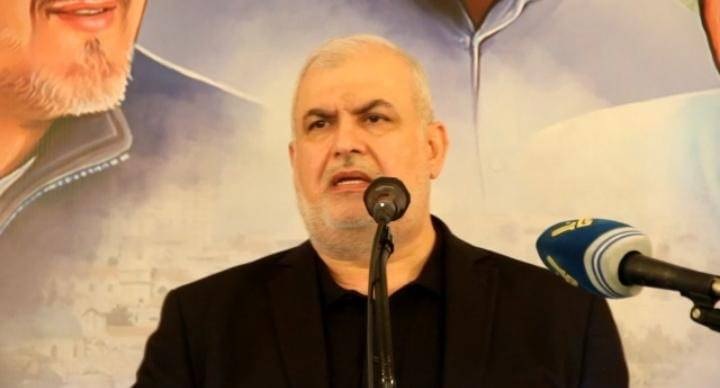
MP Mohammad Raad, head of Hezbollah's parliamentary bloc. (Credit: NNA)






BEIRUT — The head of Hezbollah’s parliamentary bloc, MP Mohammad Raad, said Monday that the pressures previously exerted on former Prime Minister Saad Hariri to influence his approach to Hezbollah were stronger than those currently faced by the head of the present government, Nawaf Salam, who one month ago oversaw Cabinet's decision to adopt a U.S. plan to disarm the party.
"The pressures on Saad Hariri were greater than those currently exerted on this government," Raad said in an interview with media outlet al-Nour. "For 12 years, Saad Hariri endured these pressures but would not accept any bloodshed within the country, and he paid the price for it."
Hariri served as prime minister from September 2009 to January 2011, and again from December 2016 to January 2020, before abruptly announcing his resignation in an announcement made under unusual circumstances, after having briefly disappeared during a trip to Saudi Arabia. His father, also a former prime minister, was assassinated in 2005 in a car bombing in downtown Beirut that killed 22 people and wounded 226 others.
Raad insisted that Hezbollah "is keen to maintain the relationship with President Joseph Aoun, because the head of state at least listens to what we propose, expresses his opinions, his concerns, or the offers he receives."
"Unlike some officials," Raad continued, "we favor prudence, calm, and refraining from rushing decisions, which is one of the merits of governing. But among some, there is disdain and stubbornness."
Sovereign national strategy
Raad also insisted his party "is not carrying out a show of force on the domestic scene," pointing a finger instead at "those who flaunt their power while also relying on Western, American and Israeli support."
"This support will be of no use to them in pressuring Hezbollah to obtain something to which they have no right," Raad said. "We are open to a dialogue about arms, but let's first establish sovereignty and then discuss it." Throughout the recent-months conversation around the party's disarmament, Hezbollah has maintained its demand that Israel first end its occupation of Lebanese territory along the southern border and that Lebanon receive assurances that Israel would uphold the cease-fire it agreed to last November.
"As long as there is no Israeli commitment to a cease-fire, and as long as hostages remain in Israel, how can we discuss these weapons domestically? When the Israeli withdraws from our land and puts an end to aggression on our soil, then we will come to an understanding among ourselves in Lebanon," Raad said.
The issue of disarmament should be addressed "within the framework of a true sovereign national strategy that protects Lebanon," he said.
Two highly anticipated and closely followed Cabinet meetings in early August resulted in Salam's government officially adopting a U.S. outline for Hezbollah's disarmament and tasking the Lebanese Army with developing the plan. On Friday, Cabinet confirmed it had "welcomed" the plan presented by the army, which has no precise timetable for implementation.