


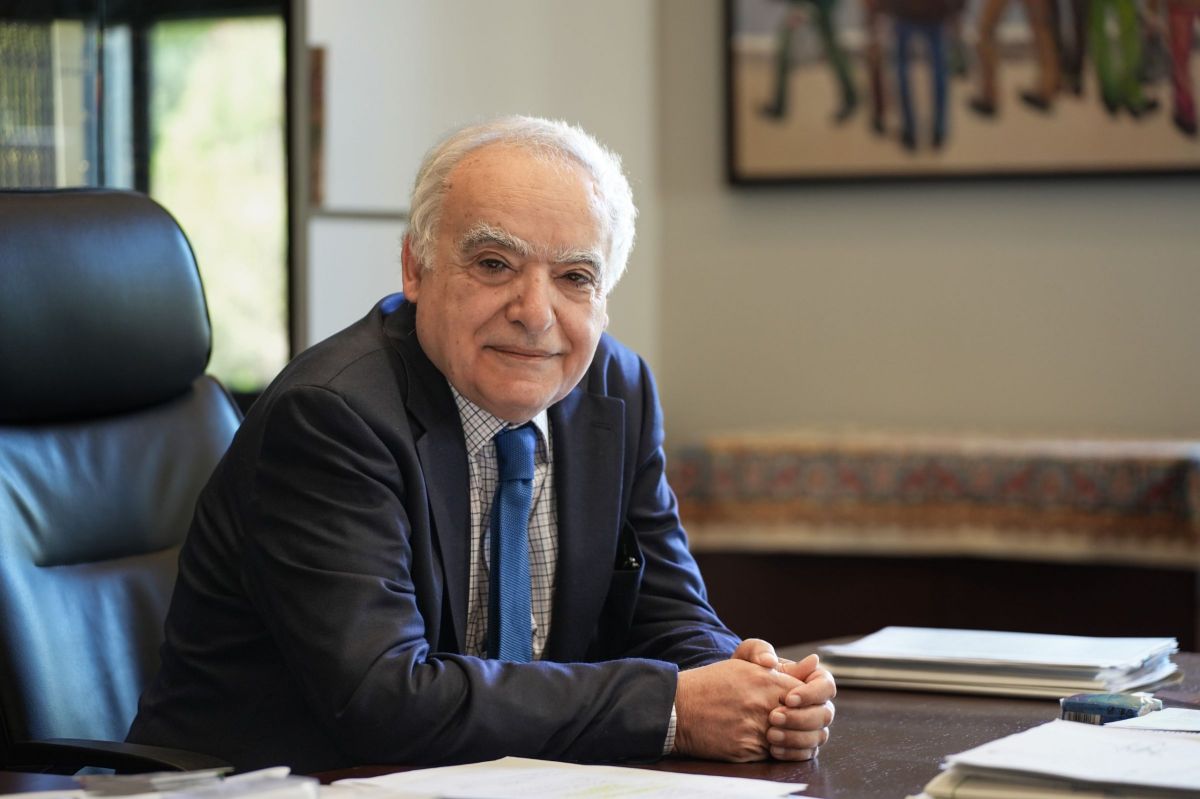
The Lebanese Minister of Culture, Ghassan Salameh. (Credit: Mohammed Yassine/L'Orient Today.)






BEIRUT — Culture Minister Ghassan Salameh said Tuesday there will be "no armed confrontation" with Hezbollah over its weapons, despite the group's opposition and warnings the move could spark internal conflict.
The minister, assured that "there is no risk of civil war," noting that he is in contact with all parties.
He expressed confidence that Lebanese authorities will reach an agreement with Hezbollah, insisting that the army will not delay submitting its plan for the disarmament of Hezbollah to the authorities, a plan scheduled to be presented on Sept.2.
Last week, the Lebanese foreign minister indicated that the army might request an additional two-week delay to submit its plan to the cabinet.
"We have not reached the level of confrontation and will not get to such a confrontation, because the army and security forces do not want it, and neither do the 'resistance' forces. There is also no risk of civil war, as I am in contact with all parties," he told al-Hadath.
"We will reach an agreement that will preserve Lebanon's sovereignty and its international relations, to help it emerge from the financial and economic catastrophe," Salameh added, noting that "Hezbollah's base is an integral part of the Lebanese people and is made up of a realistic youth."
Since the government tasked the Lebanese Army on Aug.5 with preparing by the end of the year a plan to disarm all armed groups — Hezbollah above all — after the end of the latest war with Israel, supporters of Hezbollah have criticized Prime Minister Nawaf Salam's Cabinet and raised the threat of unrest at home, while the cease-fire in effect since November 2024 has been violated daily by the Israeli army.
Salameh’s interview comes as U.S. emissary Tom Barrack is in Lebanon as part of the U.S. roadmap on Hezbollah's disarmament.
'Freeing the state from the mafias'
In this context, Salameh made clear that the government’s absolute priority is "to extend the authority of the state, not only by confiscating weapons, but by freeing the state from the mafias that have taken control of a number of its sectors for personal gain."
Speaking on the legislative elections scheduled for May 2026, the minister of culture said the government aims to hold the vote on time.
"Parliament is divided over the electoral law. I fear a new law will take time. But we also want the elections to take place, and for the government to run the elections with professionalism and neutrality," he emphasized.
The diaspora vote has split the political class into two camps: On one side, those who want to confine diaspora voters to six seats, as laid out in the never-applied 2017 law — particularly the Free Patriotic Movement (FPM) and the Hezbollah-Amal alliance.
On the other side, about 68 deputies from the Lebanese Forces, the Kataeb Party, the Progressive Socialist Party (PSP), independents, and other political groups, who are calling to amend the law to eliminate the six-seat clause and allow expatriates to vote for all 128 MPs.
Lebanon 'needs daily cooperation with Syria'
On relations with Syria, Salameh recalled that "the government’s position is clear. Lebanon supports stability in Syria and the political regime chosen by the Syrians, whatever that regime may be, because Lebanon has an interest in Syrian stability. It needs daily cooperation with Syria to revive exports to the Gulf countries and the regional gas network, to end the trafficking of captagon and drugs, and finally to resolve the issue of Syrian displaced persons in Lebanon."
Lebanese authorities use the term "displaced persons" to refer to Syrian migrants and refugees in Lebanon since the start of the Syrian civil war in 2011. The issue of their repatriation is raised regularly, even more so since the fall of Assad's dictatorship on Dec. 8, 2024.
The UNHCR and the government launched the "voluntary return of Syrian refugees" program on July 1. According to the UNHCR, 168,000 people have been removed from its registers so far, due to a "verified or presumed return" by the agency.
At the end of July, 17,000 people had already signed up to return to Syria, while the government aims for "between 200,000 and 400,000 returns" by the end of the year.
Other issues, such as that of Syrian detainees in Lebanon, are expected to be discussed soon by a Syrian delegation expected in Beirut. "No meeting date has been set" for this encounter, deputy prime minister Tarek Mitri said this morning.

 7 p.m. recap: Netanyahu seeks mastermind behind Flydubai incident; Washington sanctions 2 French nationals; Ben Gvir's 'I want to kill you' threat