





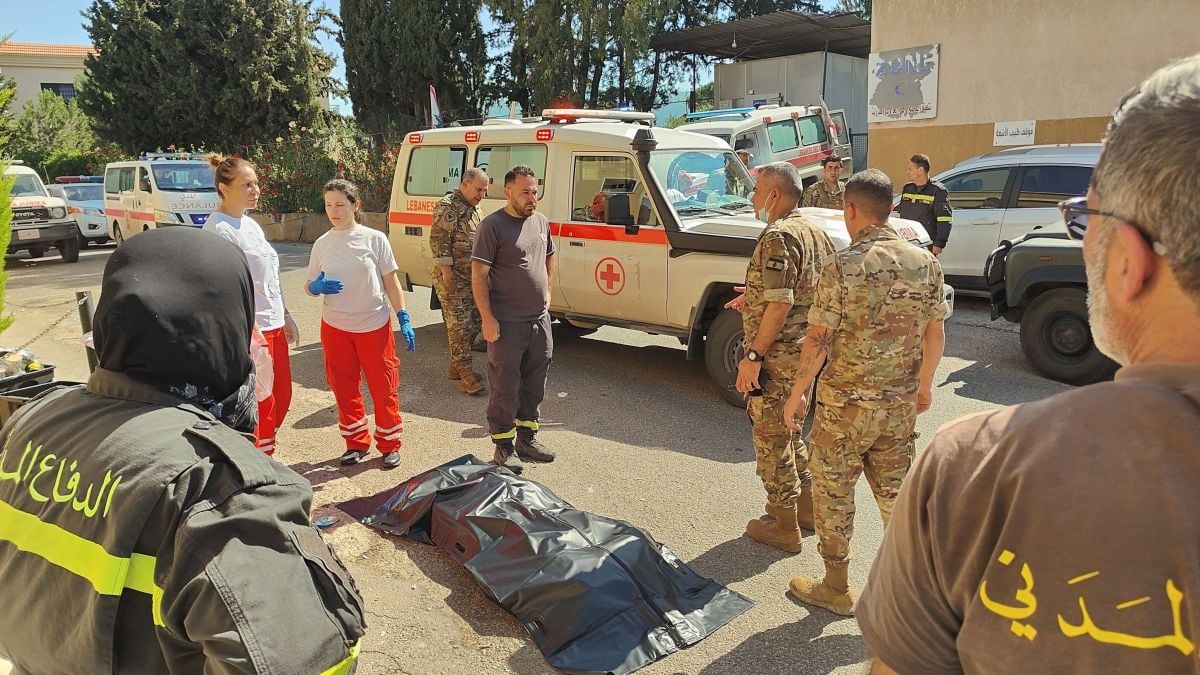
Rescue workers from the Lebanese Red Cross, members of Civil Defense, and soldiers from the Lebanese army gather around a covered body after an Israeli strike targeted a military vehicle on the Khardali-Nabatieh road, June 6, 2026. (Credit: Mohammad Yassine/L'Orient-Le Jour)






BEIRUT — The Lebanese Ministry of Foreign Affairs said on Sunday that it had filed two complaints against Israel with the U.N. Security Council on June 10 and 11.
The first concerned "glyphosate spraying" in southern Lebanon on Feb. 1, and the second the killing of three Lebanese Army soldiers on June 6 as well as "ongoing Israeli attacks in Lebanon." "Israel's targeting of Lebanese soldiers directly undermines diplomatic efforts" with Israel, the ministry said in its statement.
The first complaint is "based on a report prepared by the National Council for Scientific Research," noting that "the Convention on the Prohibition of Chemical Weapons prohibits the use of herbicides as a means of warfare," the statement said, as reported by the state-run National News Agency (NNA).
Glyphosate is a toxic herbicide with serious consequences for health, soil, and crops. Chemical analyses and laboratory tests conducted on soil samples taken from Aita al-Shaab (Bint Jbeil district), Ras Naqoura and Dhaira (Sour district) "confirmed the use of glyphosate at high concentrations reaching 22,750 micrograms per gram, a level far higher than the concentrations usually found in agricultural soils after farmers' direct use of this product, which generally range between 0.5 and 2 micrograms per gram at most," the ministry reported.
At the time of the incident, Lebanese authorities denounced a "new violation of international law" and said that they were preparing to submit a complaint to the U.N.

'Targeting' of army soldiers
The second complaint, concerns "ongoing Israeli attacks in Lebanon," and more specifically the "targeting, on June 6, 2026, by the Israeli army, of a Lebanese Army military vehicle on the Kfar Tibnit-Khardali road," in the Nabatieh district.
The statement said that this attack "caused the death of two officers, holding the rank of brigadier general and captain, as well as a soldier, while they were carrying out their national duty in southern Lebanon." The Israeli army at the time justified its attack by stating that the military vehicle was moving in a "suspicious" manner toward Israeli soldiers near Kfar Tibnit, in an "active combat zone that had been subject to an evacuation order."
The Lebanese ministry called on the United Nations to "condemn this attack and take immediate necessary measures to end these repeated aggressions and ensure compliance with the United Nations Charter and the relevant international resolutions, including Resolution 1701 (2006)."
Lebanon added that Israel's targeting of the Lebanese Army "directly undermines the diplomatic efforts" between Beirut and Tel Aviv, as direct negotiations between the two countries began last April, and "threatens efforts to strengthen the authority of the Lebanese state and to extend its sovereignty over all its territory."
Complaints submitted to the U.N. Security Council are fundamentally political and diplomatic in nature, and are not judicial proceedings. Their main objective is to document incidents, apply pressure, and draw the international community's attention to these issues. Depending on the nature and seriousness of the complaint, as well as the political will of Security Council members, the Council may react in several ways. It may, for example, convene meetings (public or closed), issue official or informal statements, or, in rarer cases, adopt a resolution. However, most complaints do not result in any concrete action.

 7 p.m. recap: Iran warns Egypt, Israeli soldiers vote in south Lebanon, Haret Hreik responds to Kataeb