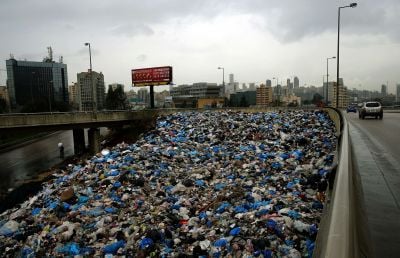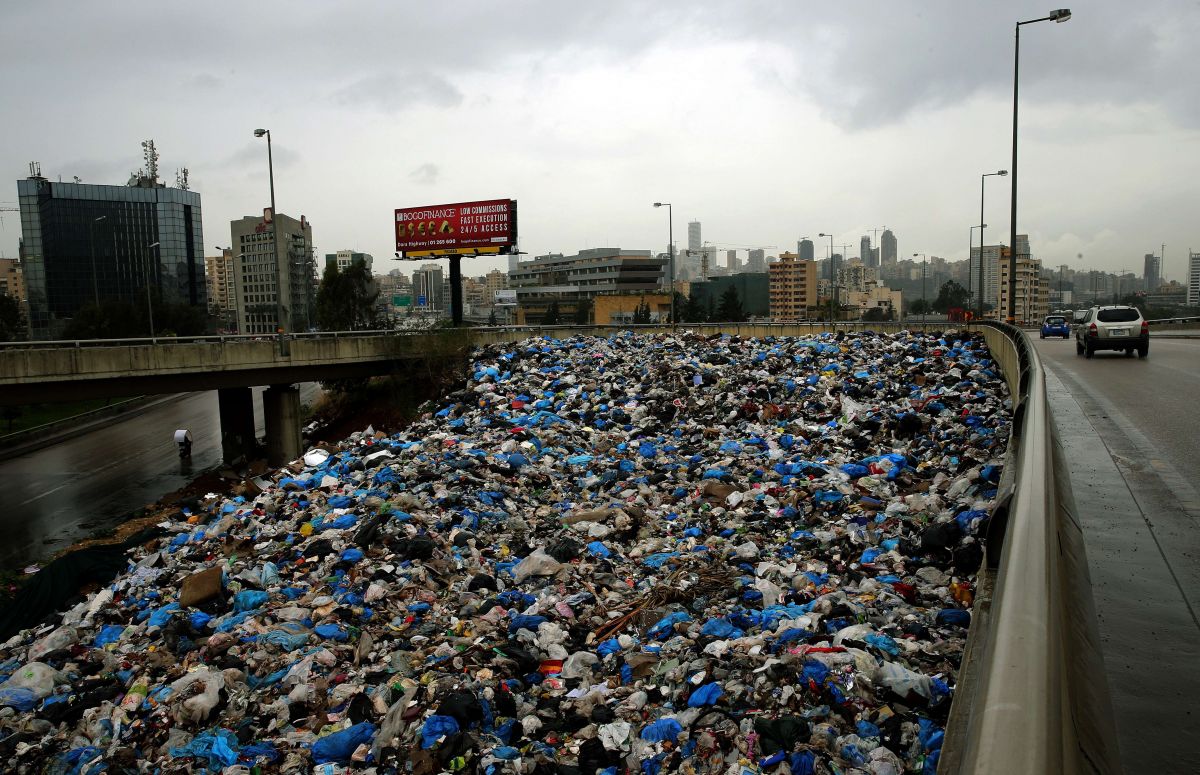
A huge pile of garbage bags stacked up in East Beirut in January 2016, several months after the beginning of the crisis. Archive photo L’OLJ






At dawn on July 17, 2015, hundreds of activists prepared to block trucks from dumping tons of garbage at the Naameh landfill in the Chouf district. Opened in 1997 as an emergency measure after the closure of dumping sites from Lebanon’s 1975-1990 Civil War, it had become the only landfill serving Mount Lebanon and Beirut.
By then, it was overflowing. Insiders knew how grave the situation was, but many still believed the government would extend its use yet again.
This time, however, the garbage trucks really did stop.
There had been warning signs: repeated protests by environmentalists and residents fed up with foul odors and toxic fumes from what was supposed to be a controlled landfill, but where waste was dumped without sorting.
"There were 300 to 400 of us blocking the road to Naameh, including activists from the Lebanese Ecological Movement [an alliance of NGOs] and residents of surrounding villages, whom we had been mobilizing since 2013," recalls Ajwad Ayash, then president of the National Campaign to Close the Naameh Landfill. The activists succeeded, and soon trash piled up in the streets.
"We were aware of our responsibility, but we had no choice but to let others experience what we had been living with for years," he said.
"I believe that faced with angry public opinion in villages around the landfill, such as Ain Drafil and Baawerta [both in the Aley district], local leaders — including Walid Joumblatt — chose to appease residents by refusing to postpone the closure," said environmentalist and waste-treatment engineer Ziad Abi Chaker.
The protests
Chaos followed. Caught off guard, Environment Minister Mohammad Mashnouk shifted the burden to municipalities, instructing them to find temporary dump sites. But after two decades without authority over waste collection and treatment — monopolized under a state contract with Averda, which ran the Sukleen and Sukomi firms — municipal councils were helpless.
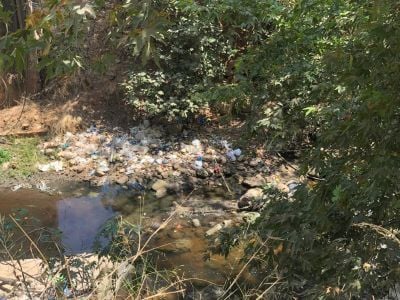
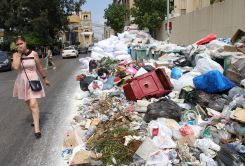
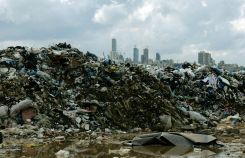
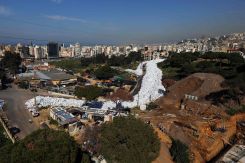
Small garbage dumps cropped up everywhere: between homes in cities, in valleys, in riverbeds. In desperate attempts to reduce the towering, multicolored mounds, some set trash on fire, blanketing Lebanon’s most populated areas in nearly constant toxic smoke.
When officials tried to move trash to more remote regions — such as Srar in Akkar, in the far north — they faced fierce local resistance, reigniting old regional and communal rifts. The “not in my backyard” mentality took on massive proportions. With no solution in sight, a grassroots movement emerged. What began with a handful of activists soon drew in large crowds of angry citizens.
Environmentalists were joined by young people who saw the crisis as proof of entrenched state corruption. "I was making comedy sketches targeting politicians. I did one about the garbage, ending it with the words: ‘You stink!’" recalls Assaad Thebian, one of the movement’s leaders. “‘You Stink!’ [tol'it rihetkon] quickly became the campaign’s name.”
Lucien Bou Rjeili, another leader, recalls the trigger: "I went to get my car, which had been parked for days next to a garbage bin. It was half-buried under trash bags I had to push aside to open my door."
For the next nine to 10 months, the nauseating smell — worsened by the summer heat and winter rains — suffocated the capital and its suburbs. "I felt like I was breathing in the decay of our political system," Bou Rjeili said.
Protests drew even larger crowds, most of them downtown near the Grand Serail, where the government struggled to respond. The movement peaked Aug. 29, 2015, when nearly 100,000 people rallied at Martyrs’ Square, according to organizers — a first for a movement without a leader or political backing. The next day, however, the movement staged a surprise visit to the Environment Ministry, which ended in some participants' arrests.

Decline
The movement’s decline was gradual. Thebian and Bou Rjeili recall direct attacks from the political establishment: intimidation, violence from party supporters at rallies, smear campaigns, arbitrary arrests. "We had big dreams, but the system fought back stronger. It had too much to lose," Bou Rjeili said.
Tensions also emerged between environmentalists, who wanted to keep demands focused on waste management, and political activists, who saw the crisis as inseparable from the need for political reform. "I would have preferred if the demands had remained focused and not so politicized. That weakened the movement," said Paul Abi Rached, president of the NGO Terre-Liban, who led the Lebanese Ecological Movement at the time.
Abi Chaker also remembers "the lack of organization within the movement and the divisions that came with sudden notoriety." He argued that the crisis became a springboard for a broader political struggle that ultimately failed.
Still, Thebian insists that clashes with the authorities mattered more than internal problems. "The 2015 crisis was much more than a garbage crisis. The movement was the precursor to the 2019 uprising against the ruling class at the start of Lebanon’s economic collapse," he said.
Limbo
While protests faded by late summer 2015, the trash crisis lasted until spring 2016. Temporary dumps turned into mountains or rivers of garbage, captured in images that gave Lebanon a notorious global reputation.
After failed attempts to open new dumps, the government even tried to export Lebanese waste, in total secrecy. Russia was briefly considered the main destination, but the plan collapsed when it turned out Moscow had not approved it.
In March 2016, the Cabinet finally adopted an emergency plan that repeated the flaws of 1997: over-centralized contracts and two coastal landfills, one at Costa Brava south of Beirut and the other at Burj Hammoud-Jdeideh to the north. The trash that piled up over those nine months was dumped back into the temporarily reopened Naameh landfill.
With no plan grounded in environmental sustainability, the two new sites became disasters in the making. Since 2016, they have filled up prematurely and have been expanded several times. In August 2025, the Cabinet again debated the planned closure of the Jdeideh landfill — another attempt to stave off a new crisis.
Abi Chaker says the key lesson is that "we cannot expect a solution from the central government, because this sector, like many others, operates on a system of divvying up shares." He notes the crisis "exposed the fragility of centralization and monopoly in waste management."
Ten years later, nothing has changed. After recurring crises worsened by economic collapse and security woes, and despite years of rhetoric about reform, Lebanon’s waste sector remains stuck in limbo.