






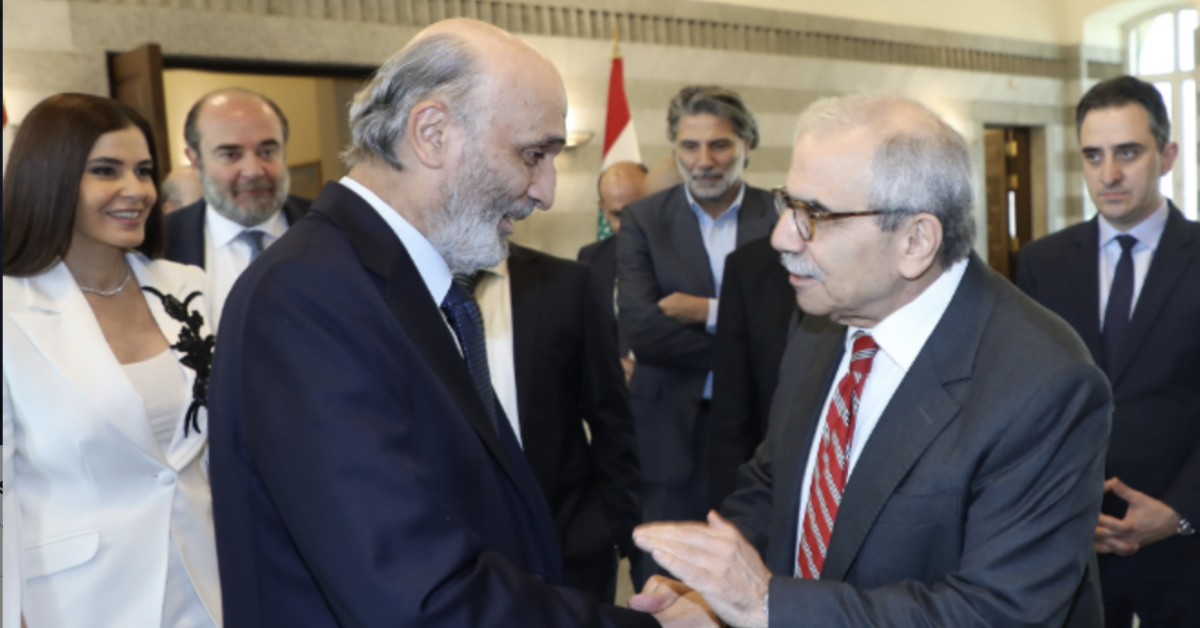
The leader of the Lebanese Forces, Samir Geagea, surrounded by deputies from his parliamentary bloc, shakes hands with Prime Minister Nawaf Salam on August 22, 2025, at the Grand Serail in Beirut. ANI Photo






BEIRUT — Contact between Hezbollah officials and President Joseph Aoun have resumed. On Friday — four days ahead of a planned visit by U.S. envoy Tom Barrack — Hezbollah parliamentary bloc chief Mohammad Raad received General Andre Rahal, adviser to President Aoun.
According to the state-run National News Agency (NNA), the two discussed “the current political situation, the latest developments, as well as the positions of the parties concerned regarding these matters.”
Two days earlier, Rahal visited Ain al-Tineh to meet Parliament Speaker Nabih Berri, who's also the head of Amal Movement, Hezbollah's ally. These meetings come as the government awaits an army plan by the end of August for the disarmament of militias in Lebanon, including Hezbollah, following a two-stage Cabinet decision earlier this month.
The move triggered pushback from Hezbollah and Amal and strained relations between Hezbollah and President Aoun, and even more so with Prime Minister Nawaf Salam. Behind the scenes, the president and Hezbollah have been negotiating the party’s disarmament in recent months, reflecting the new administration’s commitment to exclusive state control of arms.
In this context, President Aoun met on Friday with Army Commander-in-Chief Rodolph Haykal to discuss the security situation and matters concerning the military institution. The president also received General Edgard Lawandos, director general of State Security.
Geagea signals support for Nawaf Salam
Meanwhile, Lebanese Forces (LF) leader Samir Geagea visited the Grand Serail in Beirut on Friday for a symbolic meeting with Prime Minister Salam. Accompanied by most of his party’s MPs, Geagea emphasized that “everyone must comply” with the government’s decisions regarding the state’s monopoly on arms.
He criticized those targeting Aoun and Salam following the government’s initiative to disarm militias. “Everyone must comply with the decision of the Lebanese government regarding the monopoly of arms. However, this decision is being implemented only partially,” said Geagea, signaling his full support for the prime minister.
“Everyone agrees that Palestinian arms should be handed over to the army, and the government has launched this operation. So why do some reject it?” he added, praising what he called the “bold decisions” of the Salam government, which “put Lebanon back on the right track.”
“Before this, for 40 years, we lived in a semblance of a state, a state that had no say and was therefore very weakened. With these decisions, every Lebanese started to feel the presence of a real state,” he said. “We are here today to say that a real state has begun to take shape. But some people are still trying to obstruct this project, whether by attacking the president or the head of government. This is unacceptable. In the end, those who try to hinder this progress will lose out, because it will continue,” Geagea added.
He urged Salam’s critics to use democratic institutions if they object to government policy. “Those who consider the prime minister a traitor can withdraw their confidence in parliament ... Our system is a parliamentary democracy. They can request an extraordinary parliamentary session to discuss the arms issue. We are ready for that, but attacking the head of government day and night is unacceptable,” he added.
Salam has faced a campaign by Hezbollah and its allies, who accuse him of serving “Israeli-Saudi” interests or label him a “Zionist.” At the same time, he enjoys strong backing from Hezbollah's opponents.

