


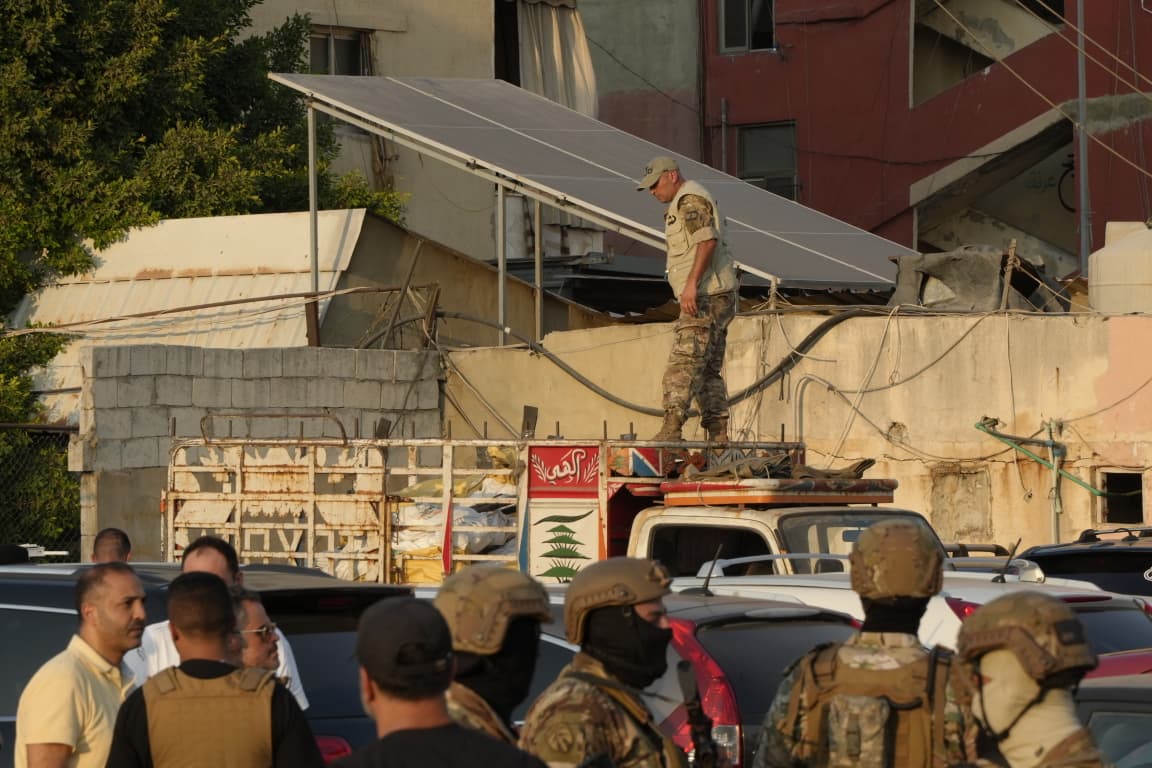
A truck loaded with bags of weapons in a parking lot at the entrance of the Burj al-Brajneh camp, on Aug.21, 2025. (Credit: Mohammad Yassine/L'Orient Today.)






BEIRUT — Disarmament began Thursday evening at the Burj al-Barajneh Palestinian camp, in the southern suburbs of Beirut, in accordance with an agreement reached last May aimed at guaranteeing the Lebanese state's monopoly on weapons.
At the entrance to the camp, Lebanese Army soldiers, armored vehicles and ambulances lined the road leading to Rafic Hariri International Airport. The press was present, but soldiers prevented access to the camp and asked everyone to stay back. Also at the entrance, Fateh elements, wearing military uniforms with a patch representing the Palestinian flag, stood guard.
"I'm coming back from work. I didn't even know about a disarmament," said a man on his scooter. "We know nothing. Everything happened all of a sudden," added a shopkeeper, observing the scene with concern. In the parking area where the operation was taking place, army trucks entered. According to information by L'Orient Today, both heavy and light weapons were involved. Under the soldiers' watchful eyes, a pickup truck loaded with bags of weapons arrived.
Some residents objected to the operation. "We should not hand over weapons to the state," stated a resident. Hiba, 24, a Palestinian nurse, believes Fateh should hand over its weapons, which "are useless" and "used against its own people." "But I don't want Hamas to hand theirs over," she added.
Ihab, another resident, also said he opposed handing over the weapons: "It's a mistake, otherwise the army will be able to enter the camp whenever it wants."
"We don't anticipate any clashes," assured an informed source. "The most complicated camps will be Ain al-Hilweh, Rashidieh and Mieh Mieh, due to the presence of radicals."
On the road towards the camp, traffic was heavy. "It's them [the Palestinians] now, and us next," said Hussein Hamieh, 59, a taxi driver, referring to the announced disarmament of Hezbollah, which he supports.
In a cafe whose walls bear the portrait of former Hezbollah leader Hassan Nasrallah, assassinated by Israel, a 27-year-old Palestinian man explained: "Our weapons are our honor. We are giving up our honor."
A 42-year-old shopkeeper, watching the disarmament, confided her confusion and anxiety: "I don't understand what's happening. All I want is to go home." "Handing over these weapons means giving up one's honor," she said, doubting that the Palestinian factions were genuinely surrendering their weapons. "The factions don't hand over weapons. It's a kind of theatrics," said a man presenting himself as a Fateh member at the scene.
Sami Diab, 25, who lives near the airport road, said it was "about time. These weapons have only been used against the Palestinians themselves." Other voices were raised against the operation. "We shouldn't have handed over the weapons," "We are not happy," said some young people from the camp.
Hajj Hanaa Slim, 62, expressed concern: "Do you see what's happening? Soon it will happen in Beirut's southern suburbs and in the South. And after that? A complete [Israeli] invasion. May God have mercy on the Sayyed's [Hassan Nasrallah] soul and protect us from what lies ahead."
"Why should they hand over their weapons? Will the country be better if the weapons are handed over?" asked a Lebanese man from the Burj al-Barajneh neighborhood in the southern suburbs of Beirut.
Nearby, his friend, a Hezbollah supporter, was not worried about the "weapons of the resistance." "Even if Sheikh Naim Qassem asks us to hand over the weapons, we will refuse (...) We will resist anyone who tries to take them."
 The 7 p.m. recap: Houthis advance, government announces counteroffensive; Iran raises stakes; Israeli shells hit close to journalists in south Lebanon
 2 Israeli soldiers injured in 'operational accident,' as army continues attacks in the South
All Lebanese know how the weapons of the palestiniens were used in 1975 against Lebanese so please don’t talk of honor to us
21 August 2025 20:30