






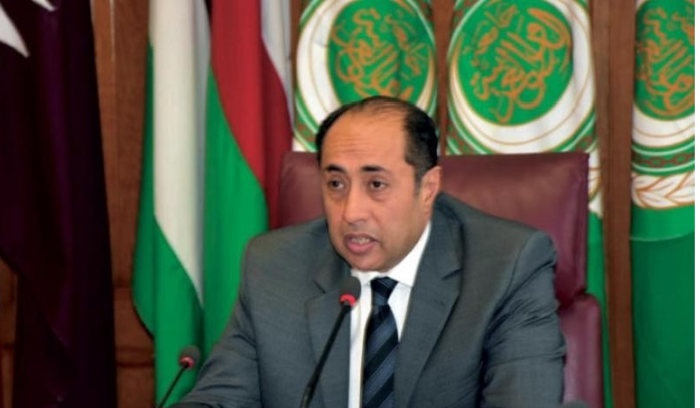
Arab League Deputy Secretary-General Hossam Zaki. (Credit: NNA)






Arab League Deputy Secretary-General Hossam Zaki said during a visit to Beirut that his trip reflects the League’s support for Lebanon’s efforts to assert full sovereignty and ensure weapons remain solely under state control. His remarks, made in an interview with Cairo News Channel and reported by the National News Agency, came as disarmament began Thursday at the Burj al-Barajneh Palestinian camp under a May agreement granting the state a monopoly on arms.
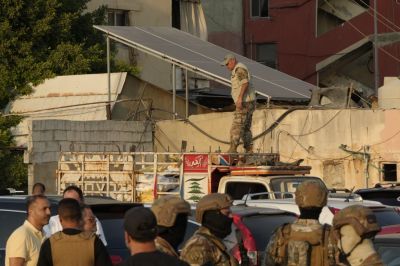
"The Lebanese government’s decision to task the army with preparing a plan to implement the principle of exclusive arms control aligns fully with resolutions of past Arab summits," Zaki said, noting that the Arab League was quick to express its support.
Zaki urged Arab and non-Arab states to swiftly provide tangible support to the Lebanese Army emphasizing that, “The League has never hesitated to provide moral and political backing to the Lebanese Army.” He added that the League, being a political organization, does not possess military support tools but continues its efforts to mobilize regional and international support for the army.
He continued: "If an international conference is held to support the army, the Arab League would welcome participation and would strive to generate the necessary momentum to encourage donor countries to provide essential assistance in support of Lebanon’s stability and the safety of its people."
Zaki noted that domestic fallout from the government’s decision — including media clashes and sharp political rhetoric — led to the dispatch of the Secretary-General’s envoy to Lebanon to reaffirm the Arab League’s support for the country’s sovereignty and exclusive arms control, as well as to help ease tensions.
Despite the truce, Israel continues to strike southern Lebanon and, less frequently, Hezbollah strongholds in the Bekaa Valley and Beirut’s southern suburbs. In an effort to halt the attacks, U.S. envoy Tom Barrack has proposed a “roadmap” outlining step-by-step measures between Beirut and Tel Aviv.
'Disagreement around principle of exclusive arms control lies in implementation, not objectives'
Zaki reiterated the "Arab League’s firm support for Lebanon’s ongoing demands to the U.S. mediator to pressure Israel into honoring its commitments, halting violations of Lebanon's sovereignty, and ending its occupation of Lebanese territory."

Despite the truce reached on Nov. 27, Israel continues to strike southern Lebanon and, less frequently, Hezbollah strongholds in the Bekaa Valley and Beirut’s southern suburbs. To end the attacks, U.S. envoy Tom Barrack has proposed a “roadmap” of step-by-step measures between Beirut and Tel Aviv. Lebanon has taken an initial step by officially accepting the plan and tasking the army with disarming Hezbollah and other armed groups by year’s end. In return, Israel is expected to gradually withdraw from positions it still holds in southern Lebanon and release Lebanese detainees from its prisons.
The government’s adoption of the U.S. roadmap has drawn sharp criticism from Hezbollah, whose Secretary-General, Naim Kassem, warned of potential internal conflict. Zaki emphasized that disagreement over exclusive arms control centers on implementation rather than objectives, noting that Speaker of Parliament Nabih Berri supports the principle but raised concerns about timing and feasibility in Lebanon’s complex reality.
Zaki said his meetings with Lebanese officials reflected broad consensus on rejecting sectarian rhetoric, reducing political escalation, and avoiding incitement, warning that inflammatory discourse could push the country down a dangerous path. He described his first meeting with Army Commander General Rodolphe Haikal as “excellent,” praising Haikal as a significant military figure with direct knowledge of the South Litani region. Zaki added that the commander’s vision was “realistic and serious,” reflecting the heavy responsibilities facing the Lebanese Army and its commitment to implementing political directives and strengthening state institutions.
On Thursday, after meeting President Joseph Aoun at Baabda Palace, Zaki stressed that “no one wants to see Lebanon sink into a situation with undesirable consequences.”
