






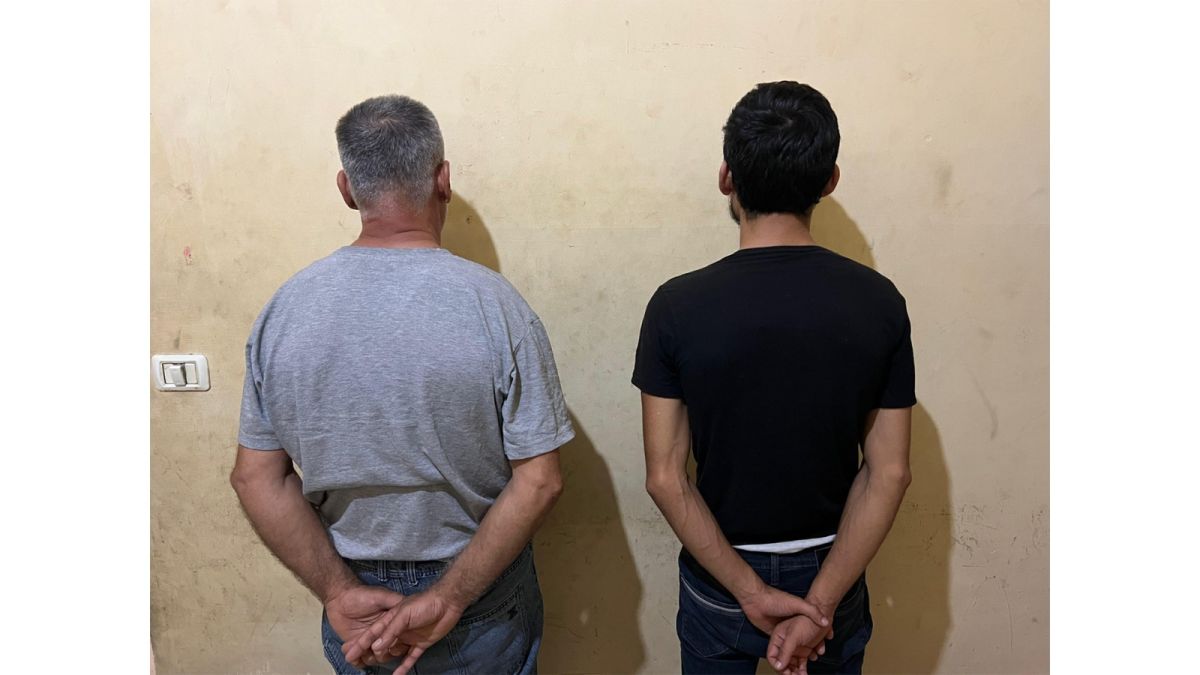
The two suspects, seen from behind, after the murder of a mother in Minyeh. (Credit: ISF website.)






BEIRUT — The Internal Security Forces (ISF) have arrested M.F. in Bhanine, North Lebanon, the main suspect in the murder of his sister, R.F., a young mother born in 1994, according to a statement issued Friday.
The victim's body was found at the family home on Aug.9 in Bhanin, in the Minyeh-Dinnieh district. The crime had been staged as a suicide and was reported as such by the media and on social networks, which said the young woman had hung herself with a piece of cloth. But the forensic examination revealed the cause of death was "strangulation" by another person.
"The forensic examination revealed scratch marks on the body as well as marks around the neck, confirming that the cause of death was strangulation," the police said in their statement.
Following an investigation by ISF intelligence services, suspicion fell on the victim's brother, who was arrested in Minyeh. The statement reports that, during his interrogation, the man, born in 1995, admitted to strangling his sister after informing his father (Y.F.).
The latter allegedly told him to "deal with the problem." Y.F. was also arrested and "admitted to the facts with which he was charged."
This femicide was described by a Bhanin resident as an "honor crime," that is, a crime committed in response to behavior perceived by some as having brought dishonor to the family and thus violating a so-called code of honor. The vast majority of victims are women, making it a femicide. The Council of Europe prefers the term "so-called honor crime," while the U.N. refers to it as a "crime in the name of honor," since "there is no honor in crime."
A mother of two children
According to rumors circulating in the village, the brother killed his already-divorced sister because she was in a relationship with another man. The victim had two young children, according to this resident. "That's what we hear here," he said.
At the end of December 2024, a femicide took place inside the Sharia court of Chhim, a locality in Chouf south of Beirut. On Aug.11, the ISF published a count of calls made to the emergency line reporting domestic violence in July. The document recorded 59 cases of physical violence, in which the main suspects were most often the victim's husband (28 cases), her father (23), or her brother (2).
Data on gender-based violence cases in Lebanon is scattered for 2024 due to the conflict between Hezbollah and Israel, which displaced much of the population, particularly from the South, the Bekaa, and the southern suburbs of Beirut.
The situation led to the interruption of services to combat such violence for several months, according to the annual report by the Gender-Based Violence Information Management System, which brings together several U.N. agencies. The disruption of these services resulted in a 38 percent decrease in the reporting of such incidents nationwide.

 2 p.m. recap: UNIFIL, Hezbollah at heart of debates; ballistic missile intercepted in Riyadh; pope operated for cancerous nodule