





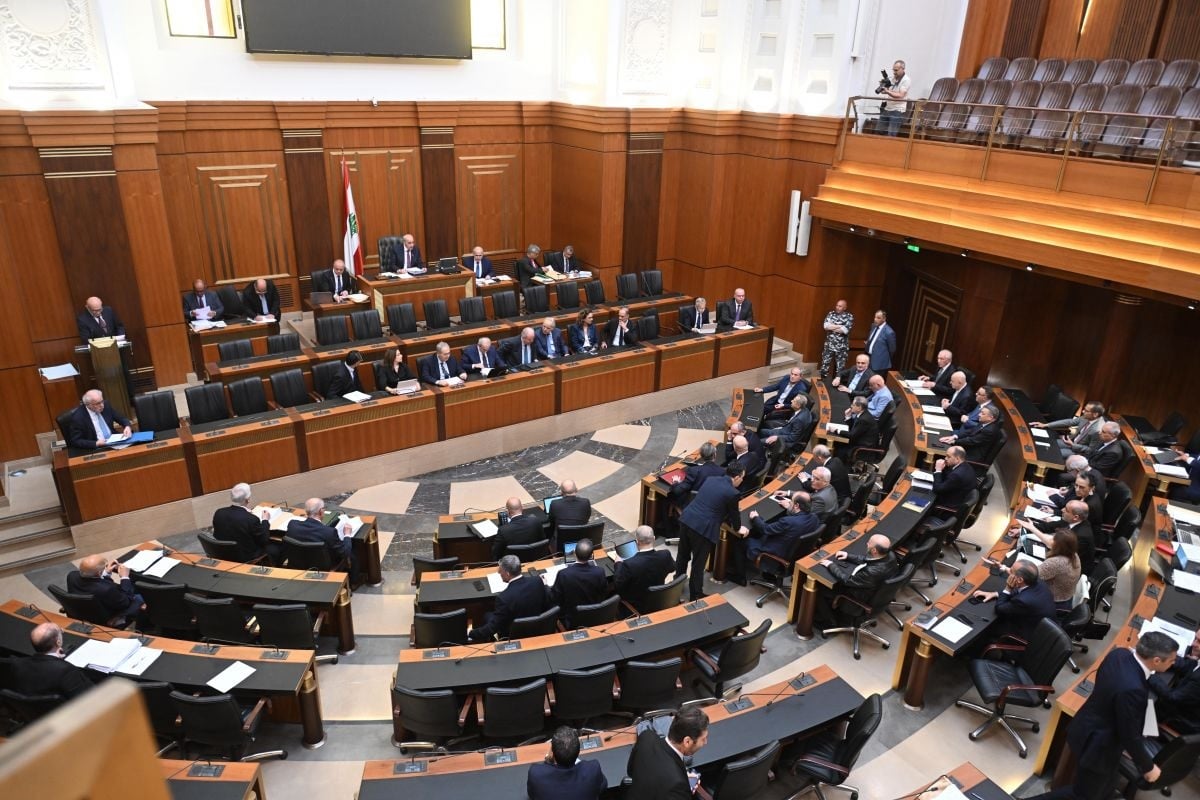
The Lebanese Parliament gathered on May 15, 2025. (Credit: Ali Fawaz / Lebanese Parliament)






Human Rights Watch (HRW) said in a report published on Aug. 15, 2025, that the bill on judicial independence, adopted by the Lebanese Parliament on July 31, is “a positive step” but “does not sufficiently guarantee judicial independence.”
The organization noted that “the new law includes some advances in judicial independence, notably greater autonomy and a larger role for judges in electing their peers.” However, the report continues, “it allows the government-appointed attorney general to order other prosecutors to halt ongoing judicial proceedings and limits the highest judicial body in Lebanon [the Supreme Judicial Council] in overcoming government deadlock and obstruction in judicial appointments.”
Ramzi Kaiss, an HRW researcher in Lebanon, said that “the Lebanese Parliament has made progress but has not truly seized the opportunity to protect the judiciary from political interference.”
The report also notes that, although the bill was signed by Parliament Speaker Nabih Berry and sent to Prime Minister Nawaf Salam and President Joseph Aoun, the parliament and government should amend the text. It has been widely criticized by civil rights groups, including the Coalition for Judicial Independence in Lebanon and Legal Agenda, for not taking their recommendations into account and for amendments made during its passage through the Administration and Justice Committee.
“The draft presented in 2018 followed very high standards,” said Nizar Saghiyé, executive director of Legal Agenda, cited in the report. He acknowledged progress on transparency in judicial elections and freedom-of-expression guarantees but said there is still a long way to go.
The new law indeed expands judges’ in the process of electing their peers and strengthens self-governance in appointments, disciplinary measures, and the transfer of cases among magistrates. It also tasks the Supreme Judicial Council (SJC) with developing internal judicial regulations and a judicial code of conduct. Article 53 states that “judges are independent in the exercise of their functions” and “cannot be transferred, evaluated, sanctioned, or suspended from their judicial duties, except in cases provided by law.” Judges remain irremovable for four years unless subject to disciplinary proceedings, and they cannot remain in the same position for more than five years. However, whereas the original version stipulated that the vast majority of SJC members should be appointed by their peers, following the recommendations of the Venice Commission (the Council of Europe’s advisory body on constitutional matters), the bill was amended to increase the number of judges appointed by the government from three to four out of eight.
What worries civil society most is that the government-appointed public prosecutor is still authorized by law to instruct other prosecutors to take legal measures of their choosing, giving them powers that remain excessive, according to the report.
Civil society also highlighted significant violations in the legal process of adopting the text. These included “last-minute amendments that members of Parliament could not examine before the vote, as well as a random tallying process that led some journalists and MPs to conclude that the bill had not received a majority of votes,” the report notes.
“We did not discuss the law, and the text was not put to a vote. They called certain names [of parliamentarians], then the law was approved,” said MP Halimé Kaakour (protesting) in a video posted on social media, a statement cited by HRW.
Finally, the report raised the need for the government to ensure that the military prosecutor’s office no longer handles civilian cases, contrary to its internal regulations. The appearance of civilians before this “special” body had become commonplace in recent years, in what the organization described as attempts at “intimidation.”
The HRW report also notes that the newly adopted law is subject to review by the Constitutional Council and should be amended.
“The adoption of this law represents a first step in judicial reform, but the struggle will not be over until Lebanese leaders permanently remove the legal provisions used to obstruct and paralyze the work of the judiciary,” concluded Ramzi Kaiss.

 Evening recap: Netanyahu announces West Bank offensive; 7 killed in Jordan church shooting; tents burned in south Lebanon
 US strike on Iran this weekend? ‘Absolutely,’ says Barrack; ‘I have no idea,’ says Trump