






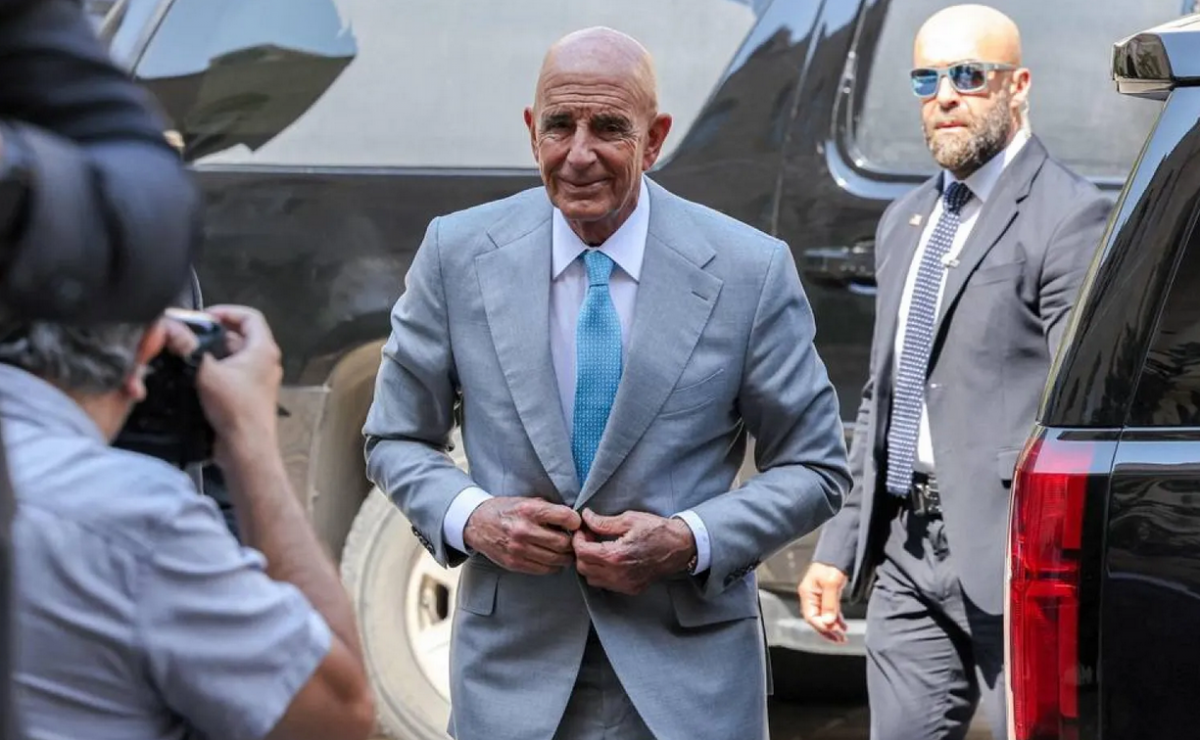
American envoy Tom Barrack during his most recent visit to Lebanon on July 21, 2025. (Credit: AFP)






Iran has drawn its red line in Lebanon: supporting Hezbollah and all its allies, refusing to surrender weapons, while emphasizing a clear watchword — "dialogue and consensus" — to handle this issue. This was the message conveyed during the official meetings of the Iranian envoy on Wednesday in Beirut.
But in the political meetings held with forces and groups allied with Tehran, Ali Larijani stated that Iran had not emerged defeated from the war with Israel, that it was working to develop its capabilities and technologies and would seek to provide all the required support in its own way. The question many are asking remains about the modalities of this support, particularly after the fall of the Assad regime and the tightening of pressure on Hezbollah, both militarily and financially. The day after Iran’s position was announced, the Lebanese file was on the table for the French and Americans.
The fate of UNIFIL
France on Thursday hosted a political, diplomatic, and military meeting bringing together French officials, notably Anne-Claire Legendre, who is in charge of the Middle East file, and heads of the French army, alongside American military commanders from the United States Central Command (CENTCOM) and the U.S. envoy for Syria and Lebanon, Tom Barrack, L’Orient-Le Jour learned from diplomatic sources.
In practice, the meeting addressed all regional issues, but focused in particular on the Lebanese file, without dissociating it from Syria, given the international perception that Lebanon remains linked to Syria due to their interconnected stakes and the fact that Damascus constitutes both a point of connection with Lebanon and a cut-off point with Hezbollah and its supply routes.

The meeting had several goals, the main one being to examine the process of renewing the mandate of the United Nations Interim Force in Lebanon (UNIFIL). France, which is in charge of preparing the written proposal, is trying to convince the United States to extend UNIFIL's mission, maintain its budget and troop numbers, and broaden its prerogatives and field of action. In Washington, some favor a reduction of the budget and the troop numbers, as well as a shortening of the mandate, while others support a final one-year renewal after which UNIFIL would withdraw from Lebanon.
Follow-up of government action
Another concern was boosting the work of the cease-fire monitoring committee and holding more frequent meetings to ensure the agreement's implementation, as well as the implementation of the plan by Barrack and adopted by the Lebanese government. Washington appeared ready to grant Paris a greater role in this area. The debate also focuses on Israel’s condition: in case of a withdrawal from southern Lebanon, French and American forces, or a multinational force, should be deployed at certain strategic points and hills, with Israel refusing the entry of the Lebanese Army or UNIFIL.
The third goal is to accompany the Lebanese government's decision to monopolize weapons in the hands of the state and withdraw those from Hezbollah, by monitoring the implementation plan that the Lebanese Army must establish by the end of the month, as well as how to implement it. Discussions also concern the support Washington could give — including pressure on Israel to stop its strikes and violations — to facilitate the government's work. The expected support for the army must be financial, military and logistical, with ongoing discussions among several capitals to increase their contributions.
Barrack’s visit
The fourth objective deals with American and French coordination on Syria, with Barrack showing keen interest in the success of the new Syrian administration. Washington is relying on Syria to cut all Hezbollah supply lines. France has a historic interest in Syria: it has obtained several investments in the country and hosts meetings between Ahmad al-Sharaa’s government and the Syrian Democratic Forces (SDF) to reach an agreement, and also sponsored a Syrian-Israeli meeting to find a security arrangement in southern Syria.
On Monday, Barrack, accompanied by former U.S. envoy Morgan Ortagus, will be back in Beirut. The Lebanese are waiting to see whether this visit will bring political aid to the country or new demands, especially as some voices in Washington and Israel believe that no topic should be discussed until the Lebanese Army begins implementing its plan for the withdrawal of weapons. This plan, still under development, was the focus of discussions during the tour by the army’s commander, Rodolph Haykal, to visit President Joseph Aoun, Prime Minister Nawaf Salam and Parliament Speaker Nabih Berri.
He presented them with the overall military situation, the achievements of the troops so far, its needs to achieve its objectives and how to support it politically by strengthening and providing all necessary human, military, financial, and informational means, as well as the conditions allowing it to continue its deployment to extend the state’s sovereignty over the entire territory.
