






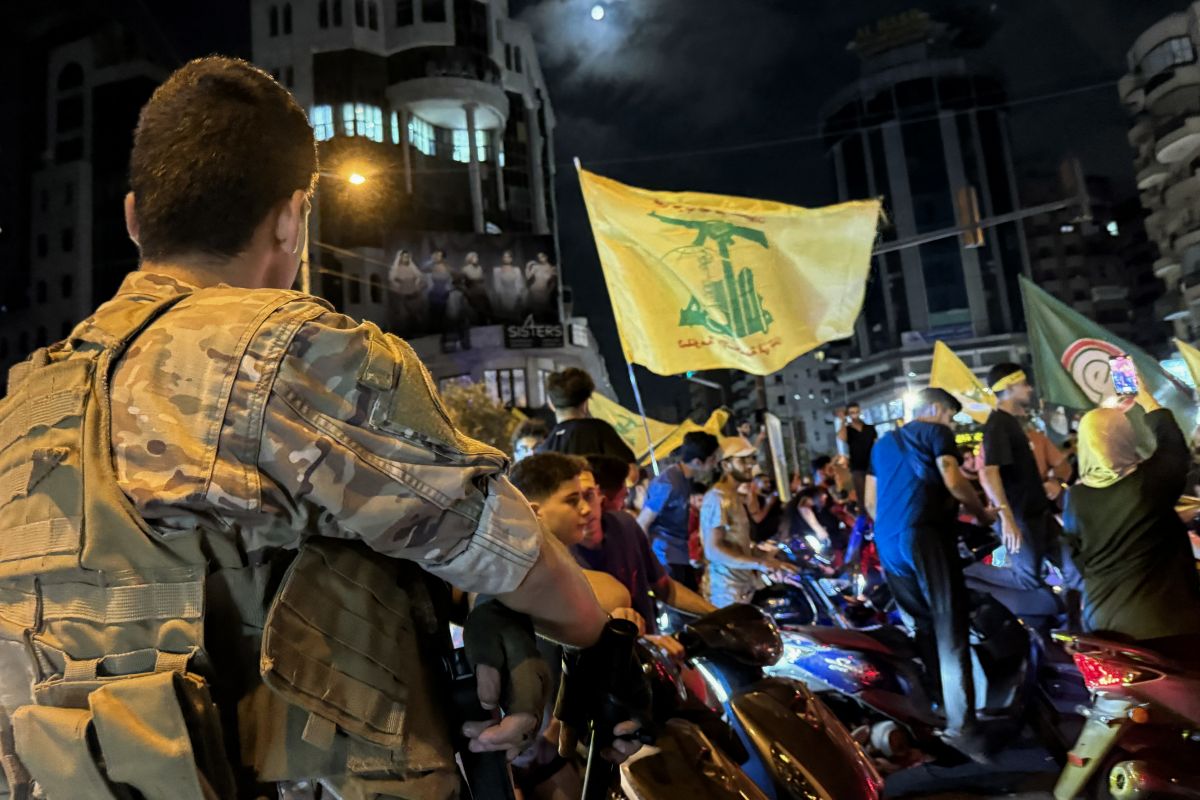
Soldiers deployed in the southern suburbs of Beirut during a Hezbollah convoy, on Aug. 7, 2025. (Credit: Ibrahim Amro/AFP)






The secretary of Iran's Supreme National Security Council is traveling Monday to Iraq, then to Lebanon, where the government has approved a plan to disarm Hezbollah, an Iranian ally, according to Iranian state media.
"Ali Larijani is leaving today [Monday] for Iraq and then Lebanon for a three-day visit, his first trips abroad since taking office [last week]," state television reported. He is expected in Beirut on Wednesday, according to Saudi channel al-Hadath.
The Iranian official's visit comes after the Lebanese government tasked the army with preparing a plan to disarm Hezbollah by the end of the year.
"Lebanon is one of the important and influential countries in the region and in West Asia. We have long had civilizational and historical relations with its people and government," Larijani told Iran’s IRNA news agency on Sunday.
Referring to "broad and long-standing cooperation with the Lebanese government and people," he said he had also held "consultations on various regional issues," without giving further details.
Asked about his visit to Beirut, Larijani said Iran’s position in Lebanon "have been known for a long time: we consider that national unity in Lebanon is of paramount importance and that it must be preserved in all circumstances," as well as "the sovereignty and independence of Lebanon, [which] have always been at the center of our attention."
"Strengthening trade relations between the two countries is also one of the other important issues that we attach importance to," he said.
Larijani added that Lebanon "has a long history of dealing with such [sensitive] situations and has recently conducted an intense confrontation with the Zionist entity [Israel], as have we. This is why this type of dialogue can always contribute to establishing stability in the region,” said Larijani, who until a few days ago was a senior adviser to Supreme Leader Ali Khamenei before taking up his new post.
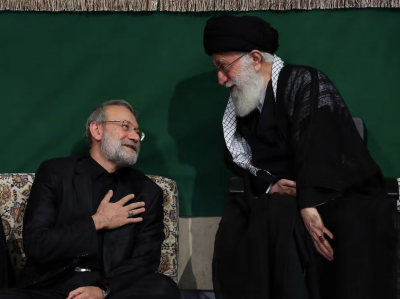
Larijani to sign security pact in Baghdad, cites shared regional stability goals
On Iraq, Larijani said he had "prepared a security agreement" that will be signed during his visit to Baghdad. He called the deal "extremely important, because Iran’s vision and method in its relations with its neighbors is based on the principle that the security of Iranians is a priority, while also giving importance to the security of neighbors — unlike some countries that limit security to themselves and ignore or harm other peoples in the region," in what appeared to be a reference to Israel.
He also praised "cooperation between the two peoples ... at a very high level," citing as "one of the best examples" the annual commemoration of Arbaeen (The 40th), the Shiite observance marking the end of the mourning period for Imam Hussein 40 days after his death.
Iranian Foreign Ministry spokesperson Esmail Baghai told the channel the trip was aimed at "contributing to the maintenance of peace in the Middle East." He said Iran recognized Lebanon’s "right to defend itself against the aggression of the Zionist regime [Israel]," which he added "would be impossible without military capabilities and weapons."
'Leave Iran in Iran'
Lebanese Forces MP Ziad Hawat and Kataeb MP Elias Hankash strongly criticized the trip. "Leave Iran in Iran ... and Lebanon and the interests of the Lebanese in the hands of Lebanese officials, under the auspices of the state, the Constitution, and the Taif Agreement," wrote Hawat, an MP from Jbeil, on X. "What is happening, namely Iran's blatant interference in the issue of handing over Hezbollah's weapons and inciting obstinacy and the retention of these weapons, is contrary to the Constitution, the laws, the founding concepts of the state, Lebanese interests, and international customs."
The same tone was used by Hankash, who spoke of "Iran's audacity."
"Iran is encouraging Hezbollah not to hand over its weapons, pushing it to more wars and destruction in Lebanon, to more forced displacement, to more murder and bloodshed ... while it negotiates with the one it calls the 'Great Satan.' And now we have news of Larijani's visit ... Insolence beyond insolence," he posted on X.
Former President Michel Sleiman, with his well-known sovereigntist positions, asked that "the [Iranian] visitor bring with him an official clarification concerning Tehran's positions expressed after the government's recent decision on the exclusivity of weapons," specifying that this "clarification should constitute an essential condition for meeting any official, so that a clear and explicit Lebanese position is adopted on the issue of interference in internal affairs."
Accusations of interference
On Saturday, an adviser to Iran's supreme leader, Ayatollah Ali Khamenei, said his country "certainly" opposed the Lebanese government's decision to disarm Hezbollah. The Lebanese foreign ministry, in turn, condemned what it called "a flagrant and unacceptable interference" by Iran in Lebanon's internal affairs. On Wednesday, Tehran said it would support any decision made by Hezbollah, which was severely weakened by its latest war with Israel and the fall of its former ally Bashar al-Assad in Syria.
A 12-day war in June saw Iran and Israel face off, sparked by an unprecedented campaign of Israeli strikes inside Iranian territory, to which Tehran responded with missile and drone attacks.
Regarding Larijani's visit to Iraq, Iranian television said his "main objective" was "the signing of a bilateral security agreement," without giving further details.
