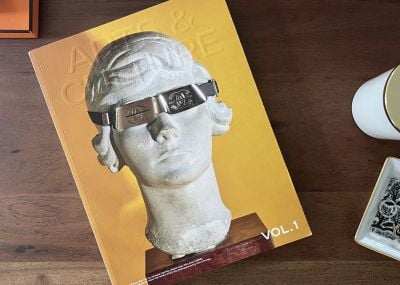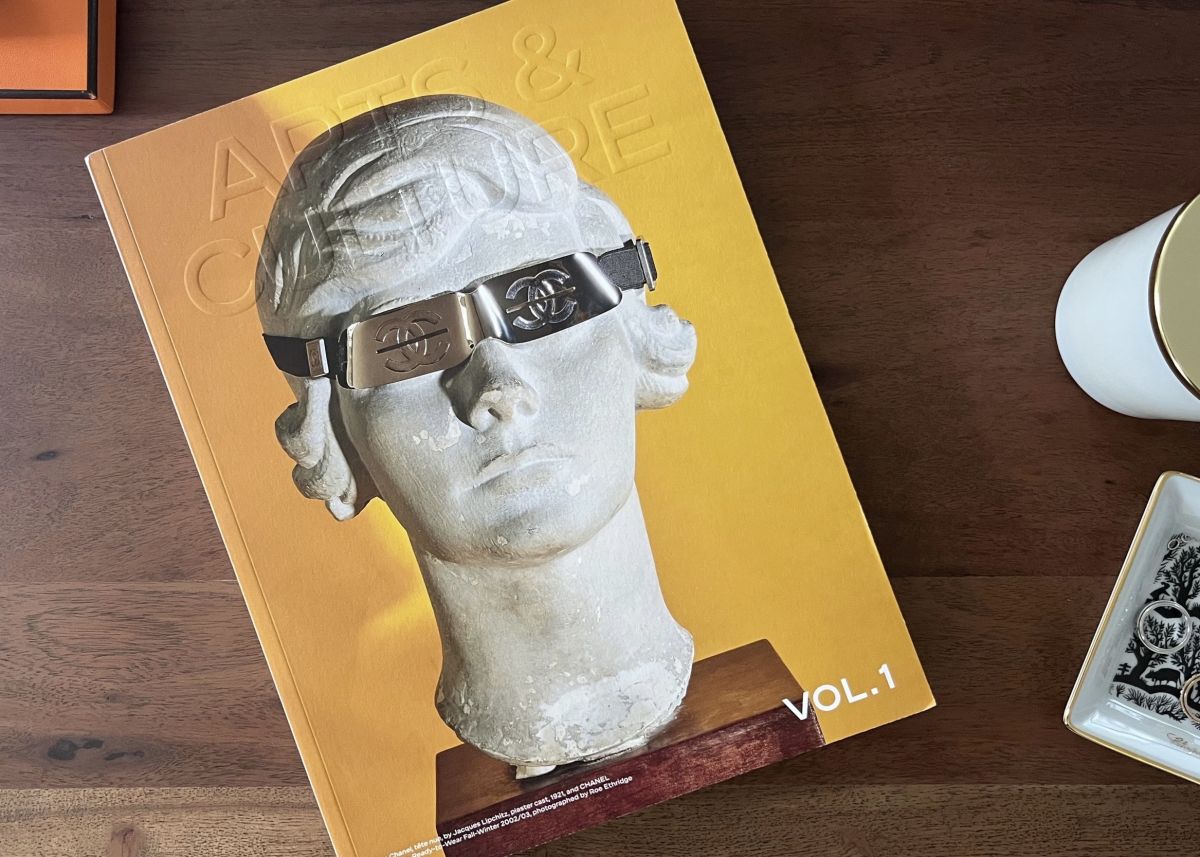
Cover of Vol. 1. (Credit: Chanel/Roe Ethridge/Jacques Lipchitz)






A 250-page magazine features an enigmatic cover with a cubist bust of Gabrielle Chanel, sculpted by Jacques Lipchitz in 1921, wearing metallic glasses from a 2002 show. Roe Ethridge took the photograph, and Chanel designed the piece.
The Chanel Arts & Culture Magazine – volume 1, published in June 2025, is not just a simple brand supplement. It is a love letter to ideas, creation and transmission, distributed only in 23 independent bookstores worldwide, from Tokyo to London, via Paris, Zurich or Bangkok.
You won’t find it online. You’ll have to go get it, making it a little treasure hunt. Then, you'll leaf through it slowly and carefully, and finally, line it up like a rare collector’s item with other magazines that became cult favorites the moment they were published.
One naturally thinks of Égoïste, the cult magazine launched in 1977 by Nicole Wisniak, all in black and white, embodying pure rigor and mystery. It shares a love for luxurious paper and the same goal of bringing together great writers, artists and photographers in a free space.
It also reminds me of Visionaire, the art and fashion magazine launched in the 1990s, with each issue designed as a one-of-a-kind piece, somewhere between an artist’s book and a surprise box. Past issues are nearly impossible to find, sometimes auctioned by major houses.
In the same category, you could add The Gentlewoman, which explores femininity through interviews and staging in a more contemporary style, with intelligence and precision.
Haute couture lore
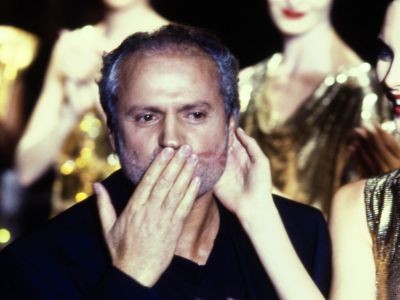
Nine days before his assassination, Gianni Versace left the world a final message
If this first volume is unlike any other, it still engages with an editorial constellation that is as selective as it is visionary. Chanel Arts & Culture draws from its own heritage and from a specific French idea of culture as a driving force.
The initiative is led by Yana Peel, who has headed Chanel’s cultural programs since 2020. A former director of the Serpentine Gallery in London, she believes that the great houses should move beyond just sponsorship roles. They need to co-create — generate meaning, give a voice and build networks of ideas.
Chanel aims to make this publication the highlight of a larger ecosystem: the Chanel Culture Fund, launched in 2021, which supports museums, art projects and emerging artists worldwide. The Chanel Next Prize identifies upcoming talents. The Chanel Art Partnerships benefit the Centre Pompidou, Moscow's GES-2 or the National Portrait Gallery.
Within the pages of this first volume, you’ll find Tilda Swinton discussing the avant-garde and icons. Digital artist Refik Anadol explores data as sensitive material. The visual artist is Tracey Emin, the video artist is Cao Fei, and the director is Savanah Leaf.
Also, architect Peter Marino, art historian Rose Lee Goldberg and several Next Prize winners, all at the intersection of new disciplines.
It is not about selling Chanel products, but about inspiring readers to think, dream and preserve the present — a stand against the flow of digital streams flooding our lives. Here, each text serves as a pause, and each image forms part of a narrative that goes beyond fashion to touch art and ideas.
Through this project, Chanel reminds us that luxury, beyond material possessions, is primarily about storytelling. Gabrielle Chanel, in her time, had already understood that clothing could serve as agents of emancipation and language. Today, her house continues this legacy with another medium.
Gradually abandoned due to costs and the shift of a new generation that gets its information from digital media and social networks, print publications themselves are becoming luxury items, and they behave as such, aiming for quality and rarity.
This first volume should be regarded as a book-magazine that both reflects its era and goes beyond it — a collector’s item, but above all a catalyst.
In a world flooded with images, where culture is often pushed into the background by algorithms, Chanel’s editorial gesture invites us to indulge in pleasure and to slow down.
This article was translated from L'Orient-Le Jour.