






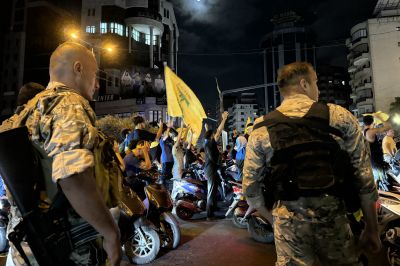
Soldiers are deployed as Hezbollah supporters take to the streets in cars and on motorcycles to protest the government’s support for a plan to disarm the group, in the southern suburbs of Beirut, on Aug. 7, 2025. (Credit: Ibrahim Amro/AFP)






On Saturday evening, the Lebanese Ministry of Foreign Affairs condemned statements made earlier in the day by Ali Akbar Velayati, adviser to Iran’s Supreme Leader, in which he expressed Tehran’s opposition to the Beirut government’s decision to disarm Hezbollah. For the second time this week, it denounced what it called “unacceptable” interference in Lebanon’s internal affairs.
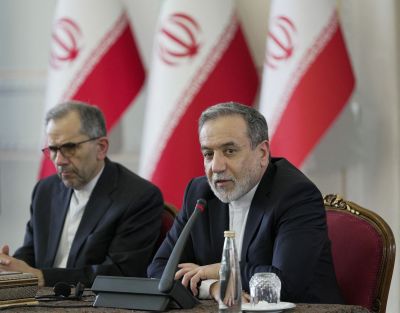
Lebanese diplomacy “strongly condemns” the statements by the Iranian official, “which constitute blatant and unacceptable interference in Lebanon’s internal affairs,” according to a communiqué from the Bustros Palace. The statement recalls that “this is not the first time such interference has occurred” and describes it as “unacceptable behavior that will under no circumstances be tolerated by the Lebanese State.”
“Lebanon will not allow any external party, whether friend or foe, to speak on behalf of its people or claim any form of guardianship over its sovereign decisions,” it stresses, calling on the Iranian authorities to “focus on the problems of their own people.” Rejecting any “interference, diktat, pressure, or violation,” the Lebanese Foreign Ministry affirms that the State “will respond, in accordance with diplomatic practice, to any attempt to undermine the authority of its decisions,” though it does not announce a summons of the Iranian ambassador or any concrete measures.
An adviser to Iran’s Supreme Leader, Ayatollah Ali Khamenei, said Saturday that his country opposes the Lebanese government’s decision to disarm Hezbollah, the movement allied with Tehran, according to a local media report.
Last Tuesday, the government of Nawaf Salam announced it had tasked the army with preparing a plan to implement the disarmament of militias, including Hezbollah, before the end of the year. Two days later, the cabinet approved the “objectives” laid out in a roadmap proposed by U.S. envoy Tom Barrack to ensure the proper implementation of the ceasefire agreement, which came into effect on Nov. 27, 2024, after 13 months of war between Hezbollah and Israel.
‘Iran has always helped the Lebanese people and the Resistance’
“The Islamic Republic of Iran is certainly opposed to the disarmament of Hezbollah, because Iran has always helped the Lebanese people and the Resistance, and continues to do so,” Ali Akbar Velayati said in an interview with the Tasnim news agency.
On Thursday, the deputy commander of the Quds Force of Iran’s Revolutionary Guards, Brigadier General Iraj Masjedi, also commented on the Salam government’s decision. He asserted that Hezbollah “will never be disarmed.” “The American-Zionist axis will not succeed in disarming the ‘Resistance,’” he insisted.
Recent remarks by Iranian Foreign Minister Abbas Araghchi had already sparked outrage in the Land of the Cedars. He had stated that Iran would support any decision taken by the Shiite party. According to comments cited by some local media but absent from the transcript of an interview published by the Islamic Republic News Agency, Araghchi had also said the Hezbollah disarmament plan “is doomed to fail.” Lebanese Foreign Minister Joe Raggi denounced this as “Iranian interference.”
The “Barrack Plan” calls for the disarmament of Hezbollah and other armed groups by the end of the year, along with a set of other measures, such as implementing a series of reforms, supporting the Lebanese Army, and demarcating the borders with Syria and Israel.

 7 p.m. recap: Saudi Arabia warns Houthis as Israeli strikes hit south Lebanon