


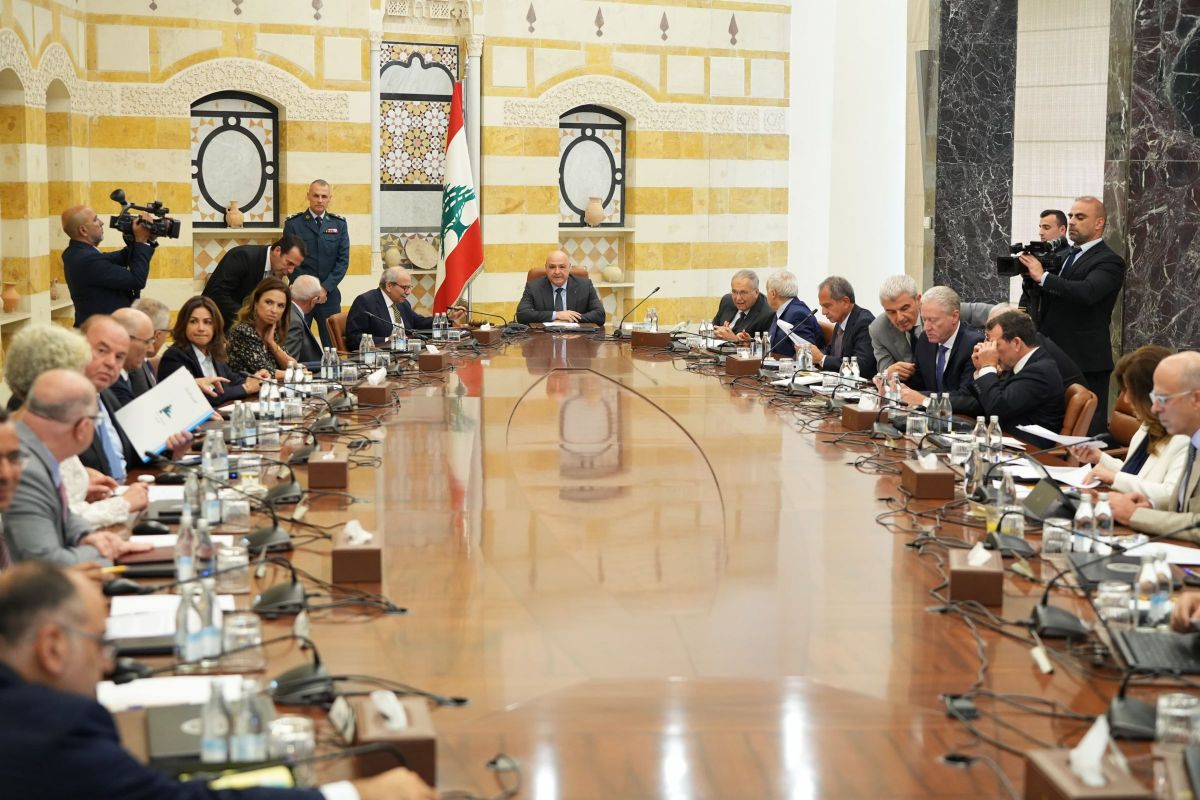
The government meeting at the Presidential Palace in Baabda, on August 7, 2025. (Credit: Mohammad Yassin/L'Orient Today)






Thursday’s Cabinet meeting — during which Prime Minister Nawaf Salam’s cabinet adopted the “goals” of a roadmap proposed by U.S. envoy Tom Barrack to restore calm between Lebanon and Israel — divided the Lebanese press. Some outlets welcomed the move, while others harshly criticized the authorities. To signal their disapproval, all Shiite ministers withdrew from the meeting before the vote, including Amal and Hezbollah ministers, as well as Fadi Makki, who is neither affiliated with Hezbollah nor the Amal Movement.
The U.S. roadmap calls for “gradually ending the armed presence of all non-state factions, including Hezbollah, throughout Lebanese territory, both south and north of the Litani,” among 11 measures intended to ensure proper implementation of cease-fire modalities in effect since November 2024.
On Friday morning, Nidaa al-Watan, close to the Lebanese Forces (LF), ran a photo of the Shiite ministers who left the Cabinet meeting, with a headline accusing them of “breaking with the national consensus.” The newspaper claimed the Shiite ministers were receiving instructions via WhatsApp during the session: “It appeared they were torn between participating in the discussion and consulting instructions received on WhatsApp.”
The daily An-Nahar also welcomed the government’s decision, headlining: “The decisive resolution progresses, and the Barrack plan overcomes obstacles.” The newspaper noted that despite their opposition, Hezbollah and Amal did not, this time, resign and withdraw from government, as they did in 2006 following failed talks on forming a national unity government under then-Prime Minister Fouad Siniora.
Meanwhile, the moderate daily al-Joumhouriya took a more nuanced tone, noting that the withdrawal of Shiite ministers from Cabinet for the second time exposed the government to a “disruption of the balance of the National Pact.”
'Bin Farhan government' and American diktats
On the other side of the political spectrum, criticism of the government was particularly harsh. Al-Akhbar, close to Hezbollah, described the session as a “coup d’état,” a term the publication had already used earlier in the week. “Barrack congratulated Aoun and Salam on the coup d’état,” the newspaper wrote, dubbing the Cabinet the “Bin Farhan government,” referring to Saudi Foreign Minister Faisal bin Farhan al-Saud. “Lebanon remains under the grip of the coup d’état led by Presidents Joseph Aoun and Nawaf Salam during the ministerial session on Aug. 5,” the newspaper said, adding it was a “complete capitulation to American-Saudi diktats.”
Similarly, Addiyar, once considered close to ousted Syrian President Bashar al-Assad’s regime, said the principles of the “National Pact” had fallen for the first time under the current presidential term’s first government. “This is an early warning that will have consequences if the country sinks further into divisions because of submission to American diktats, with Washington having succeeded in transferring the problem onto the Lebanese domestic scene,” Addiyar wrote.
As for the publication al-Bina, affiliated with the Syrian Social Nationalist Party (SSNP), an ally of Hezbollah, it denounced the adoption of the roadmap, saying it proved that “talk of sovereignty in government rhetoric is merely a slogan used for marketing, promotion, and diversion purposes.”
 7 p.m. recap: Flames, smoke reported near Aramco site near Riyadh; Houthis accuse Saudi Arabia of 56 strikes on Sanaa