





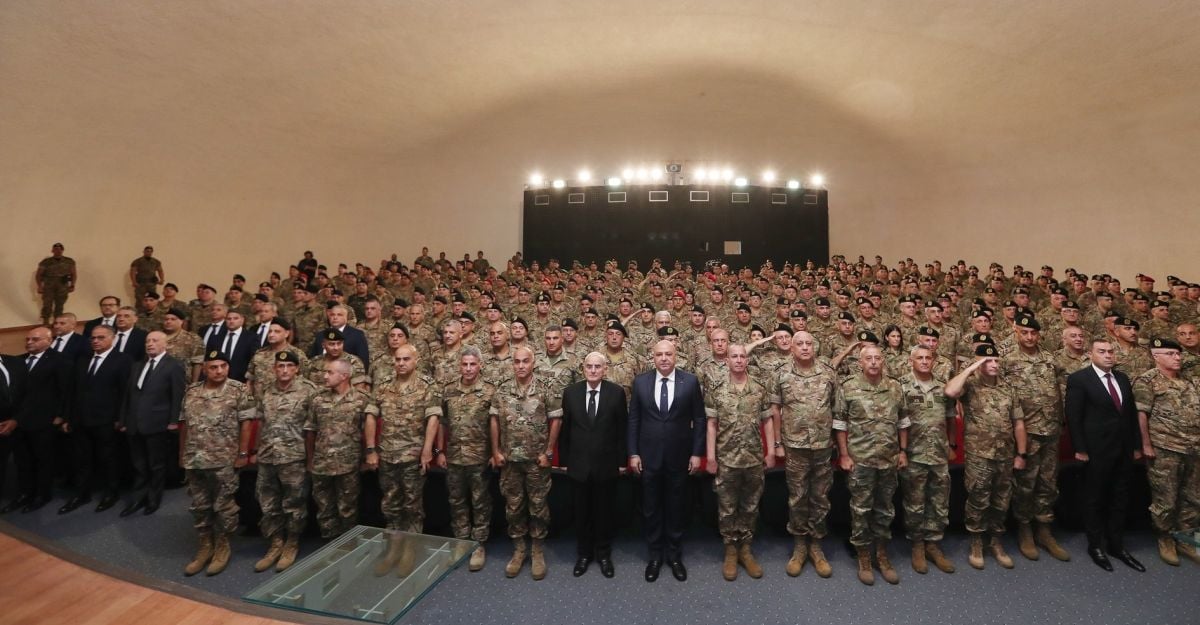
President Joseph Aoun, surrounded by Army Chief Rodolph Haykal and a number of officers on the occasion of Army Day, July 31, 2025, in Yarzeh. (Credit: Lebanese Presidency)






Two dates, five years apart, one challenge.
On Aug. 4, 2020, the explosion at the Port of Beirut showed the world the full extent of Lebanon’s state failure. Five years later — almost to the day — the Cabinet is convening amid a similarly explosive climate to tackle the taboo issue of Hezbollah’s disarmament.
This timing may be nothing more than the irony of history, but it rings like a harsh reminder for the country’s urgent need to diffuse its ticking time bombs.
The real question now is whether the state finally intends to take back control — or whether, like in 2020, it will once again choose silence and delays until the next detonation.
Adding to an already busy schedule is a third date: May 5, 2008 — the day a Cabinet meeting tore off all the masks. Two days later, Hezbollah carried out a coup de force in Beirut and the Chouf region to pressure Fouad Siniora’s government to reverse its decision to dismantle the group’s telecommunications network and dismiss the head of airport security in Beirut, who was close to Hezbollah.
If, for the past two days, Hezbollah — through its media mouthpieces — has been relentlessly drawing a parallel between the two sessions, it’s because it finds itself cornered once again. In fact, both internal and international pressures are converging to present the party with a fait accompli: the time has come to hand over its arsenal to the Lebanese Army.
However, 17 years later, the threat of civil war seems to be the only real weapon left at Hezbollah’s disposal. This one, it wields freely, without fear of the drones monitoring it day and night or the missiles that could strike.
It makes (unofficial) calls for mobilizations in the streets against “the death of the resistance”; it launches a violent campaign smearing President Joseph Aoun, who, since his last speech, is perceived in the eyes of Naim Qassem as one of those “serving the Israeli project.” Escalating the pressure to its highest point seems to be the order given by Hezbollah and Iran.
But what’s really happening behind the scenes, and in reality? And more importantly, is Hezbollah still capable of “cutting off hands” to defend its weapons? First, it’s essential to understand the unprecedented context in which the party has been evolving since the “flood” that swept it away. This is the first time in decades that the issue of weapons has been added to the agenda of a Cabinet session, the highest executive body of the state.
This shift marks a major turning point, breaking with years of passivity, sterile dialogues, and the deferral of the issue to the regional level.
Such a move is akin to removing the political cover that had until now shielded the party’s armed existence. As a result, Hezbollah is on the verge of being officially classified, by the state itself, as an illegitimate militia.
Never before has Hezbollah been so marginalized in the Lebanese decision-making process. There is also a new factor that is tipping the scales: several of the party’s traditional allies, who until now defended the “resistance” or carefully avoided taking a stance, are beginning to shift to the other side of the political spectrum.
The moumanaa axis is cracking, yesterday’s loyalties are breaking up, and the balance of power is faltering, revealing the emergence of a new political order in which Hezbollah’s military hegemony no longer appears as an unquestionable reality.
To delay things, it seemed to be relying on President Aoun’s caution – or rather, taking advantage of it – believing that the head of state would oppose holding the Cabinet session or continue to treat the matter as part of a discreet bilateral dialogue.
But surprisingly, on July 31, Aoun, for the first time, explicitly ordered it to lay down its weapons and directly addressed the Shiite community, urging them to “bet on the state.”
The day before, Hezbollah’s leader loudly proclaimed to anyone who would (still) listen that the weapons would not be surrendered and that the sacrifices of his popular base will not be in vain.
Two speeches, two visions, two Lebanons: one clinging to an era where illegitimate force reigned, the other aspiring to a state finally in control of its destiny.
Aoun has not changed. It is the danger that has become imminent. His silence of yesterday was a bet on dialogue; his firmness today is an alarm signal. And the confrontation is just beginning, under the watchful eyes of the international community.
Hezbollah may still have the option to persist in the logic of power balance, waiting for instructions from Tehran. It is free to “commit suicide,” as the justice minister said. But Lebanon cannot continue to stand still. We already know it from experience: when the state hesitates to assume its responsibilities, others step in – with their own methods, and often to their own advantage.
The time has come to make a choice. This Tuesday, it’s not just a Cabinet meeting; it’s a rendezvous with History.

 Evening recap: Netanyahu announces West Bank offensive; 7 killed in Jordan church shooting; tents burned in south Lebanon
 US strike on Iran this weekend? ‘Absolutely,’ says Barrack; ‘I have no idea,’ says Trump