





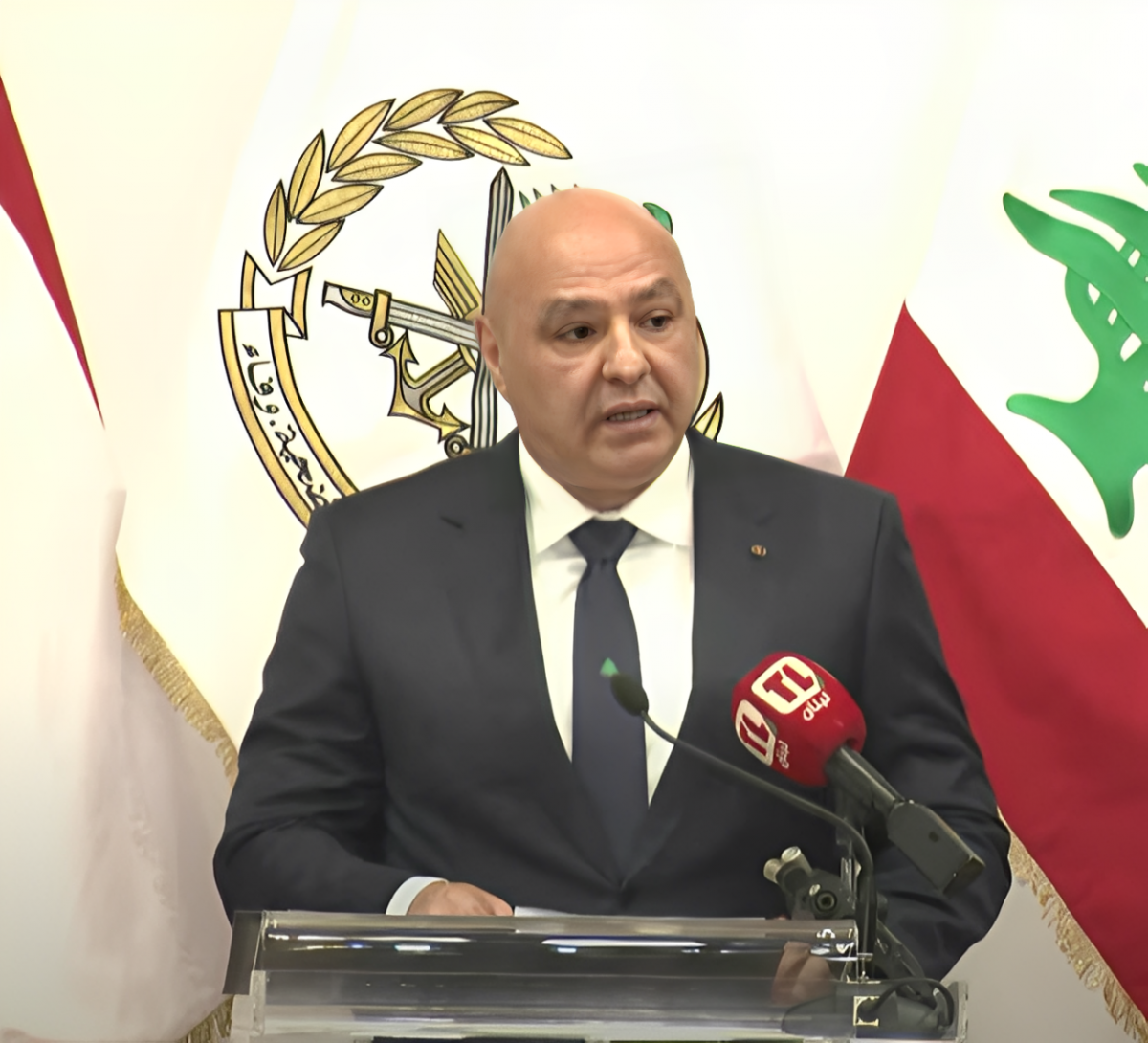
Joseph Aoun during his speech on the occasion of the 80th anniversary of the Lebanese Army, July 31, 2025. Screenshot.






BEIRUT — On the occasion of the 80th anniversary of the Lebanese Army, President Joseph Aoun delivered a forceful speech calling for the army and security forces to hold the exclusive right to bear arms “across all Lebanese territory,” and to do so “starting today.”
His remarks were directed both at Hezbollah — urging the party and its base to “place their bet on the Lebanese state” — and at his critics, whom he urged to avoid “provocation and one-upmanship.”
Speaking from the Defense Ministry, where he laid a wreath in honor of fallen soldiers, Aoun said it is “the duty of all political forces, through Cabinet, the Higher Defense Council, Parliament and all parties, to seize the historic opportunity to clearly affirm that arms must be held exclusively by the army and security forces, across all Lebanese territory, starting today.”
Recalling his pledge in his January inaugural address to enforce a monopoly on weapons, Aoun stated this is an oath he “will never abandon.” He said such a monopoly is essential for the international community to “restore confidence” in the Lebanese state and its ability “to defend against constant Israeli attacks and terrorism.”
Debate on disarmament reaches Cabinet
Aoun’s remarks come amid heated domestic and international debate over the issue of exclusive control of arms — particularly the disarmament of Hezbollah — and ahead of a Cabinet meeting Tuesday where the issue is expected to be discussed.
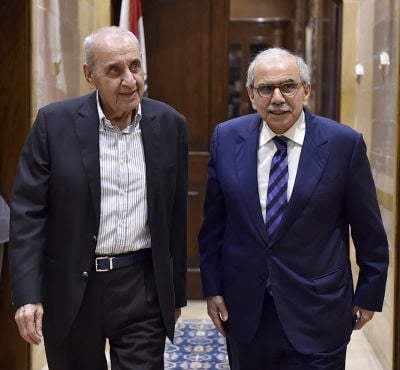
His comments also indirectly addressed statements made Wednesday night by Hezbollah Secretary-General Naim Qassem, who said the group’s weapons are “meant to resist Israel, not to be used domestically,” and that any call for Hezbollah to disarm “serves the Israeli project.”
Standing before Lebanese and army flags, Aoun noted that he had “entrusted the army with the task of monitoring the cease-fire” in coordination with the international committee established upon the truce’s implementation.
“Despite its limited resources and numerous missions, the army succeeded in asserting its authority over the unoccupied area south of the Litani River, recovering weapons and destroying those that were unusable,” he said proudly, affirming that the army is “determined to continue its mission by recruiting over 4,500 soldiers, training and equipping them, and completing its deployment, despite Israel’s failure to meet its obligations.”
He also noted that the army had been supported in its southern deployment by local residents, “who have always exemplified patriotism and resilience.”
Lebanese demands in U.S. negotiations
Aoun then revealed several points presented by Lebanese authorities during ongoing negotiations with the United States, following two visits by American envoy Tom Barrack aimed at “enforcing the cease-fire.” These demands include the immediate halt of Israeli violations of Lebanese sovereignty, “including targeted killings,” the withdrawal of Israeli forces from Lebanese territory, and the release of Lebanese prisoners in Israeli custody.
On the Lebanese side, Beirut commits to “extending state authority over its entire territory” and recovering all weapons held by non-state actors, including Hezbollah’s, through the army.
Lebanon is also seeking $1 billion per year in financial support over 10 years “to strengthen the army and security forces,” and the organization of an international donor conference for Lebanon’s reconstruction this fall, which France has pledged to host.
According to Aoun, “this plan blocks the path to Israeli aggression” and would provide needed reconstruction funds, “while reinforcing confidence in the state and its institutions, starting with the army, in order to establish lasting peace — a key condition for reviving the economy and continuing structural reforms.”
Appeals to Hezbollah and its critics
Aoun said he had “sacrificed a large share” of his popularity to spare both the army and the Lebanese people from “absurd wars,” particularly by advocating dialogue. “The moment of truth is upon us: the region is in turmoil, and today we must choose — collapse or stability,” he said. “No faction should seek strength from external sources — neither through arms, foreign alliances, nor shifting balances of power.”
“Let us together, with courage and responsibility, take a historic decision: to entrust our national army alone with the mission of carrying arms on behalf of us all and protecting our borders in everyone’s name.” He added, “There is no weapon more secure in the face of attacks than that of the national army, supported by a state governed by justice and shared interest,” and called on all Lebanese to “rally behind the army.”
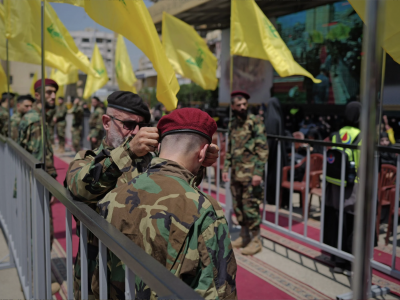
Addressing “those who have faced aggression, and their honorable national environment” — a reference to Hezbollah and its allies who fought in the recent war with Israel — Aoun urged them to “place your bet solely on the Lebanese state. Otherwise, your sacrifices will have been in vain, and with them, the state — or what remains of it — will collapse.”
“You are too dignified to compromise the project of state-building, and too noble to provide pretexts for an aggression whose only aim is to prolong the war,” he continued. “I reaffirm that my insistence on exclusive control of arms stems from my desire to defend Lebanon’s sovereignty and borders, to liberate occupied Lebanese territory, and to build a state that welcomes all its children. You are an essential part of that state: its pride is your pride, its rights are your rights, and its security is your security.”
Turning to Hezbollah’s critics and other political factions, Aoun urged them to “address the issue of arms control with the highest sense of responsibility.”
“Disagreements must remain within the framework of respect and fair competition, under the auspices of the National Pact and the Constitution,” he said, “without provocation or escalation.”
Tribute to martyrs and Mohammad Farhat
Lamenting the deaths that have occurred since the November 2024 cease-fire — at least 285 people have been killed by Israeli strikes and gunfire during that time, according to the U.N. — Aoun praised the army for having “stood bravely alongside the population despite everything.”
In that context, he paid tribute to Commander Mohammad Farhat, a soldier from South Lebanon known for blocking Israeli troops from crossing the Blue Line years ago. Farhat was killed in October 2024 amid escalating Israeli attacks.
His assassination made him, Aoun said, “a symbol of sacrifice, honor, and loyalty” to the military, echoing the army’s motto.
Paying tribute to all soldiers “martyred” for the nation, Aoun said, “I am proud, because no institution in the Lebanese state enjoys as much national consensus as the army. None has made as many sacrifices. None has resisted corruption and crisis like the army has. None has preserved Lebanon’s unity and safeguarded its security like the soldiers and officers of the army. The economy collapsed, but the army stood tall. Borders and sovereignty were violated, but it did not give in. The enemy planted agents among us, but they found no traitors in your ranks.”
Also speaking from the defense ministry, Army Commander Rodolph Haykal declared, “We are committed to safeguarding stability and civil peace, and we will not allow any threat to our country’s security.” He also expressed hope that “the days ahead will bring our beloved nation stability and prosperity.”

 Evening recap: Netanyahu announces West Bank offensive; 7 killed in Jordan church shooting; tents burned in south Lebanon
 US strike on Iran this weekend? ‘Absolutely,’ says Barrack; ‘I have no idea,’ says Trump