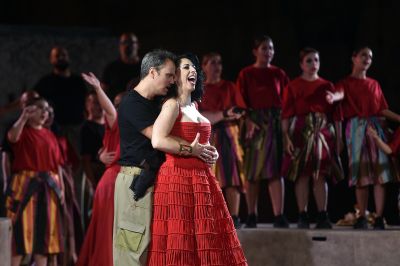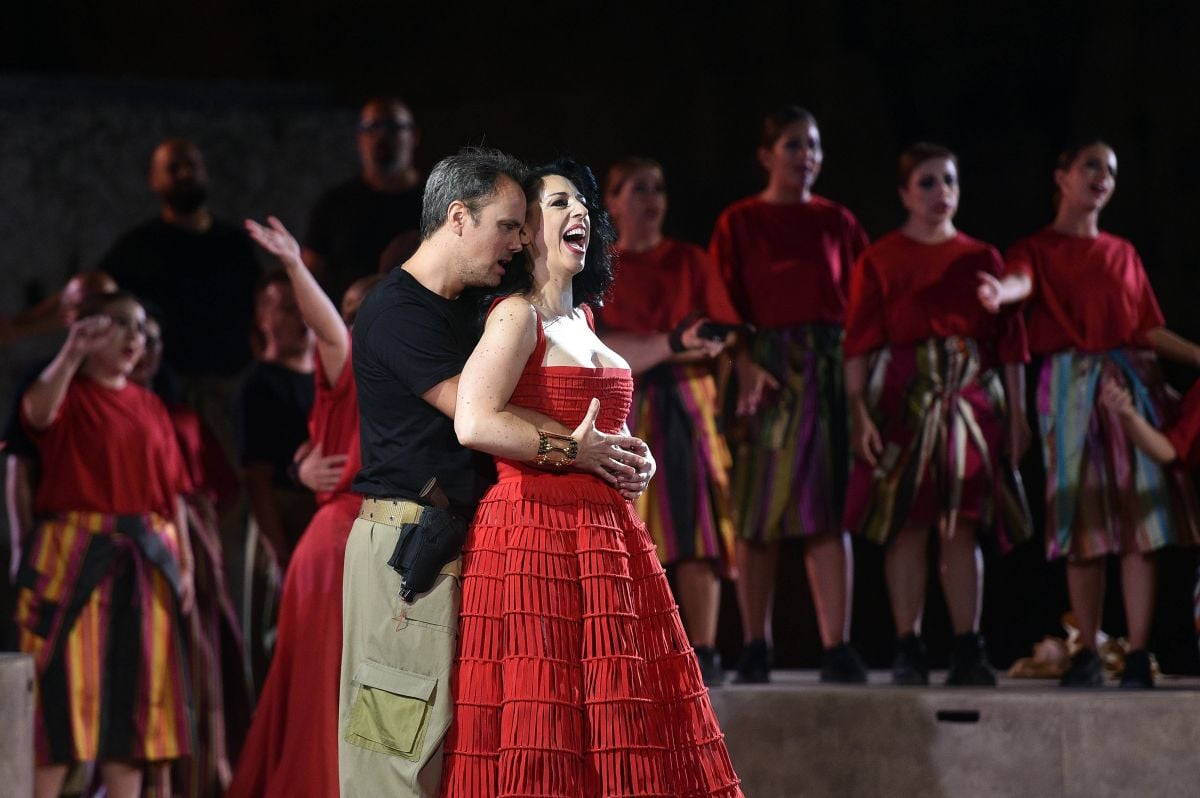
Marie Gautrot and Julien Behr in Jorge Takla's "Carmen" at the Baalbeck Festival. (Credit: Press Photo Agency.)






This is a staging of "Carmen" that will no doubt be hotly debated and rejected, as the appreciation of this most popular opera is so often based on a misunderstanding of its true values in favor of a routine falsely called "tradition".
Whether we like it or not, no, "Carmen" is no longer a French opera. It is one of the few masterpieces to have been internationally appropriated. This internationalization has been both Bizet’s greatest triumph and an open door to all sorts of new interpretations beyond the habits of public and music lovers alike.
It is this kind of recreation that director Jorge Takla and conductor Father Toufic Maatouk brought to life last Friday and Saturday at the prestigious Baalbeck Festival.
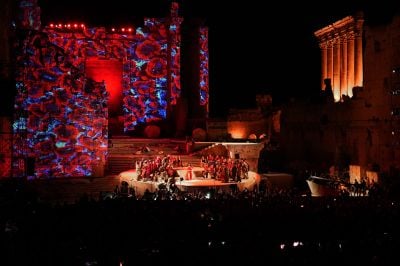
Let’s say right away that the result differs quite a bit from what we’re used to. Changes were made to the opera, likely due to a time limit of two and a half hours and probably budget constraints as well. But to me, Father Maatouk’s direction is a complete success — not just for how it blends music and action with Takla, but because the action itself seems to grow naturally from the music. It is always difficult to achieve convincing staging in an open-air setting, and Takla managed to adapt it perfectly to the venue.
The freedom of this direction will no doubt be criticized, even though there are no flashy effects, nor even the less gratuitous ones found in some familiar versions. The movements change constantly, adjusting to the fluidity of emotions and, most importantly, to the space and stage. Yet, in the rare places in the score where Bizet gave specific directions, these are always respected.
For example, the marking "don’t rush" at a particular moment in the Act II quintet, which the so-called "tradition" never observes. Otherwise, one notes that the flexibility of tempos, accents, and rubato bring out both the pure musical value of Bizet’s inspiration and writing, and add to the dramatic meaning of the music.

Generally speaking, the main originality of Maatouk’s conducting is how he creates a dialogue between the orchestra and the singers. This goes beyond simply accompanying the voices, the orchestra becomes a protagonist, just like Carmen or Don José.
Its presence is an active force, immersing the characters in a brilliant sound environment, but also shaping them in spite of themselves, the sonic expression of the fate that, as Carmen sings, is the true master. The progression is fascinating and culminates fantastically in the final scene. All of this is achieved with a restraint that the singers’ occasional excesses only barely disrupt.
But what about the singers?
Marie Gautrot is certainly a remarkable Carmen. Her interpretation is as compelling as Callas’, but her vocal timbre is even better suited to the role of the gypsy, and at rare moments, she tends to push her acting — perhaps because this is open-air rather than a traditional opera stage — though not in the veristic style of Puccini, but more in the direction of realism.
Julien Behr has a voice whose impact is stunning in the most violent passages and in the climaxes of Acts III and IV. His Don José, more external than Jon Vickers’, has the raw power of a wounded animal. The lyrical moments — "Parle-moi de ma mère", "La fleur que tu m’avais jetée" — shine with melodic elegance and intrinsic vocal beauty.

Vannina Santoni, on the other hand, phrases delightfully as Micaëla, and though Jérôme Boutiller’s tone lacks a little brilliance for Escamillo, he sings with all the desired panache. The secondary roles are overall well cast: Mira Akiki (Frasquita), Grace Medawar (Mercedes), César Naassy (Zuniga), Fadi Jeanbart (Morales), Philippe-Nicolas Martin (Le Dancaïre), and Jason Choueifaty (Le Remendado).
The Antonine University choir and the Romanian Radio Chamber Orchestra were magnificent, possessing tremendous dynamism. As for the "Olles!" and other added exclamations that will no doubt shock some purists, I think they form an integral part of the realistic aesthetic deliberately chosen by the conductor and director, without disfiguring Bizet’s musical intent.
In conclusion, bravo to the Baalbeck Festival committee. A grand spectacle, an extraordinary version for Carmen fans — many of whom perhaps love Bizet’s masterpiece for the wrong reasons? One thing is certain: you had to be there. Because beyond the striking impression it made, many music lovers that evening discovered, thanks to the conductor, new beauties in a score they thought they knew well.
This article was originally published in French by L'Orient-le Jour.