





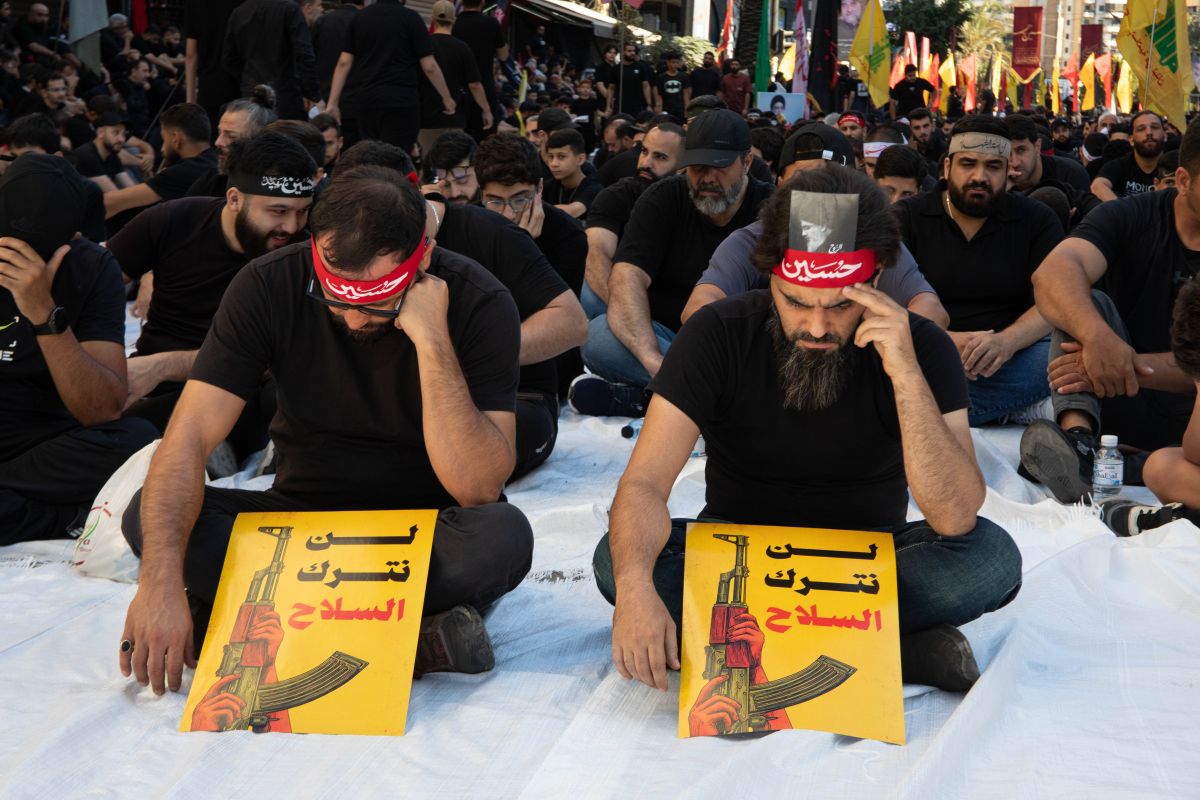
Two men sit with signs saying "We will not leave the weapons" during Ashura commemorations in Beirut's southern suburbs on July 6, 2025. (Credit: Nicholas Frakes/L'Orient Today)






Through diplomacy and arms, pressure is mounting on Lebanon, which is being called on to seriously engage in the process of disarming Hezbollah. The day after Lebanese authorities received U.S. comments in response to their answer regarding Tom Barrack’s proposal, Israel opted for one of the biggest escalations since the cease-fire last November.
Israeli army strikes targeting Hezbollah positions in the Bekaa killed 12 people, including seven Syrians. These bombardments were "the deadliest since 2024," according to Baalbeck-Hermel governor Bashir Khodr. According to a security source quoted by Reuters, five Hezbollah members were also among the dead.
The Israeli army said in a statement that it carried out strikes on "several Hezbollah terrorist targets in the Bekaa region," citing "military camps" belonging to the "Radwan Force," Hezbollah’s elite military unit. Among the targets, the Israeli military statement mentioned facilities "used to plan and carry out terrorist attacks against Israeli troops and the state of Israel." The statement added that since Israel "eliminated" the commanders of the Radwan Force in September, "the unit has been striving to reestablish its capabilities." Weapons storage and other "activities" at the sites struck Tuesday "constitute a flagrant violation of agreements between Israel and Lebanon and represent a future threat to the state of Israel," the military statement added.
'A clear message'
Israeli Defense Minister Israel Katz said the bombardments sent "a clear message" to Hezbollah and the Lebanese government, which is responsible for upholding the cease-fire agreement."
"We will strike all terrorists and thwart any threat against residents of the north and the state of Israel, and we will respond with maximum force to any attempt at reconstruction," he said.
Hezbollah denounced "a major escalation amid the ongoing aggression against Lebanon and its people," accusing Israel of "respecting neither laws nor international conventions" and of "committing massacres against innocent civilians." In a statement, Hezbollah called on Lebanese authorities to "act seriously, immediately and firmly" to "put all international bodies, especially the countries guaranteeing the cease-fire, before their responsibilities."
Under the truce agreement, Hezbollah was to withdraw its fighters north of the Litani River, about 30 kilometers from the Israeli border, leaving only the Lebanese Army and United Nations peacekeeping forces to be deployed in the area. Israel, which was to completely withdraw its troops from Lebanon, maintains its presence in five positions in the south.
These Israeli strikes were just one way of putting pressure on officials and Hezbollah’s popular support base to remind them that time was running out. The day before, Lebanon received, via the U.S. Embassy, a response to the answer it had sent to Barrack concerning Hezbollah's disarmament.
What does the American response say?
Despite positive signs, Barrack’s statements on the same day, and leaked U.S. remarks, reveal a major crisis on the horizon regarding Hezbollah’s arsenal – particularly heavy weaponry – which Barrack described as a threat to Israel. "The weapons we want Hezbollah to give up are those that represent a threat to Israel," the American envoy said in a television interview, warning that "an attempt at forced disarmament could trigger a civil war in Lebanon," given the country’s sectarian and political complexities. He added that the United States did not consider Hezbollah as a whole to be a terrorist organization, but that "the armed group affiliated with it" was, and poses problems on the regional stage.
And while Lebanon preferred not to commit to a clear timetable for weapons withdrawal, citing Lebanese specificity and the necessity for internal dialogue on the issue, the American side insisted in its reply on setting a precise deadline for the withdrawal of heavy weaponry from Hezbollah. The Americans that the Lebanese government, in which Hezbollah participates, should be responsible for carrying out this process – in other words, with the party’s consent – to avoid civil war.
According to a source monitoring the issue closely, the American response offered no guarantees regarding an Israeli withdrawal or a stop to ongoing aggressions against Lebanon. In clear and direct terms, the American reply made the withdrawal of weapons – particularly heavy weapons – conditional on a deadline set for the end of the current year, asking the Lebanese state to reach an agreement with Hezbollah on this issue. Regarding the Lebanese Army, the United States insisted on its role in taking control of the south and demanded that it present, in the coming weeks, a technical and final plan for the withdrawal of weapons.
The American response includes a proposal based on the “step-by-step” principle, accompanied by a timeline divided into several stages:
- First stage: withdrawal of weapons north and south of the Litani.
- Second stage: withdrawal of weapons from Beirut and its suburbs.
- Third stage: withdrawal of weapons from the Bekaa region.
These stages focus primarily on heavy weapons – missiles and drones – before moving on to the withdrawal of medium-range arms. The document also insists on dismantling the military infrastructure of Palestinian factions, starting with the al-Bass and Rashidieh camps south of the Litani. If the Lebanese government begins implementing these steps, the United States would start pressuring Israel to withdraw from the points it still occupies.
The American document also revisited the issue of economic reforms, in particular the adoption of the banking restructuring law, and the need to close al-Qard al-Hassan, Hezbollah’s microfinance organization, and affiliated exchange companies.
The committee comprising representatives of the three presidencies resumed its meetings Tuesday to discuss the content of the document and prepare an appropriate response. This is expected to be finalized by July 28, the date Barrack is set to return to Beirut, according to the same source.
This article was originally published in French in L'Orient-Le Jour.

 7 p.m. recap: Iran warns Egypt, Israeli soldiers vote in south Lebanon, Haret Hreik responds to Kataeb