






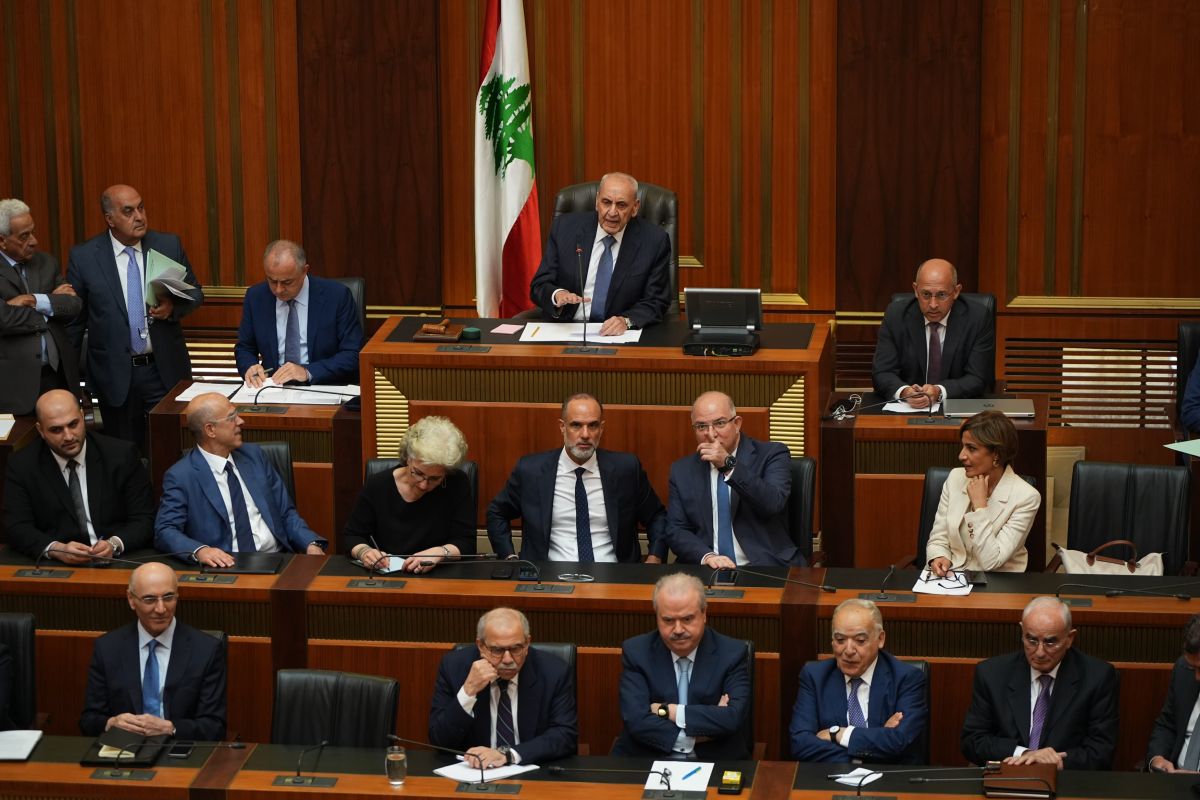
The Nawaf Salam government gathered in Parliament, in the presence of Parliamentary Speaker Nabih Berri, on July 15, 2025, in Beirut. (Credit: Mohammad Yassin/L'Orient Today)






Parliament, meeting at Nejmeh Square, opened at 11 a.m. with a questioning session for Nawaf Salam's government, as the issue of Hezbollah’s disarmament — demanded by the authorities and the international community, led by the United States — continues to divide Lebanon.
The session is expected to focus mainly on the American "roadmap" regarding the disarmament of the party, and the ongoing cease-fire between Israel and Lebanon that went into effect in November 2024, after 13 months of war.
"This is the first time we are having this kind of discussion. We will hear contradictory statements from all sides, as well as calls for a monopoly on arms and for reconstruction," said Deputy Speaker Elias Bou Saab at the start of the session.
Parliamentary Speaker Nabih Berri adjourned the session until 5 p.m.
Disarmament timetable
Taking the floor, Lebanese Forces (LF) MP Georges Adwan called on "the government to set a timetable for Hezbollah’s disarmament."
"This is the government's last chance and there's a need to move quickly. The government must hold the decisions on war and peace," he said. This position was supported by another LF MP, Pierre Bou Assi.
"Everything must begin with strengthening sovereignty. Israel will not withdraw from southern Lebanon before Hezbollah’s weapons are withdrawn," he stated.
"We've been hearing all kinds of speeches for five months and nothing has changed. We do not even know what the content of the responses [sent to Tom Barrack] are," Kataeb MP Nadim Gemayel said.
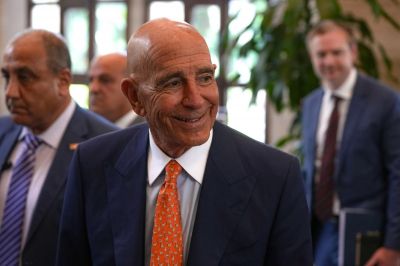
The issue of Hezbollah's disarmament remains at the heart of Lebanese and international political debates, especially after the more than year-long war between Hezbollah and Israel. American envoy Tom Barrack visited Beirut last week to promote Washington’s "roadmap" for the disarmament of the party. According to L'Orient Today's information, the Americans want the Hezbollah weapons issue to be resolved by the end of the year. American sources involved in the issue told L’Orient Today that the Trump administration expressed its disappointment with the Lebanese response, while acknowledging that this is only a starting point for negotiations that, according to Washington, cannot last indefinitely. The U.S. Embassy sent Lebanese authorities "ideas" regarding Beirut’s response to Barrack's roadmap.
'National defense strategy'
Amal bloc MP Qassem Hashem called for implementing a "national defense strategy and engaging in dialogue," asking the government to "serve the country's interests."
Free Patriotic Movement (FPM) MP Salim Aoun said, "The Lebanese people are being robbed and no one cares except when the international community gets angry."
"Trust in the Lebanese people must be regained," he said.
"No topic will be off limits to MPs. The government must be clear regarding the weapons issue," MP Alain Aoun stated.
"We want Hezbollah to hand over its weapons to the state, but we are against civil war and in favor of dialogue on disarmament," said the leader of the Free Patriotic Movement (FPM), MP Gebran Bassil. "Lebanon will not be wiped off the map. We must ask Syria to implement a plan for the return of displaced persons, except that Syria is now asking us to hand over those who killed our soldiers."
The issue of extraditing Syrian detainees from Lebanese prisons resurfaced last week. Dozens of these prisoners are accused of "terrorism," including attacks against the Lebanese Army.
Beirut MP Fouad Makhzoumi called for "Beirut to be free of all illegal weapons."
"The issue of negotiations with the United States must be studied by the government," he stated. "We call for the prosecution of all those who carry weapons outside the state," calling on "those who carry weapons to hand them over to the state to avoid war."
'Foreign veto' against the supply of weapons to the Lebanese Army
Hezbollah MP Ibrahim Moussaoui said that his party "is the first to support the Lebanese state."
"We do not question anyone's patriotism, and the Lebanese Army is our army, but there is a foreign veto that prevents us from supplying it with weapons," he said.
Addressing the prime minister, the independent MP for Zgharta, Michel Moawad, asked "what plan is in place to resolve the arms issue and according to what timetable?"
"The government's work is insufficient at the moment," he added.
"We want the state to monopolize decisions regarding war and peace and protect its borders," stated the LF MP for Jbeil, Ziad Hawat, who also distinguished between "those who want to drag Lebanon into war and those who respect the Constitution."
"Where are we with the implementation of 1701 and the Israeli withdrawal? What about the state's arms monopoly? What is the American response to the Lebanese roadmap, and about which we have the right to be informed?" asked former FPM MP Ibrahim Kanaan.
Regarding the economic situation, the MP, who is also head of the Finance Committee, asked the government if it would send the law concerning the restitution of deposits to Parliament, "knowing that it is closely linked to the law on the reform of the banking sector."
MP Yassine Yassine (West Bekaa) said that "the arms monopoly is not a slogan but a constitutional and political rule without which the state and the presidency will not be able to recover."
He also called for the establishment of a timetable for disarmament, as did Beirut MP Ibrahim Mneimneh.
Adib Abdel Massih, an MP from Koura, also called on the authorities to "monopolize weapons and begin collecting them throughout Lebanon, without any obligation to begin this work in southern Lebanon."
