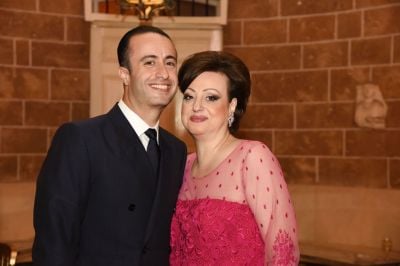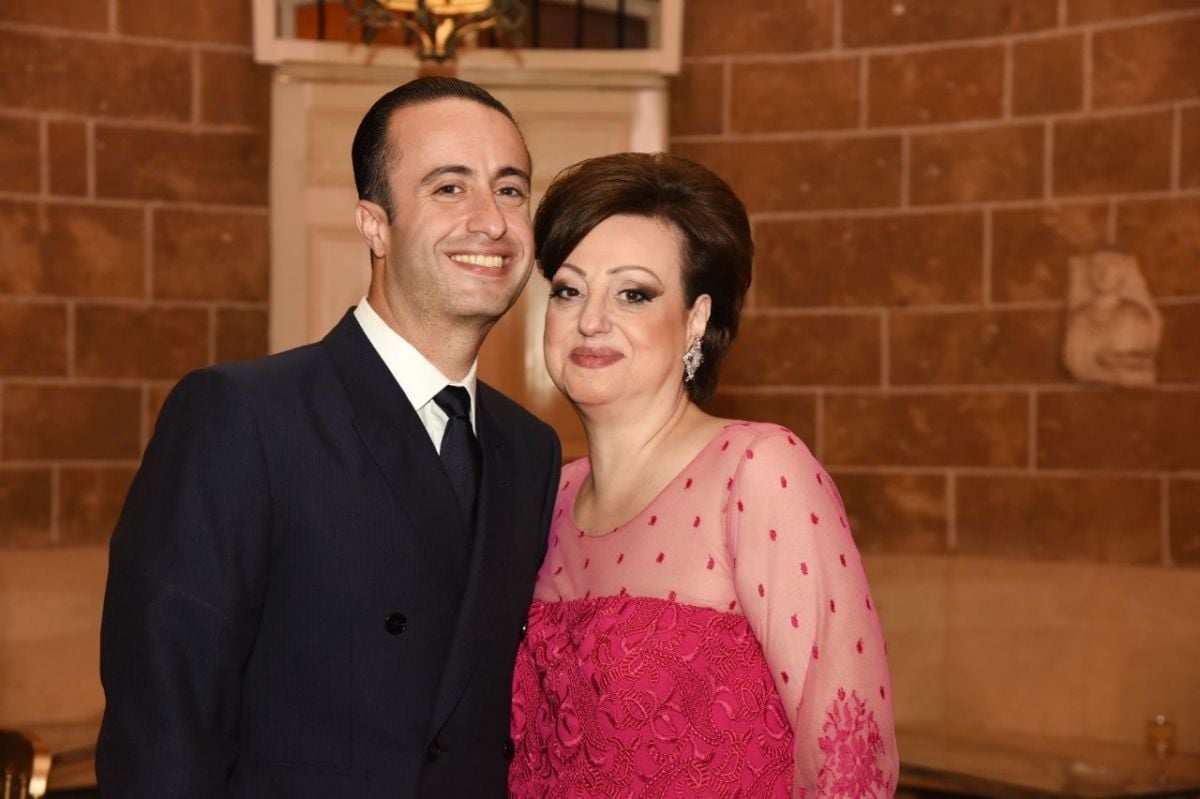
Between Rani Zakhem and his mother Maggie, a bag that sums up more than a century of transmissions. (Credit: Rani Zakhem.)






For five years, Rani Zakhem made careful, almost secretive progress on an object he had carried within him all his life. Five years of patient work with precious materials, administrative steps, gilded metal buckles and childhood memories.
Five years to carry a world in one bag
The story, in reality, begins long before him. At the end of the 19th century, in another life, on another continent. His mother's grandfather, Ibrahim Chammas, left Lebanon for Argentina, taking with him the hopes of a migrant departing from a land without a future. There, in the province of Santa Fe, he made his fortune breeding animals that were then synonymous with luxury and exoticism: chinchilla and alligator.
It was the heart of the Belle Époque — a post-war era when hedonism and prosperity returned to Europe, especially France. Demand soared. He would later return home with suitcases full and memories enchanted. His daughter, Laura Chammas, born in Argentina became the grandmother of Lebanese designer Zakhem. In his blood already flowed the brilliance of rare skins, the whispers of distant farms, and the art of the rare and the beautiful.
Zakhem was born in Beirut in October 1983. A few months later, his mother Maggie went to the Valmont clinic to recover her health. Around that time, Karl Lagerfeld had just taken over as artistic director at Chanel, and the house was rising once again. Maggie treated herself to a limited-edition black alligator evening bag from Chanel, a piece she would carry for the rest of her life.
Thirty years later, with the handle worn and the zipper tired, Zakhem brought the bag to Chanel’s flagship in Paris for restoration. He had the original box and certificate. The boutique director came down, took the bag with gloved hands, like handling a relic, impressed by how well it had been kept. They replaced the strap, restored the clasp, and returned the bag to its former glory.
Perhaps that was the moment the idea first took hold: to create a bag with a soul, one that carried its own story.
One day, his mother told him: "I'd like a bag like this one, but without that zipper that breaks nails." That simple wish was the trigger.
In 2013, Zakhem had already designed his monogrammed RZ buckle to enhance a collection where the belt was a key element. There were still supplies left, dreams, shapes that were still just projects. Another buckle was born, evoking an ivory tusk he used to observe as a child in a house full of mysterious objects.
Childhood always finds its way back. Argentina, Africa the places where Zakhem spent his early years left vivid memories that still inspire him. In his studio, he already had everything he needed to create a bag: gilded buckles, a shoulder strap inspired by a belt, scattered sketches, and most importantly, a midnight-blue alligator hide (black was out of stock). It had arrived a year after being ordered, just before the Aug. 4 explosion in Beirut.
He designed a hybrid piece: a trapezoid shape echoing the Hermès Kelly, with a half-moon pocket inspired by Chanel perfect for slipping in essentials without opening the whole bag. A practical, noble creation, both unique and familiar.
The model measures 40 cm, the full width of a single hide. No more, no less. The material defined its shape, imposed a constraint, and gave it elegance.
He named it Migdalah, the biblical origin of his mother’s name, born on July 14. He hadn’t noticed the connection at first. But on the day of the launch, he remembered, and the coincidence felt like fate.
Migdalah became a story of legacy, memory, and ancestral inspiration.
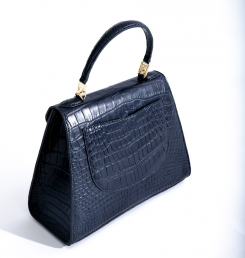
The bag comes in several colors of leather: vibrant lemon, Valentino red, brazen fuchsia, deep burgundy, classic black, and a Himalaya alligator, a marvelous white streaked with gray, almost unreal.
All come from certified farms in Asia. "The alligator is a predator," Zakhem comments. "Nothing to do with the barbarity of a world that lets Gaza’s children die." The first campaign was shot in 2021 by photographer Pedro Hasrouni, just before his final departure from Lebanon.

Later, the financial crisis worsened to the point of collapse. The country wavered, but the idea held firm. Migdalah slept for a while, like a gemstone in its mine. Zakhem waited to have the right hides, the right partners. In 2024, he went back to work. In 2025, the bag is finally ready and available by order. "I'm making small steps," says the designer, "but here we are!"
Migdalah is more than just a bag. It's a synthesis, a transcontinental heritage. It corresponds to a vision of fair luxury, neither flashy nor unattainable, Zakhem champions. It's an object that tells of a bygone world and brings it back to the present. A quiet desire that took the time to come to life. A future classic that observed the greatest before defining its own identity.
This article was originally published in French by L'Orient-le Jour.