






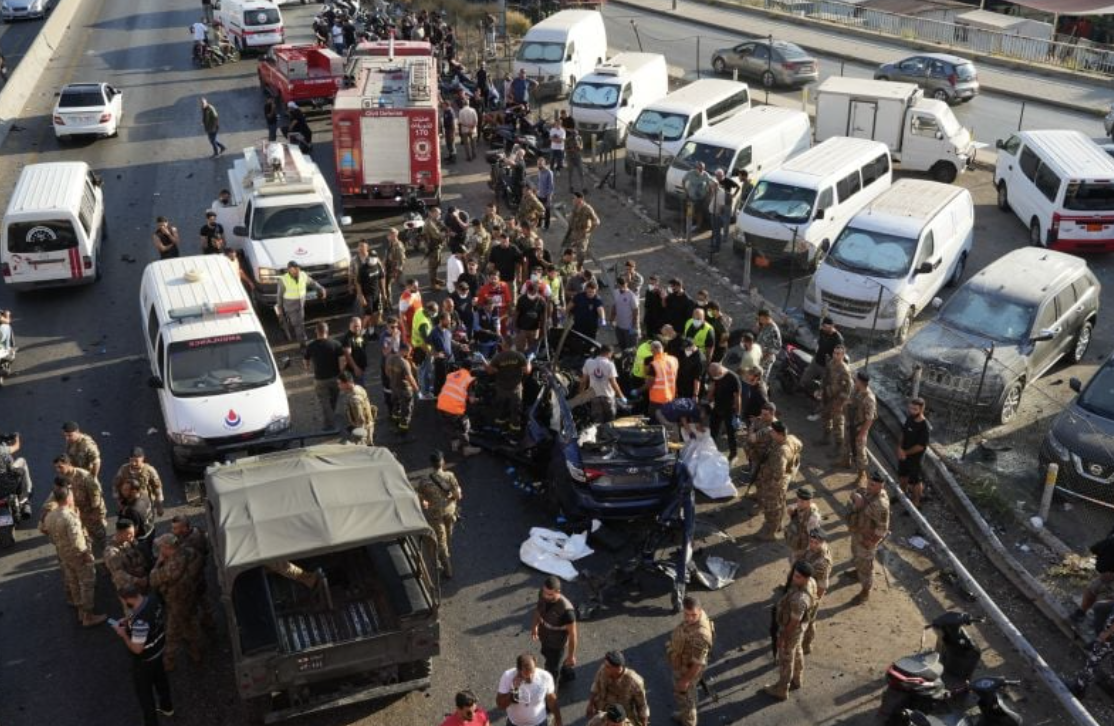
Ambulances, along with soldiers from the Lebanese army, around the vehicle targeted by an Israeli drone in Khaldé, on July 3, 2025. Mohammad Yassine/L’Orient-Le Jour.






A few days before the expected return of U.S. envoy Tom Barrack to Beirut — where Lebanese officials are due to respond to his proposal for Hezbollah’s disarmament — Israel has escalated military pressure.
In addition to over a dozen powerful airstrikes across southern Lebanon, the Israeli army carried out a rare drone strike in Khaldeh, near Beirut, on Thursday. Conducted during rush hour, the strike targeted a vehicle near the Khaldeh bridge, a key artery linking Beirut to the Chouf and the south. The attack killed the driver and injured at least three people.

According to eyewitnesses cited by L’Orient Today’s correspondent, two explosions were heard: a first missile missed its target before the bridge, while a second, fired after the vehicle had crossed and briefly stopped, struck it directly. The Israeli army later claimed responsibility, saying it had targeted "a saboteur involved in arms trafficking and implementing terrorist plans against Israeli civilians and soldiers on behalf of the Iranian al-Qods Force," according to a message on X by Arabic-speaking military spokesperson Avichay Adraee. The identity of the person targeted was not immediately known, as the body was dismembered in the strike.
While Israel has continued to conduct daily strikes on southern Lebanon and often the Bekaa Valley despite the cease-fire concluded on Nov. 27, 2024, which ended nearly 13 months of war with Hezbollah, attacks outside these areas are uncommon.
Following the Khaldeh strike, Israeli warplaned carried out more than 10 strikes targeting areas around the Litani River basin, including Zawtar and Yohmor al-Shaqif (Nabatieh district), the outskirts of Deir Siryan (Marjayoun), the Aishieh hills (Jezzine), the Berghoz (Hasbaya) and the heights of Iqlim al-Tuffah (Nabatieh). Adraee later claimed on X that the Israeli army struck "military sites and weapon depots ... as well as military buildings and terrorist infrastructure bellowing to Hezbollah in southern Lebanon."
US sanctions senior Hezbollah-linked financiers
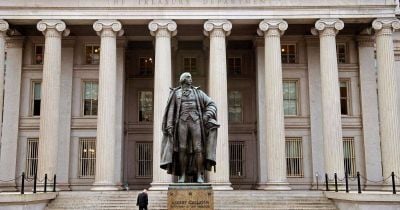
The United States also stepped up financial pressure Thursday, announcing new sanctions against seven senior officials of al-Qard al-Hassan, Hezbollah's financial arm, and a related Lebanese company, Tashilat SARL. The sanctions are part of what the U.S. Treasury described as an intensified campaign aimed at "disrupting Hizballah’s sanctions evasion schemes and supporting efforts by the new Lebanese government to limit the terrorist group’s influence."
According to the Office of Foreign Assets Control (OFAC), the sanctions individuals — long active within al-Qard al-Hassan — served in the leadership positions and facilitated the evasion of U.S. sanctions, allowing Hezbollah access to the formal financial system. They are accused of orchestrating complex financial transactions that concealed the group's involvement in seemingly legitimate business activities in Lebanon, exposing the institutions to significant money laundering and terrorism financing risks, "while allowing Hezbollah to funnel money for its own benefit," said Deputy Secretary Michael Faulkender.
Among those sanctioned is Nehme Ahmad Jamil, head of the audit and business departments at al-Qard al-Hassan, who also "manages financial services for Hezbollah and its affiliated institutions." Jamil is co-owner of Tashilat SARL, which played a key role in distributing mortgage loans after the 2006 war with Israel and has financial ties to Hezbollah-linked entities such as Yousser Company and Bayt al-Mal.
The sanctions also targeted Issa Hussein Kassir, in charge of logistics and procurement, accused of "sending nearly a million dollars" to other sanctions officials, including Ahmad Mohammad Yazbeck, Abbas Hassan Gharib and Hassan Chehade Osman. Others targeted by sanctions include: Samer Hassan Fawaz, the administrative director of al-Qard al-Hassan since 2010; Imad Mohammad Bezz, involved in gold-related operations exceeding $2.5 million; Ali Mohammad Karnib, who oversaw the purchase of over 1,000 ounces of gold at the institution; Ali Ahmad Krisht, director of the Sour branch of al-Qard al-Hassan, said to have worked closely with Adel Mansour and linked to 2023-sancationed Hezbollah adviser Hassan Moukalled; Mohammad Sleiman Badr, a former deputy director in Nabatieh, accused of opening a joint account with Wahid Mahmoud Sbeiti to bypass formal banking channels.
As for Tashilat SARL, it was sanctioned for being "wned, controlled, or directed by, or to have acted or purported to act for or on behalf of, directly or indirectly, Jamil, Yazbeck, and [Husayn] al-Shami." Shami, who ran al-Qard al-Hassan at the time of its designation in 2007, "was himself designated in 2006 for supporting Hezbollah"
'Genuine failure'
In an interview with The New York Times, Barrack emphasized that any disarmament plan must involve Lebanon’s Shiite community. "If the Shiites in Lebanon gain something from it, they will cooperate," he said, underscoring the need for public support.
The U.S. proposal, drafted by Secretary of State Marco Rubio and presented to Beirut in June, outlines a timetable for Hezbollah’s disarmament in exchange for an Israeli withdrawal from southern Lebanon. Barrack acknowledged the plan would require both “carrots and sticks” and would involve the Lebanese army searching homes for weapons—a step likely to provoke backlash from Hezbollah, the New York Times noted.
To support the plan, Washington is seeking financial backing from Saudi Arabia and Qatar to help rebuild areas of southern Lebanon devastated by the 2023–2024 war with Israel, Barrack explained.

Barrack also described the November cease-fire that ended the war as a "genuine failure," noting that Israel continues to bomb Lebanon while Hezbollah remains in violation of the agreement, the New York Times reported.
According the Saudi outlet al-Hadath, Barrack traveled to Paris on Thursday for discussions on Lebanon and Syria.
In Lebanon, President Joseph Aoun received Saudi Foreign Minister Adviser Yazid Bin Farhan at Baabda Presidential Palace on Thursday. According to information obtained by L'Orient Today, the meeting covered long-awaited reforms and the U.S. proposal on disarmament, which calls for the removal of weapons from all Lebanese and non-Lebanese factions before November.
After years of strained ties, Lebanon appears to be making progress in mending relations with Gulf states. President Aoun's and Prime Minister Nawaf Salam's recent visits to Riyadh were seen as a step in that direction. However, Saudi Arabia continues to enforce a travel ban on Lebanon, demanding concrete measures on disarmament before full ties restoration.
On Wednesday, Bahrain — closely aligned with Riyadh — announced plans to reopen its embassy in Beirut.